Instituto de Investigaciones Arqueológicas y Museo, Universidad Católica del Norte, San Pedro de Atacama, Chile.
PLoS One. 2010 Jun 14;5(6):e11105. doi: 10.1371/journal.pone.0011105.
Discussion surrounding the settlement of the New World has recently gained momentum with advances in molecular biology, archaeology and bioanthropology. Recent evidence from these diverse fields is found to support different colonization scenarios. The currently available genetic evidence suggests a "single migration" model, in which both early and later Native American groups derive from one expansion event into the continent. In contrast, the pronounced anatomical differences between early and late Native American populations have led others to propose more complex scenarios, involving separate colonization events of the New World and a distinct origin for these groups.
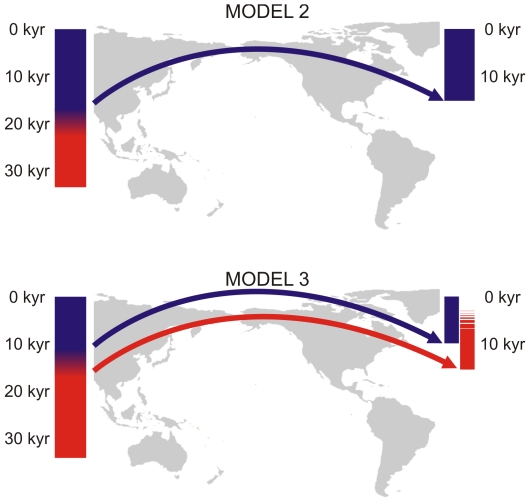
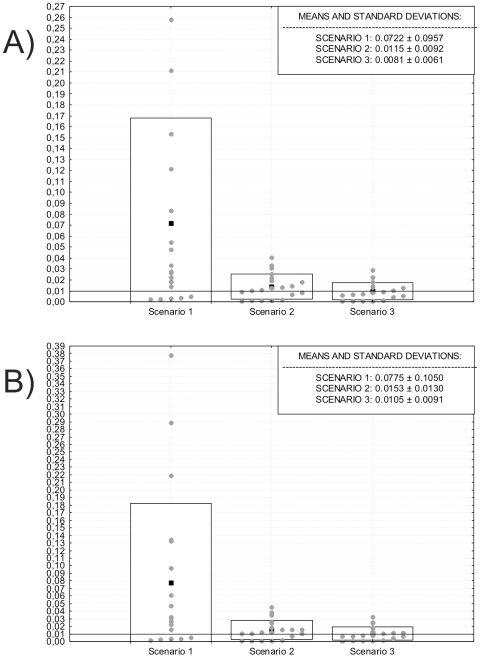
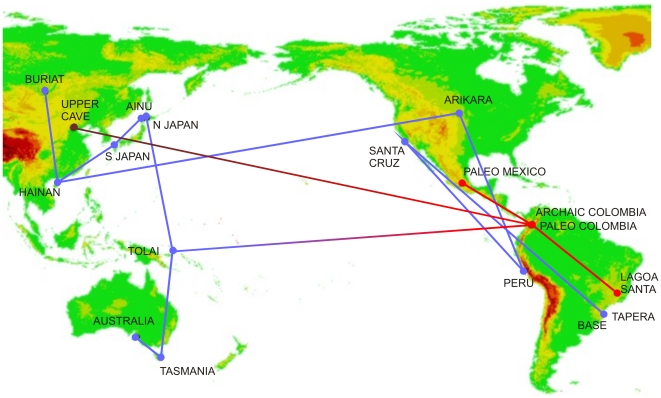
METHODOLOGY/PRINCIPAL FINDINGS: USING LARGE SAMPLES OF EARLY AMERICAN CRANIA, WE: 1) calculated the rate of morphological differentiation between Early and Late American samples under three different time divergence assumptions, and compared our findings to the predicted morphological differentiation under neutral conditions in each case; and 2) further tested three dispersal scenarios for the colonization of the New World by comparing the morphological distances among early and late Amerindians, East Asians, Australo-Melanesians and early modern humans from Asia to geographical distances associated with each dispersion model. Results indicate that the assumption of a last shared common ancestor outside the continent better explains the observed morphological differences between early and late American groups. This result is corroborated by our finding that a model comprising two Asian waves of migration coming through Bering into the Americas fits the cranial anatomical evidence best, especially when the effects of diversifying selection to climate are taken into account.
We conclude that the morphological diversity documented through time in the New World is best accounted for by a model postulating two waves of human expansion into the continent originating in East Asia and entering through Beringia.
随着分子生物学、考古学和生物人类学的进步,最近围绕新世界的定居问题的讨论愈发热烈。这些不同领域的最新证据支持不同的殖民化情景。目前可用的遗传证据表明存在“单一迁徙”模型,即早期和晚期美洲原住民群体都源自一次进入该大陆的扩张事件。相比之下,早期和晚期美洲原住民群体之间明显的解剖学差异导致其他人提出更复杂的情景,涉及新大陆的单独殖民事件以及这些群体的独特起源。
方法/主要发现:利用大量早期美洲颅骨样本,我们:1)根据三种不同的时间发散假设,计算早期和晚期美洲样本之间形态分化的速度,并将我们的发现与每种情况下中性条件下预测的形态分化进行比较;2)通过比较早期和晚期美洲印第安人、东亚人、澳大拉西亚-美拉尼西亚人和亚洲早期现代人之间的形态距离与每个扩散模型相关的地理距离,进一步测试了三种新世界殖民化的扩散情景。结果表明,假设在大陆之外存在最后一个共同祖先的假设更好地解释了早期和晚期美洲群体之间观察到的形态差异。我们的发现进一步证实了这一结果,即包括亚洲两次通过白令海峡进入美洲的迁徙的模型最符合颅骨解剖学证据,尤其是在考虑到气候多样化选择的影响时。
我们得出结论,在新大陆随时间记录的形态多样性最好通过假设存在两次从东亚进入并通过白令海峡进入该大陆的人类扩张浪潮的模型来解释。