Department of Medicine, University of Massachusetts Medical School, Worcester, Massachusetts, USA.
Diabetes. 2010 Sep;59(9):2265-70. doi: 10.2337/db10-0323. Epub 2010 Jun 22.
To create an immunodeficient mouse model that spontaneously develops hyperglycemia to serve as a diabetic host for human islets and stem cell-derived beta-cells in the absence or presence of a functional human immune system.
We backcrossed the Ins2(Akita) mutation onto the NOD-Rag1(null) IL2rgamma(null) strain and determined 1) the spontaneous development of hyperglycemia, 2) the ability of human islets, mouse islets, and dissociated mouse islet cells to restore euglycemia, 3) the generation of a human immune system following engraftment of human hematopoietic stem cells, and 4) the ability of the humanized mice to reject human islet allografts.
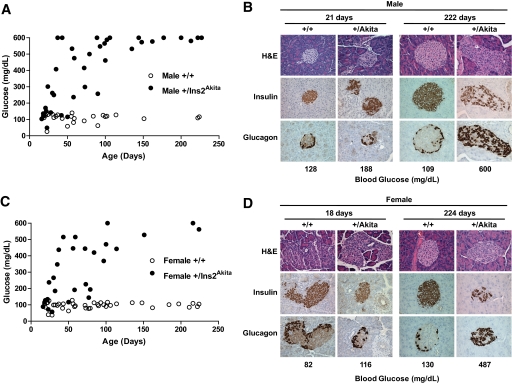
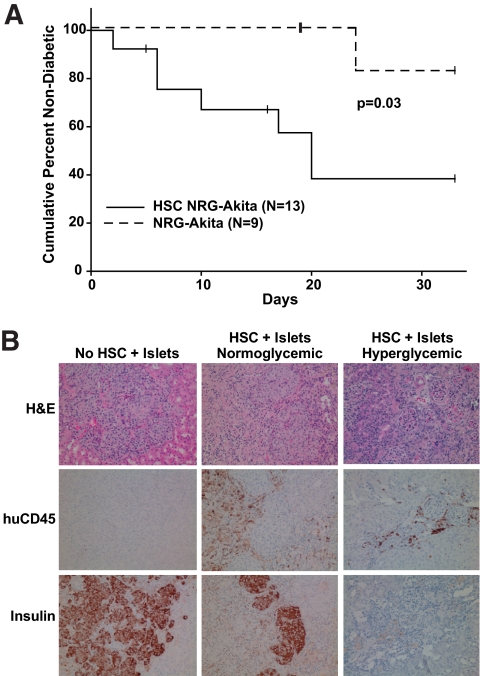
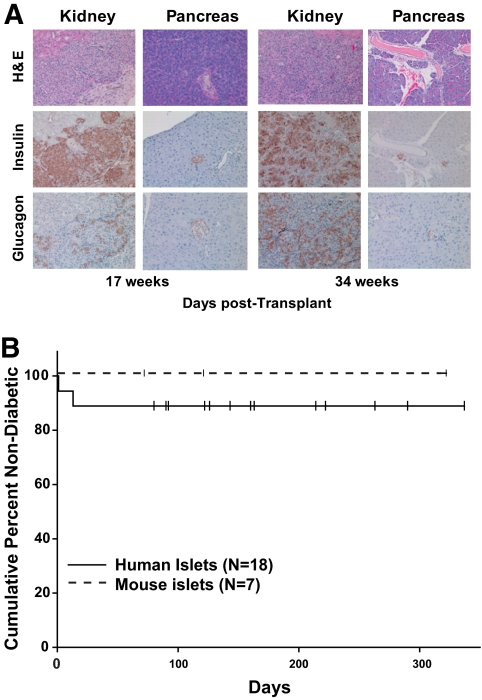
We confirmed the defects in innate and adaptive immunity and the spontaneous development of hyperglycemia conferred by the IL2rgamma(null), Rag1(null), and Ins2(Akita) genes in NOD-Rag1(null) IL2rgamma(null) Ins2(Akita) (NRG-Akita) mice. Mouse and human islets restored NRG-Akita mice to normoglycemia. Insulin-positive cells in dissociated mouse islets, required to restore euglycemia in chemically diabetic NOD-scid IL2rgamma(null) and spontaneously diabetic NRG-Akita mice, were quantified following transplantation via the intrapancreatic and subrenal routes. Engraftment of human hematopoietic stem cells in newborn NRG-Akita and NRG mice resulted in equivalent human immune system development in a normoglycemic or chronically hyperglycemic environment, with >50% of engrafted NRG-Akita mice capable of rejecting human islet allografts.
NRG-Akita mice provide a model system for validation of the function of human islets and human adult stem cell, embryonic stem cell, or induced pluripotent stem cell-derived beta-cells in the absence or presence of an alloreactive human immune system.
构建一种自发性高血糖免疫缺陷小鼠模型,作为无功能性或有功能性人免疫系统存在时人胰岛和干细胞衍生β细胞的糖尿病宿主。
我们将 Ins2(Akita) 突变基因回交至 NOD-Rag1(null) IL2rgamma(null) 品系,并确定了 1)自发性高血糖的发展,2)人胰岛、鼠胰岛和分离的鼠胰岛细胞恢复正常血糖的能力,3)人造血干细胞移植后的人免疫系统的产生,4)人源化小鼠排斥人胰岛同种异体移植物的能力。
我们证实了 IL2rgamma(null)、Rag1(null) 和 Ins2(Akita) 基因赋予 NOD-Rag1(null) IL2rgamma(null) Ins2(Akita)(NRG-Akita)小鼠的先天和适应性免疫缺陷以及自发性高血糖的缺陷。鼠和人胰岛使 NRG-Akita 小鼠恢复正常血糖。在化学性糖尿病 NOD-scid IL2rgamma(null) 和自发性糖尿病 NRG-Akita 小鼠中,通过胰内和肾下途径移植后,需要恢复正常血糖的分离鼠胰岛中的胰岛素阳性细胞被定量。在新生 NRG-Akita 和 NRG 小鼠中植入人造血干细胞导致在正常血糖或慢性高血糖环境中产生等效的人免疫系统,>50%的植入 NRG-Akita 小鼠能够排斥人胰岛同种异体移植物。
NRG-Akita 小鼠为验证人胰岛和人成体干细胞、胚胎干细胞或诱导多能干细胞衍生β细胞在无或有同种异体人免疫系统存在时的功能提供了一个模型系统。