Department of Geriatrics and Metabolic Diseases, Second University of Naples, Naples, Italy.
Diabetes Care. 2010 Oct;33(10):2169-74. doi: 10.2337/dc10-0389. Epub 2010 Jun 23.
The mean amplitude of glycemic excursions (MAGE) is a significant determinant of overall metabolic control as well as increased risk for diabetes complications. Older individuals with type 2 diabetes are more likely to have moderate cognitive deficits and structural changes in brain tissue. Considering that poor metabolic control is considered a deranging factor for cognitive performance in diabetic patients, we evaluated whether the contributions of MAGE to cognitive status in older patients with type 2 diabetes were independent from the main markers of glycemic control, such as sustained chronic hyperglycemia (A1C), postprandial glycemia (PPG), and fasting plasma glucose (FPG).
In 121 older patients with type 2 diabetes, 48-h continuous subcutaneous glucose monitoring (CSGM) were assessed. MAGE and PPG were evaluated during CSGM. The relationship of MAGE to performance on cognitive tests was assessed, with adjustment for age, glycemic control markers, and other determinants of cognitive status. The cognitive tests were a composite score of executive and attention functioning and the Mini Mental Status Examination (MMSE).
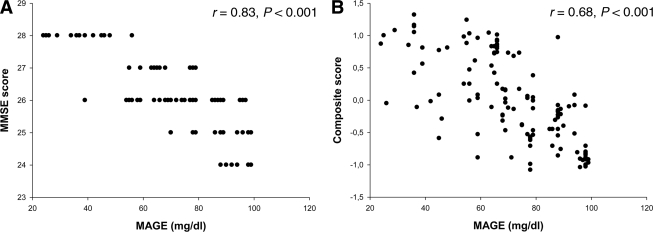
MAGE was significantly correlated with MMSE (r = 0.83; P < 0.001) and with cognition composite score (r = 0.68; P < 0.001). Moreover, MAGE was associated with the MMSE (P < 0.001) and cognition composite score (P < 0.001) independently of age, sex, BMI, waist-to-hip (WHR) ratio, drug intake, physical activity, mean arterial blood pressure, FPG, PPG, and A1C.
MAGE during a daily period was associated with an impairment of cognitive functioning independent of A1C, FPG, and PPG. The present data suggest that interventional trials in older patients with type 2 diabetes should target not only A1C, PPG, and FPG but also daily acute glucose swings.
血糖波动幅度的平均值(MAGE)是整体代谢控制的重要决定因素,也是糖尿病并发症风险增加的重要决定因素。患有 2 型糖尿病的老年人更有可能出现中度认知缺陷和脑组织结构变化。考虑到代谢控制不佳被认为是糖尿病患者认知表现紊乱的一个因素,我们评估了 MAGE 对 2 型糖尿病老年患者认知状态的贡献是否独立于主要的血糖控制标志物,如持续的慢性高血糖(A1C)、餐后血糖(PPG)和空腹血糖(FPG)。
在 121 名 2 型糖尿病老年患者中,进行了 48 小时连续皮下血糖监测(CSGM)。在 CSGM 期间评估了 MAGE 和 PPG。评估了 MAGE 与认知测试表现之间的关系,调整了年龄、血糖控制标志物和认知状态的其他决定因素。认知测试是执行和注意力功能的综合评分以及简易精神状态检查(MMSE)。
MAGE 与 MMSE(r=0.83;P<0.001)和认知综合评分(r=0.68;P<0.001)显著相关。此外,MAGE 与 MMSE(P<0.001)和认知综合评分(P<0.001)相关,独立于年龄、性别、BMI、腰臀比(WHR)、药物摄入、体育活动、平均动脉血压、FPG、PPG 和 A1C。
在日常期间,MAGE 与认知功能障碍相关,独立于 A1C、FPG 和 PPG。本数据表明,针对 2 型糖尿病老年患者的干预试验不仅应针对 A1C、PPG 和 FPG,还应针对日常急性血糖波动。