Maternal and Fetal Health Research Centre, Developmental Biomedicine, School of Medicine, Manchester Academic Health Sciences Centre, University of Manchester, St. Mary's Hospital, Level 5-Research, Oxford Road, Manchester M13 9WL, United Kingdom.
Biochem Biophys Res Commun. 2010 Jul 16;398(1):130-4. doi: 10.1016/j.bbrc.2010.06.051. Epub 2010 Jun 17.
System A-mediated amino acid transport across the placenta is important for the supply of neutral amino acids needed for fetal growth. All three system A subtypes (SNAT1, 2, and 4) are expressed in human placental trophoblast suggesting there is an important biological role for each. Placental system A activity increases as pregnancy progresses, coinciding with increased fetal nutrient demands. We have previously shown SNAT4-mediated system A activity is higher in first trimester than at term, suggesting that SNAT1 and/or SNAT2 are responsible for the increased system A activity later in gestation. However, the relative contribution of each subtype to transporter activity in trophoblast at term has yet to be evaluated. The purpose of this study was to identify the predominant subtype of system A in cytotrophoblast cells isolated from term placenta, maintained in culture for 66h, by: (1) measuring mRNA expression of the three subtypes and determining the Michaelis-Menten constants for uptake of the system A-specific substrate, (14)C-MeAIB, (2) investigating the contribution of SNAT1 to total system A activity using siRNA.
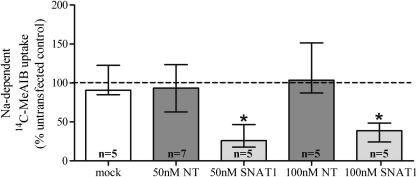
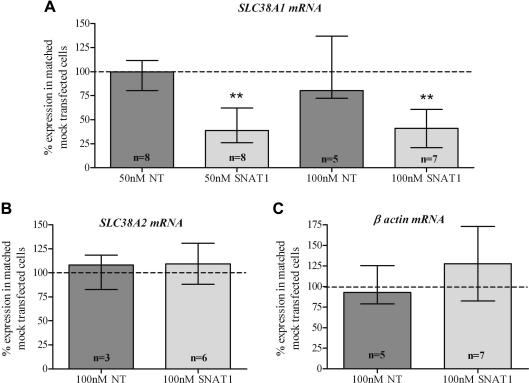
mRNA expression was highest for the SNAT1 subtype of system A. Kinetic analysis of (14)C-MeAIB uptake revealed two distinct transport systems; system 1: K(m)=0.38+/-0.12mM, V(max)=27.8+/-9.0pmol/mg protein/20min, which resembles that reported for SNAT1 and SNAT2 in other cell types, and system 2: K(m)=45.4+/-25.0mM, V(max)=1190+/-291pmol/mg protein/20min, which potentially represents SNAT4. Successful knockdown of SNAT1 mRNA using target-specific siRNA significantly reduced system A activity (median 75% knockdown, n=7).
These data enhance our limited understanding of the relative importance of the system A subtypes for amino acid transport in human placental trophoblast by demonstrating that SNAT1 is a key contributor to system A activity at term.
系统 A 介导的氨基酸跨胎盘转运对胎儿生长所需的中性氨基酸供应很重要。三种系统 A 亚型(SNAT1、2 和 4)均在人胎盘滋养细胞中表达,表明每种亚型都具有重要的生物学功能。随着妊娠的进展,胎盘系统 A 的活性增加,与胎儿营养需求的增加相吻合。我们之前的研究表明,SNAT4 介导的系统 A 活性在妊娠早期高于足月,这表明 SNAT1 和/或 SNAT2 负责妊娠后期系统 A 活性的增加。然而,每种亚型在足月滋养细胞中对转运体活性的相对贡献尚未得到评估。本研究的目的是通过以下方法鉴定从足月胎盘分离的滋养细胞中系统 A 的主要亚型:(1)测量三种亚型的 mRNA 表达,并确定系统 A 特异性底物[14C] -MeAIB 的米氏常数;(2)使用 siRNA 研究 SNAT1 对总系统 A 活性的贡献。
系统 A 的 SNAT1 亚型的 mRNA 表达最高。[14C] -MeAIB 摄取的动力学分析显示存在两种不同的转运系统;系统 1:K(m)=0.38+/-0.12mM,V(max)=27.8+/-9.0pmol/mg 蛋白/20min,与其他细胞类型中报道的 SNAT1 和 SNAT2 相似,系统 2:K(m)=45.4+/-25.0mM,V(max)=1190+/-291pmol/mg 蛋白/20min,这可能代表 SNAT4。用靶特异性 siRNA 成功敲低 SNAT1 mRNA 显著降低了系统 A 活性(中位数 75%敲低,n=7)。
这些数据通过证明 SNAT1 是足月时系统 A 活性的关键贡献者,增强了我们对人类胎盘滋养细胞中系统 A 亚型对氨基酸转运相对重要性的有限理解。