Division of Clinical Research, Fred Hutchinson Cancer Research Center, Seattle, Washington 98109-1024, USA.
Biol Blood Marrow Transplant. 2011 Jan;17(1):124-32. doi: 10.1016/j.bbmt.2010.06.018. Epub 2010 Jun 30.
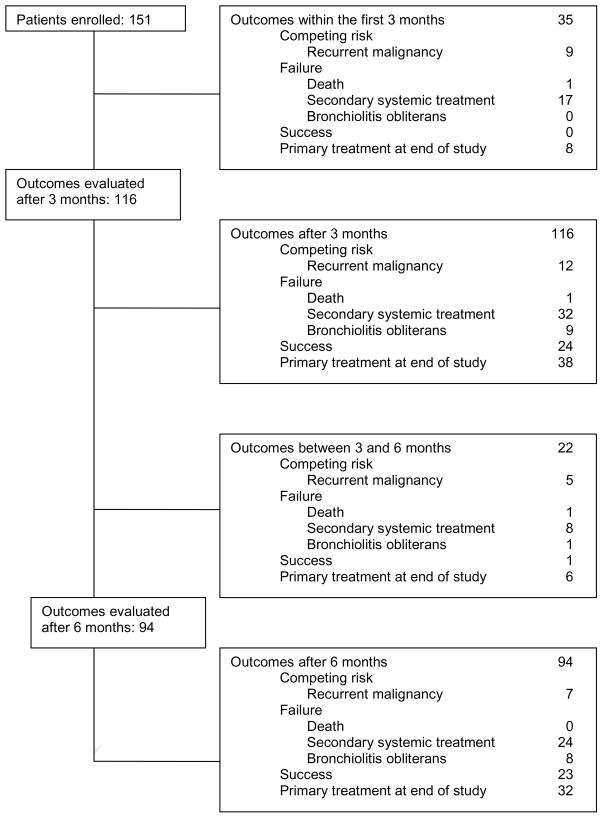
Clinical trials of chronic graft-versus-host disease (cGVHD) often use early endpoints, such as clinical response at 3 or 6 months, as the primary endpoint instead of measures of long-term treatment success, such as the ability to discontinue immunosuppressive treatment after development of immune tolerance and resolution of active disease. We evaluated the ability of defined overall and organ-specific response categories at 3 and 6 months to predict the subsequent success or failure of primary treatment. The analysis included 116 patients evaluated at 3 months after enrollment and 94 patients evaluated at 6 months after enrollment. Success was defined as withdrawal of systemic treatment after resolution of cGVHD without secondary therapy. Failure was defined as secondary systemic treatment, or death or development of bronchiolitis obliterans during primary treatment. With most definitions, response at 3 months and response at 6 months were not statistically significantly correlated with subsequent success of primary treatment. With some definitions, the absence of response at 6 months had a statistically significant correlation with subsequent failure of primary treatment. These findings suggest that early response to the agents currently used for primary treatment does not necessarily predict subsequent tolerance, an important endpoint in the management of cGVHD. Rigorously defined clinical response is an appropriate primary endpoint for studies of cGVHD, but future clinical trials should provide for extended follow-up to ascertain late outcomes that are not necessarily predictable by evaluation of response before 6 months.
慢性移植物抗宿主病 (cGVHD) 的临床试验通常使用早期终点,如 3 或 6 个月时的临床反应,作为主要终点,而不是长期治疗成功的指标,如在免疫耐受形成和活动性疾病消退后停止免疫抑制治疗的能力。我们评估了 3 个月和 6 个月时定义的总体和器官特异性反应类别预测原发性治疗随后成功或失败的能力。该分析包括 116 名在入组后 3 个月评估的患者和 94 名在入组后 6 个月评估的患者。成功定义为在 cGVHD 缓解且无继发性治疗的情况下停止全身治疗。失败定义为继发性全身治疗,或原发性治疗期间死亡或发生细支气管闭塞性细支气管炎。对于大多数定义,3 个月时的反应和 6 个月时的反应与原发性治疗随后的成功没有统计学显著相关性。对于一些定义,6 个月时无反应与原发性治疗随后的失败有统计学显著相关性。这些发现表明,目前用于原发性治疗的药物的早期反应不一定预测随后的耐受,这是 cGVHD 管理中的一个重要终点。严格定义的临床反应是 cGVHD 研究的适当主要终点,但未来的临床试验应提供延长随访,以确定在 6 个月前评估反应不一定可预测的晚期结局。