Department of Veterinary Pathobiology, College of Veterinary Medicine and Biomedical Sciences, Texas A&M University, College Station, TX 77843 USA.
BMC Vet Res. 2010 Jul 7;6:35. doi: 10.1186/1746-6148-6-35.
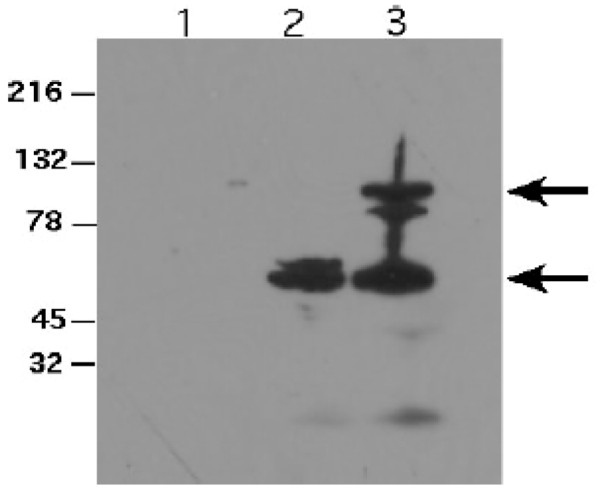
Escherichia coli serogroup O157:H7 has emerged as an important zoonotic bacterial pathogen, causing a range of symptoms from self-limiting bloody diarrhea to severe hemorrhagic colitis and hemolytic-uremic syndrome in humans. Beef and dairy cattle are considered the most important animal reservoirs for this pathogen. One of the important virulence characteristics of E. coli O157:H7 is the eaeA gene encoding the 97 kDa surface protein intimin. Intimin is required for attachment and effacement during the interaction of enterohemorrhagic E. coli with human and bovine neonatal enterocytes. The present study was undertaken to test the hypothesis that an adaptive mucosal immune response directed against intimin will reduce or prevent enteric colonization and fecal shedding of E. coli O157:H7 in cattle.
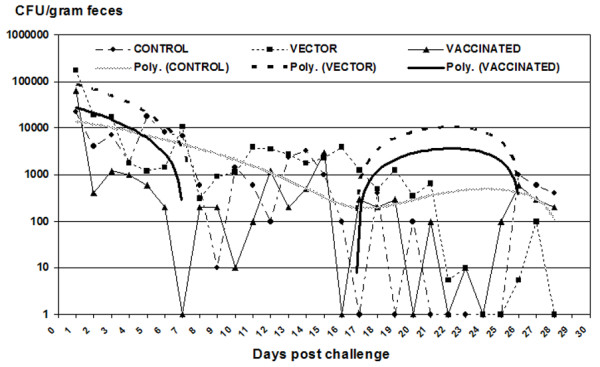
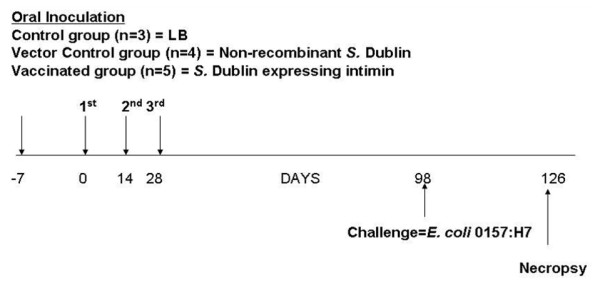
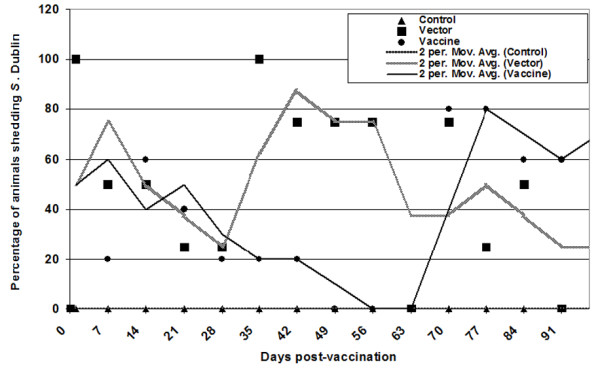
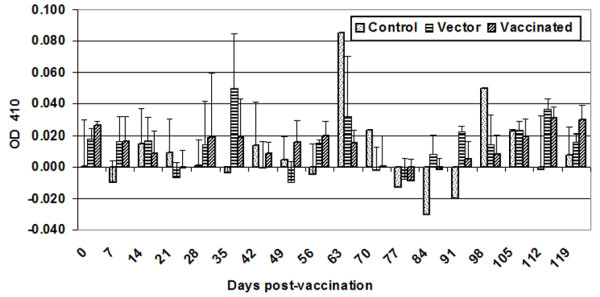
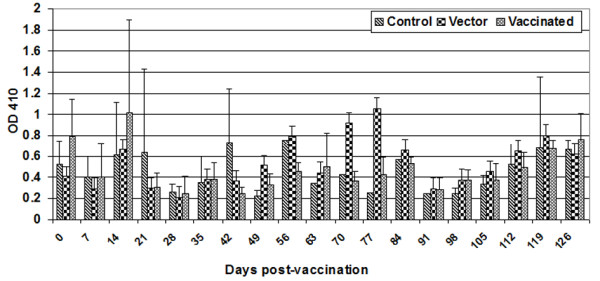
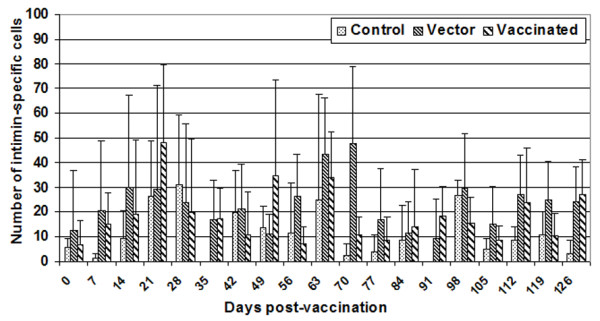
Cattle were orally inoculated with either milk (control), milk with live attenuated Salmonella enterica serovar Dublin (vector), or milk with live attenuated recombinant S. Dublin expressing intimin (vaccinated) on days 0, 14 and 28. On day 98, all calves were challenged orally with E. coli O157:H7 to evaluate whether vaccination with the recombinant S. Dublin expressing intimin would reduce the level of E. coli O157:H7 fecal shedding.During the first 28 days, vaccinated calves shed both the vector strain and the intimin-expressing S. Dublin strain at a similar level. The vector strain was shed for a significantly longer period as compared to the level of recombinant vaccine strain. Calves that received the intimin-expressed vaccine ceased shedding S. Dublin from day 28 to day 63. All calves were challenged with E. coli O157:H7 on day 98 to determine the effect on fecal shedding of E. coli O157:H7. The amount of E. coli O157:H7 in feces was measured for 30 days post-challenge. We observed a transient clearance of E. coli O157:H7 from the feces in the vaccinated calves. The magnitude of fecal E. coli O157:H7 shedding did not correlate with the presence of intimin-specific fecal IgA.
Oral vaccination with live attenuated recombinant S. Dublin expressing intimin reduced enteric colonization and fecal shedding of E. coli O157:H7. However, the transient clearance of E. coli O157:H7 was not associated with an enhanced IgA-mediated mucosal immune response.
大肠杆菌血清群 O157:H7 已成为一种重要的人畜共患病细菌病原体,可导致人类出现从自限性血性腹泻到严重出血性结肠炎和溶血尿毒综合征等一系列症状。牛肉和奶制品牛被认为是这种病原体最重要的动物宿主。大肠杆菌 O157:H7 的一个重要毒力特征是编码 97 kDa 表面蛋白 intim 的 eaeA 基因。在肠出血性大肠杆菌与人类和牛新生儿肠细胞相互作用过程中, intim 对于附着和破坏是必需的。本研究旨在检验以下假设:针对 intim 的适应性黏膜免疫应答将减少或预防牛肠道定植和大肠杆菌 O157:H7 的粪便排出。
牛在第 0、14 和 28 天分别用牛奶(对照)、含活减毒沙门氏菌肠亚种都柏林(载体)的牛奶或含活减毒表达 intim 的重组都柏林沙门氏菌(接种)的牛奶经口接种。在第 98 天,所有小牛均经口接受大肠杆菌 O157:H7 攻毒,以评估接种表达 intim 的重组都柏林沙门氏菌是否会降低大肠杆菌 O157:H7 的粪便排出量。在最初的 28 天内,接种疫苗的小牛以相似的水平同时排出载体株和表达 intim 的都柏林沙门氏菌株。载体株的排出时间明显长于重组疫苗株。接受 intim 表达疫苗接种的小牛从第 28 天到第 63 天停止排出都柏林沙门氏菌。所有小牛均在第 98 天接受大肠杆菌 O157:H7 攻毒,以确定其对大肠杆菌 O157:H7 粪便排出量的影响。攻毒后 30 天内检测粪便中大肠杆菌 O157:H7 的含量。我们观察到接种疫苗的小牛粪便中大肠杆菌 O157:H7 短暂清除。粪便中大肠杆菌 O157:H7 的排出量与 intim 特异性粪便 IgA 的存在无关。
经口接种活减毒重组表达 intim 的都柏林沙门氏菌可减少大肠杆菌 O157:H7 的肠道定植和粪便排出。然而,大肠杆菌 O157:H7 的短暂清除与增强的 IgA 介导的黏膜免疫应答无关。