Environmental Science, Policy & Management, University of California Berkeley, 137 Mulford Hall #3114, Berkeley, CA 94720, USA.
J Chem Ecol. 2010 Aug;36(8):873-84. doi: 10.1007/s10886-010-9821-3. Epub 2010 Jul 11.
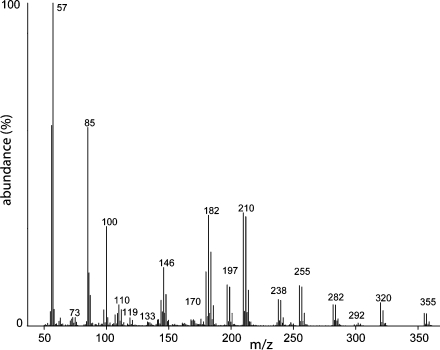
Male orchid bees collect volatiles, from both floral and non-floral sources, that they expose as pheromone analogues (perfumes) during courtship display. The chemical profile of these perfumes, which includes terpenes and aromatic compounds, is both species-specific and divergent among closely related lineages. Thus, fragrance composition is thought to play an important role in prezygotic reproductive isolation in euglossine bees. However, because orchid bees acquire fragrances entirely from exogenous sources, the chemical composition of male perfumes is prone to variation due to environmental heterogeneity across habitats. We used Gas Chromatography/Mass Spectrometry (GC/MS) to characterize the perfumes of 114 individuals of the green orchid bee (Euglossa aff. viridissima) sampled from five native populations in Mesoamerica and two naturalized populations in the southeastern United States. We recorded a total of 292 fragrance compounds from hind-leg extracts, and found that overall perfume composition was different for each population. We detected a pronounced chemical dissimilarity between native (Mesoamerica) and naturalized (U.S.) populations that was driven both by proportional differences of common compounds as well as the presence of a few chemicals unique to each population group. Despite these differences, our data also revealed remarkable qualitative consistency in the presence of several major fragrance compounds across distant populations from dissimilar habitats. In addition, we demonstrate that naturalized bees are attracted to and collect large quantities of triclopyr 2-butoxyethyl ester, the active ingredient of several commercially available herbicides. By comparing incidence values and consistency indices across populations, we identify putative functional compounds that may play an important role in courtship signaling in this species of orchid bee.
雄性兰蜂收集挥发性物质,包括来自花部和非花部的物质,这些物质在求偶展示过程中被暴露为信息素类似物(香水)。这些香水的化学特征包括萜烯和芳香族化合物,既具有物种特异性,也在亲缘关系密切的谱系中存在差异。因此,香味组成被认为在 Euglossine 蜜蜂的合子前生殖隔离中起着重要作用。然而,由于兰蜂完全从外源性来源获取香味,因此由于栖息地之间的环境异质性,雄性香水的化学组成容易发生变化。我们使用气相色谱/质谱(GC/MS)对从中美洲五个本地种群和美国东南部两个归化种群中采集的 114 只绿色兰蜂(Euglossa aff. viridissima)的后腿提取物中的香水进行了特征描述。我们共记录了 292 种香味化合物,发现每个种群的香水成分总体上都不同。我们检测到本地(中美洲)和归化(美国)种群之间存在明显的化学差异,这是由常见化合物的比例差异以及每个种群特有的少数化学物质共同驱动的。尽管存在这些差异,但我们的数据还揭示了来自不同栖息地的遥远种群之间存在几种主要香味化合物的惊人定性一致性。此外,我们还证明了归化蜜蜂会被大量的三氯吡氧乙酸 2-丁氧基乙酯吸引并收集,这是几种市售除草剂的有效成分。通过比较不同种群的发生率值和一致性指数,我们确定了一些可能在该种兰蜂求偶信号中起重要作用的功能化合物。