Canadian Institute for Advanced Research, Department of Botany, University of British Columbia, 3529-6270 University Boulevard, Vancouver, BC, V6T 1Z4, Canada.
Genome Biol Evol. 2010 Jul 12;2:304-9. doi: 10.1093/gbe/evq022.
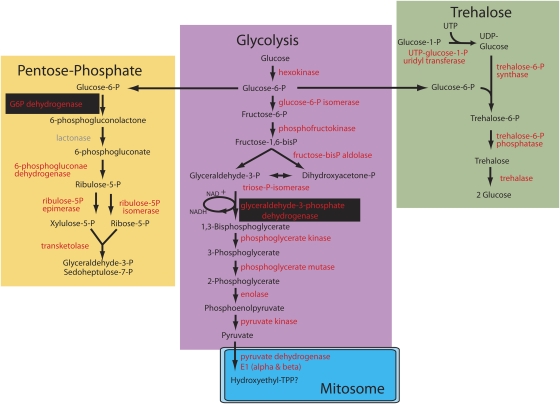
Reduction of various biological processes is a hallmark of the parasitic lifestyle. Generally, the more intimate the association between parasites and hosts the stronger the parasite relies on its host's physiology for survival and reproduction. However, some systems have been held to be indispensable, for example, the core pathways of carbon metabolism that produce energy from sugars. Even the most hardened anaerobes that lack oxidative phosphorylation and the tricarboxylic acid cycle have retained glycolysis and some downstream means to generate ATP. Here we describe the deep-coverage genome resequencing of the pathogenic microsporidiian, Enterocytozoon bieneusi, which shows that this parasite has crossed this line and abandoned complete pathways for the most basic carbon metabolism. Comparing two genome sequence surveys of E. bieneusi to genomic data from four other microsporidia reveals a normal complement of 353 genes representing 30 functional pathways in E. bieneusi, except that only 2 out of 21 genes collectively involved in glycolysis, pentose phosphate, and trehalose metabolism are present. Similarly, no genes encoding proteins involved in the processing of spliceosomal introns were found. Altogether, E. bieneusi appears to have no fully functional pathway to generate ATP from glucose. Therefore, this intracellular parasite relies on transporters to import ATP from its host.
各种生物过程的减少是寄生生活方式的标志。一般来说,寄生虫与宿主之间的联系越密切,寄生虫就越依赖宿主的生理机能来生存和繁殖。然而,有些系统被认为是必不可少的,例如,从糖中产生能量的核心碳代谢途径。即使是最顽强的缺乏氧化磷酸化和三羧酸循环的厌氧菌,也保留了糖酵解和一些下游的产生 ATP 的方法。在这里,我们描述了致病微孢子虫 Enterocytozoon bieneusi 的深度覆盖基因组重测序,结果表明这种寄生虫已经越过了这条线,放弃了最基本的碳代谢的完整途径。将 E. bieneusi 的两个基因组序列调查与来自其他四种微孢子虫的基因组数据进行比较,显示出 E. bieneusi 正常包含 353 个基因,代表 30 种功能途径,但只有 21 个共同参与糖酵解、戊糖磷酸和海藻糖代谢的基因存在。同样,也没有发现编码参与剪接体内含子加工的蛋白质的基因。总的来说,E. bieneusi 似乎没有从葡萄糖生成 ATP 的完全功能途径。因此,这种细胞内寄生虫依赖转运蛋白从宿主中输入 ATP。