Department of Biochemistry and Biophysics, University of California at San Francisco, San Francisco, California, United States of America.
PLoS Biol. 2010 Jul 6;8(7):e1000415. doi: 10.1371/journal.pbio.1000415.
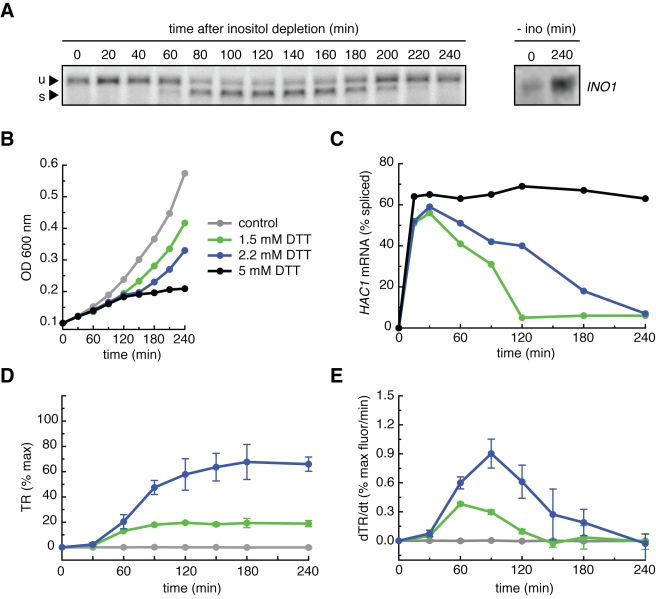
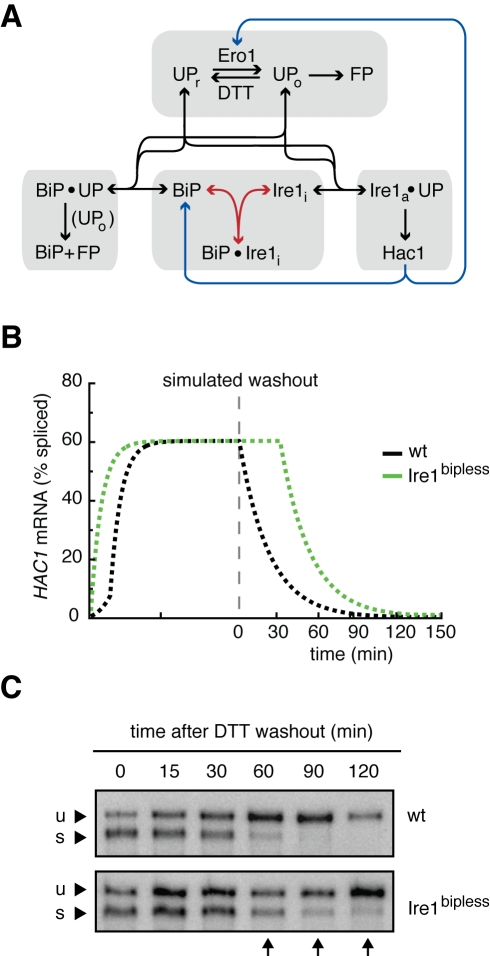
The unfolded protein response (UPR) is an intracellular signaling pathway that counteracts variable stresses that impair protein folding in the endoplasmic reticulum (ER). As such, the UPR is thought to be a homeostat that finely tunes ER protein folding capacity and ER abundance according to need. The mechanism by which the ER stress sensor Ire1 is activated by unfolded proteins and the role that the ER chaperone protein BiP plays in Ire1 regulation have remained unclear. Here we show that the UPR matches its output to the magnitude of the stress by regulating the duration of Ire1 signaling. BiP binding to Ire1 serves to desensitize Ire1 to low levels of stress and promotes its deactivation when favorable folding conditions are restored to the ER. We propose that, mechanistically, BiP achieves these functions by sequestering inactive Ire1 molecules, thereby providing a barrier to oligomerization and activation, and a stabilizing interaction that facilitates de-oligomerization and deactivation. Thus BiP binding to or release from Ire1 is not instrumental for switching the UPR on and off as previously posed. By contrast, BiP provides a buffer for inactive Ire1 molecules that ensures an appropriate response to restore protein folding homeostasis to the ER by modulating the sensitivity and dynamics of Ire1 activity.
未折叠蛋白反应(UPR)是一种细胞内信号通路,可抵抗内质网(ER)中损害蛋白折叠的各种压力。因此,UPR 被认为是一种动态平衡器,可根据需要精细调节 ER 蛋白折叠能力和 ER 丰度。内质网应激传感器 Ire1 如何被未折叠蛋白激活,以及内质网伴侣蛋白 BiP 在 Ire1 调节中的作用仍不清楚。在这里,我们表明 UPR 通过调节 Ire1 信号的持续时间将其输出与应激的幅度匹配。BiP 与 Ire1 的结合有助于使 Ire1 对低水平的应激脱敏,并在 ER 恢复到有利的折叠条件时促进其失活。我们提出,从机制上讲,BiP 通过隔离无活性的 Ire1 分子来实现这些功能,从而形成一个阻止寡聚化和激活的障碍,以及促进解聚和失活的稳定相互作用。因此,BiP 与 Ire1 的结合或释放对于之前提出的打开和关闭 UPR 并不是关键的。相比之下,BiP 为无活性的 Ire1 分子提供了一个缓冲器,通过调节 Ire1 活性的敏感性和动力学,确保对 ER 中的蛋白折叠动态平衡进行适当的响应。