Department of Clinical Research, University of Bern, Bern, Switzerland.
Br J Cancer. 2010 Jul 13;103(2):275-84. doi: 10.1038/sj.bjc.6605751.
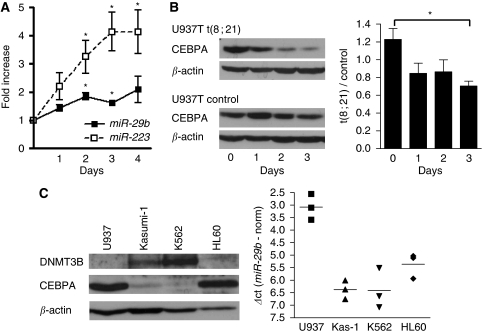
CCAAT/enhancer-binding protein-alpha (CEBPA) is crucial for normal granulopoiesis and is frequently disrupted in acute myeloid leukaemia (AML). Increasing evidence suggests that CEBPA exerts its effects, in parts, by regulating specific microRNAs (miRNAs), as previously shown for miR-223. The aim of this study was to investigate the genome-wide pattern of miRNAs regulated by CEBPA in myeloid cells.
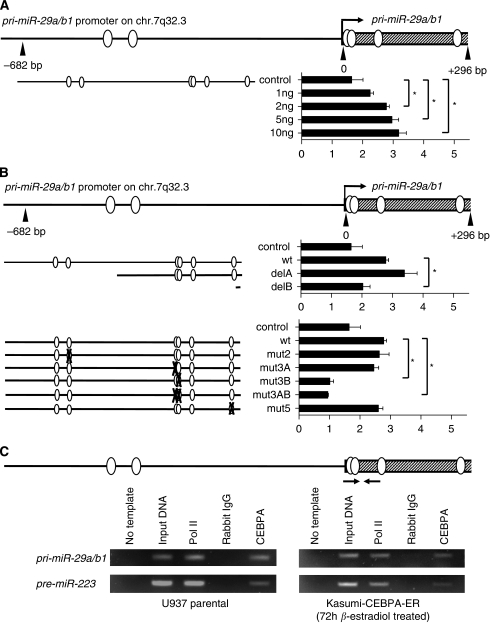
In Kasumi-1 cells, conditionally expressing CEBPA, we assessed the expression of 470 human miRNAs by microarray analysis. We further investigated the microarray results by qRT-PCR, luciferase reporter assays, and chromatin immunoprecipitation assays.
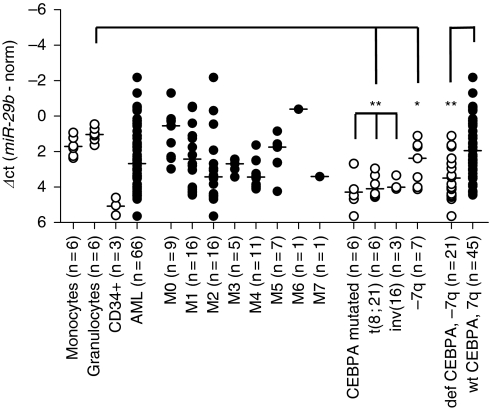
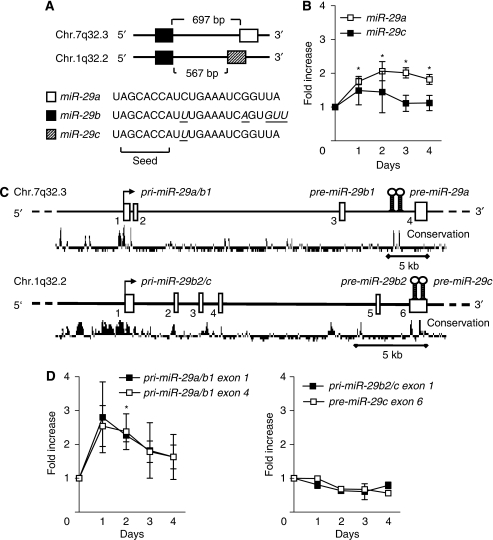
In all, 18 miRNAs were more than two-fold suppressed or induced after CEBPA restoration. Among these 18 miRNAs, we focused on CEBPA-mediated regulation of the tumour-suppressive miR-29b. We observed that miR-29b is suppressed in AML patients with impaired CEBPA function or loss of chromosome 7q. We found that CEBPA selectively regulates miR-29b expression on its miR-29a/b1 locus on chromosome 7q32.3, whereas miR-29b2/c on chromosome 1q32.2 is not affected.
This study reports the activation of the tumour-suppressive miR-29b by the haematopoietic key transcription factor CEBPA. Our data provide a rationale for miR-29b suppression in AML patients with loss of chromosome 7q or CEBPA deficiency.
CCAAT/增强子结合蛋白-α(CEBPA)对于正常的粒细胞生成至关重要,并且在急性髓系白血病(AML)中经常被破坏。越来越多的证据表明,CEBPA 通过调节特定的 microRNAs(miRNAs)发挥其作用,如先前所示的 miR-223。本研究旨在研究 CEBPA 在髓样细胞中调节的 miRNA 的全基因组模式。
在条件表达 CEBPA 的 Kasumi-1 细胞中,我们通过微阵列分析评估了 470 个人类 miRNA 的表达。我们通过 qRT-PCR、荧光素酶报告基因测定和染色质免疫沉淀测定进一步研究了微阵列结果。
总共 18 个 miRNA 在 CEBPA 恢复后被抑制或诱导超过两倍。在这 18 个 miRNA 中,我们重点研究了 CEBPA 对肿瘤抑制性 miR-29b 的调节。我们观察到 AML 患者中 miR-29b 的功能受损或染色体 7q 缺失。我们发现 CEBPA 选择性地调节染色体 7q32.3 上的 miR-29a/b1 基因座上的 miR-29b 表达,而染色体 1q32.2 上的 miR-29b2/c 不受影响。
本研究报告了造血关键转录因子 CEBPA 对肿瘤抑制性 miR-29b 的激活。我们的数据为 AML 患者中缺失染色体 7q 或 CEBPA 缺陷时 miR-29b 抑制提供了依据。