Klockenbusch Cordula, Kast Juergen
The Biomedical Research Centre, University of British Columbia, Vancouver, BC V6T1Z3, Canada.
J Biomed Biotechnol. 2010;2010:927585. doi: 10.1155/2010/927585. Epub 2010 Jun 28.
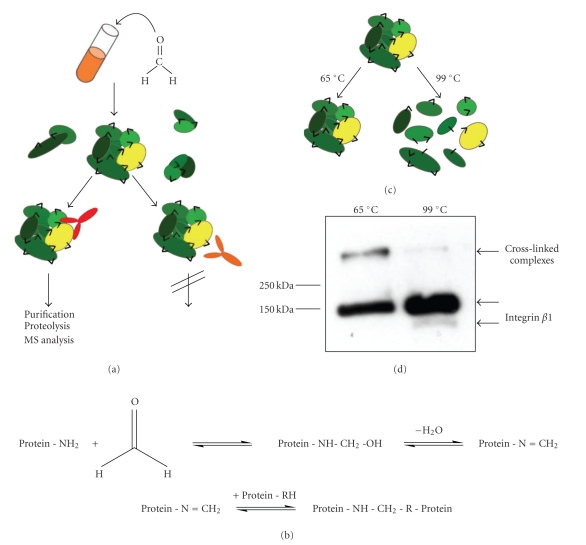
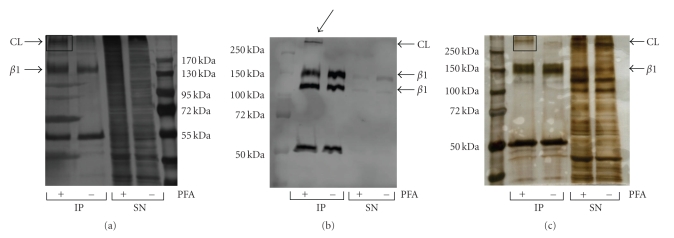
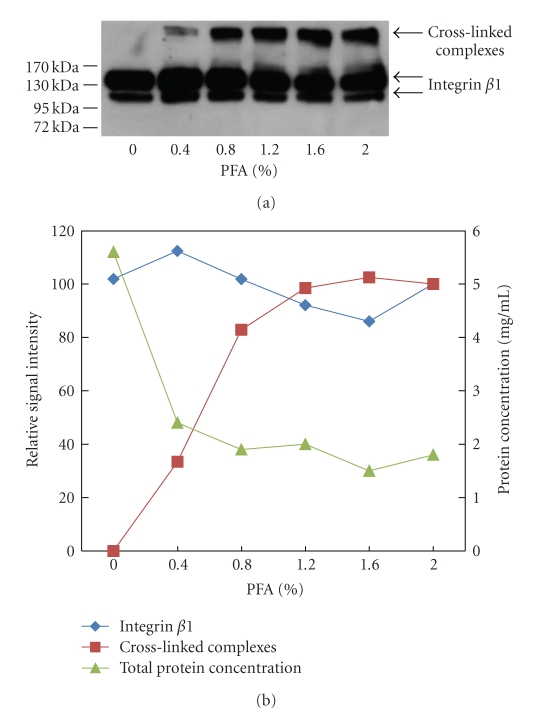
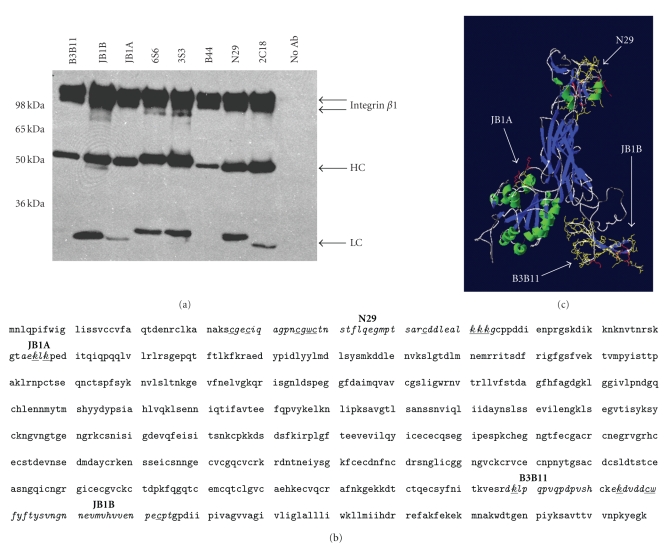
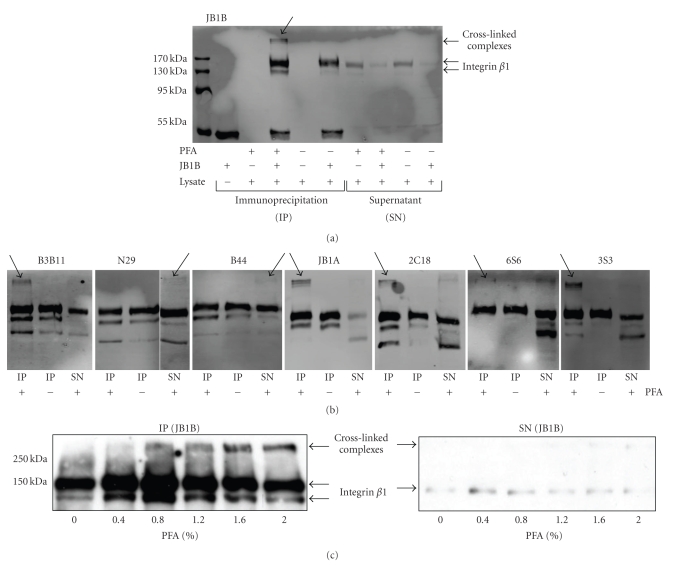
Formaldehyde cross-linking of protein complexes combined with immunoprecipitation and mass spectrometry analysis is a promising technique for analysing protein-protein interactions, including those of transient nature. Here we used integrin beta1 as a model to describe the application of formaldehyde cross-linking in detail, particularly focusing on the optimal parameters for cross-linking, the detection of formaldehyde cross-linked complexes, the utility of antibodies, and the identification of binding partners. Integrin beta1 was found in a high molecular weight complex after formaldehyde cross-linking. Eight different anti-integrin beta1 antibodies were used for pull-down experiments and no loss in precipitation efficiency after cross-linking was observed. However, two of the antibodies could not precipitate the complex, probably due to hidden epitopes. Formaldehyde cross-linked complexes, precipitated from Jurkat cells or human platelets and analyzed by mass spectrometry, were found to be composed of integrin beta1, alpha4 and alpha6 or beta1, alpha6, alpha2, and alpha5, respectively.
蛋白质复合物的甲醛交联结合免疫沉淀和质谱分析是一种很有前景的分析蛋白质-蛋白质相互作用的技术,包括那些具有瞬时性质的相互作用。在这里,我们以整合素β1为模型详细描述甲醛交联的应用,特别关注交联的最佳参数、甲醛交联复合物的检测、抗体的效用以及结合伴侣的鉴定。甲醛交联后发现整合素β1存在于高分子量复合物中。使用八种不同的抗整合素β1抗体进行下拉实验,未观察到交联后沉淀效率的损失。然而,其中两种抗体无法沉淀该复合物,可能是由于隐蔽表位的原因。从Jurkat细胞或人血小板中沉淀出的甲醛交联复合物经质谱分析,发现分别由整合素β1、α4和α6或β1、α6、α2和α5组成。