Classen Timothy J, Dunn Richard A
Loyola University Chicago.
Soc Sci Q. 2010;91(3):593-612. doi: 10.1111/j.1540-6237.2010.00709.x.
This article examines the effect of election outcomes on suicide rates by combining the theory of social integration developed by Durkheim with the models of rational choice used in economics.
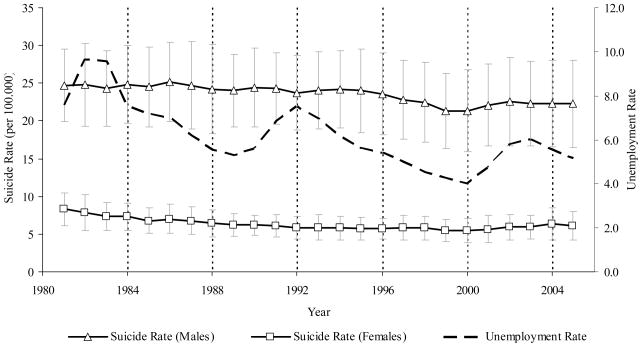
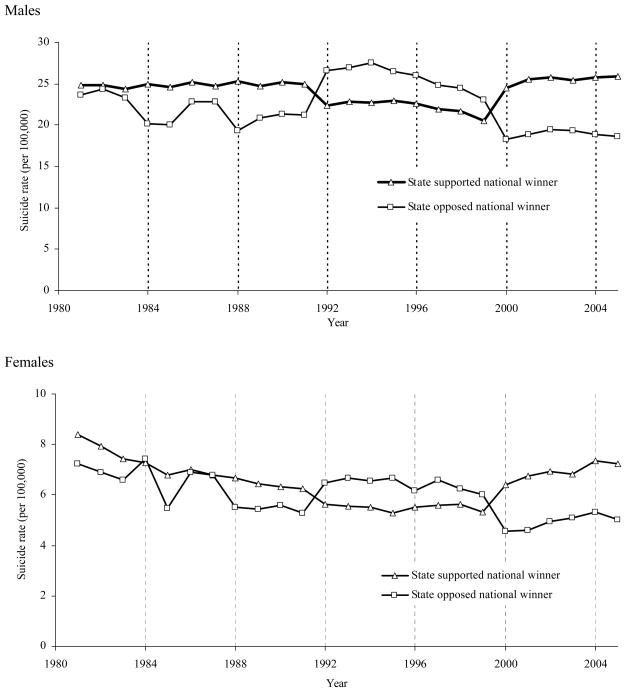
Theory predicts that states with a greater percentage of residents who supported the losing candidate would tend to exhibit a relative increase in suicide rates. However, being around others who also supported the losing candidate may indicate a greater degree of social integration at the local level, thereby lowering relative suicide rates. We therefore use fixed-effects regression of state suicide rates from 1981 to 2005 on state election outcomes during presidential elections to determine which effect is stronger.
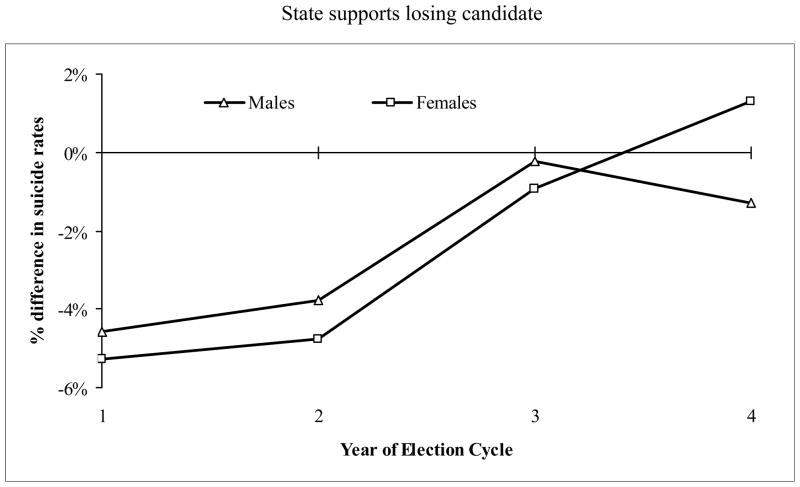
We find that the local effect of social integration is dominant. The suicide rate when a state supports the losing candidate will tend to be lower than if the state had supported the winning candidate-4.6 percent lower for males and 5.3 percent lower for females.
Social integration works at many levels; it not only affects suicide risk directly, but can mediate other shocks that influence suicide risk.
本文通过将涂尔干提出的社会整合理论与经济学中使用的理性选择模型相结合,研究选举结果对自杀率的影响。
理论预测,支持落选候选人的居民比例较高的州,自杀率往往会相对上升。然而,与同样支持落选候选人的人在一起,可能表明当地社会整合程度较高,从而降低相对自杀率。因此,我们使用1981年至2005年各州自杀率对总统选举期间各州选举结果的固定效应回归,以确定哪种影响更强。
我们发现社会整合的局部效应占主导。当一个州支持落选候选人时,自杀率往往会低于该州支持获胜候选人时的自杀率——男性自杀率低4.6%,女性自杀率低5.3%。
社会整合在多个层面发挥作用;它不仅直接影响自杀风险,还能调节其他影响自杀风险的冲击。