Silent Spring Institute, 29 Crafts Street, Newton, MA 02458, USA.
Environ Health. 2010 Jul 20;9:40. doi: 10.1186/1476-069X-9-40.
Household cleaning and pesticide products may contribute to breast cancer because many contain endocrine disrupting chemicals or mammary gland carcinogens. This population-based case-control study investigated whether use of household cleaners and pesticides increases breast cancer risk.
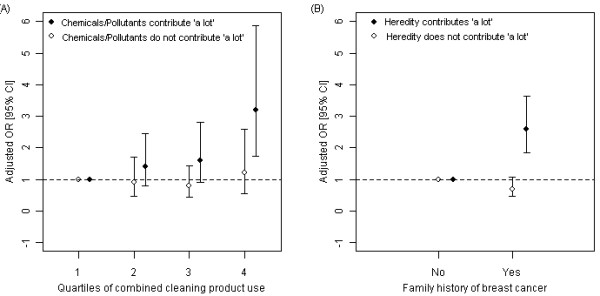
Participants were 787 Cape Cod, Massachusetts, women diagnosed with breast cancer between 1988 and 1995 and 721 controls. Telephone interviews asked about product use, beliefs about breast cancer etiology, and established and suspected breast cancer risk factors. To evaluate potential recall bias, we stratified product-use odds ratios by beliefs about whether chemicals and pollutants contribute to breast cancer; we compared these results with odds ratios for family history (which are less subject to recall bias) stratified by beliefs about heredity.
Breast cancer risk increased two-fold in the highest compared with lowest quartile of self-reported combined cleaning product use (Adjusted OR = 2.1, 95% CI: 1.4, 3.3) and combined air freshener use (Adjusted OR = 1.9, 95% CI: 1.2, 3.0). Little association was observed with pesticide use. In stratified analyses, cleaning products odds ratios were more elevated among participants who believed pollutants contribute "a lot" to breast cancer and moved towards the null among the other participants. In comparison, the odds ratio for breast cancer and family history was markedly higher among women who believed that heredity contributes "a lot" (OR = 2.6, 95% CI: 1.9, 3.6) and not elevated among others (OR = 0.7, 95% CI: 0.5, 1.1).
Results of this study suggest that cleaning product use contributes to increased breast cancer risk. However, results also highlight the difficulty of distinguishing in retrospective self-report studies between valid associations and the influence of recall bias. Recall bias may influence higher odds ratios for product use among participants who believed that chemicals and pollutants contribute to breast cancer. Alternatively, the influence of experience on beliefs is another explanation, illustrated by the protective odds ratio for family history among women who do not believe heredity contributes "a lot." Because exposure to chemicals from household cleaning products is a biologically plausible cause of breast cancer and avoidable, associations reported here should be further examined prospectively.
家庭清洁和农药产品可能会导致乳腺癌,因为它们中许多都含有内分泌干扰化学物质或乳腺致癌物。这项基于人群的病例对照研究调查了使用家用清洁剂和农药是否会增加乳腺癌风险。
参与者是 1988 年至 1995 年期间在马萨诸塞州科德角诊断出患有乳腺癌的 787 名女性和 721 名对照。通过电话访谈询问产品使用情况、对乳腺癌病因的看法以及已确定和可疑的乳腺癌危险因素。为了评估潜在的回忆偏倚,我们按是否认为化学物质和污染物会导致乳腺癌对产品使用的比值比进行分层;我们将这些结果与按是否认为遗传因素有很大影响对家族史的比值比(较少受回忆偏倚影响)进行了比较。
与自我报告的最低四分位相比,最高四分位的清洁产品总使用量(调整后的 OR = 2.1,95%CI:1.4,3.3)和空气清新剂总使用量(调整后的 OR = 1.9,95%CI:1.2,3.0)的乳腺癌风险增加了一倍。与农药使用相关性不大。在分层分析中,在认为污染物对乳腺癌“有很大影响”的参与者中,清洁产品比值比更高,而在其他参与者中,比值比则接近零。相比之下,认为遗传因素“有很大影响”的女性乳腺癌和家族史的比值比明显更高(OR = 2.6,95%CI:1.9,3.6),而不认为遗传因素有很大影响的女性比值比(OR = 0.7,95%CI:0.5,1.1)则没有升高。
这项研究的结果表明,清洁产品的使用会增加乳腺癌的风险。然而,结果也突出了在回顾性自我报告研究中,区分有效关联和回忆偏倚影响的困难。在认为化学物质和污染物会导致乳腺癌的参与者中,产品使用的更高比值比可能受到回忆偏倚的影响。或者,经验对信念的影响是另一种解释,这可以从不认为遗传因素有很大影响的女性中观察到家族史的保护比值比来说明。由于从家用清洁产品中接触化学物质是乳腺癌的一个合理的生物学原因,也是可以避免的,因此,这里报告的关联应进一步前瞻性地进行研究。