College of Physics Science, Qingdao University, 266071, Qingdao, China.
Nanoscale Res Lett. 2009 Nov 13;5(1):237-42. doi: 10.1007/s11671-009-9471-y.
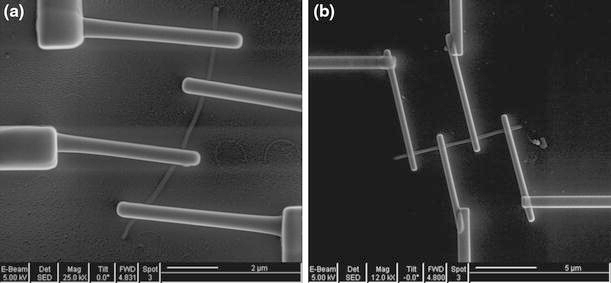
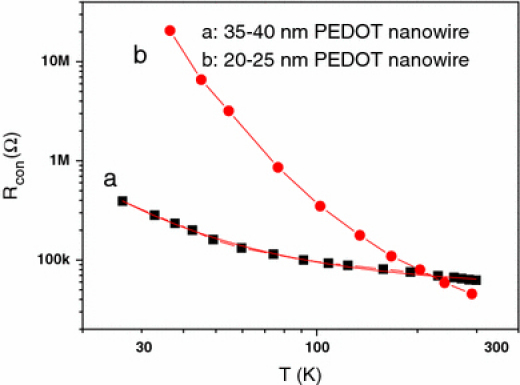
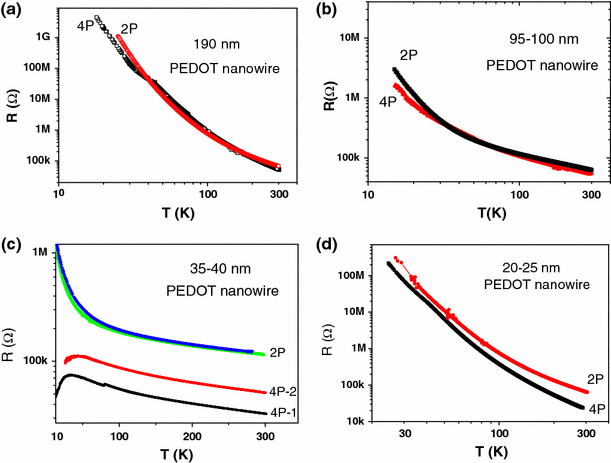
Two- and four-probe electrical measurements on individual conjugated polymer nanowires with different diameters ranging from 20 to 190 nm have been performed to study their conductivity and nanocontact resistance. The two-probe results reveal that all the measured polymer nanowires with different diameters are semiconducting. However, the four-probe results show that the measured polymer nanowires with diameters of 190, 95-100, 35-40 and 20-25 nm are lying in the insulating, critical, metallic and insulting regimes of metal-insulator transition, respectively. The 35-40 nm nanowire displays a metal-insulator transition at around 35 K. In addition, it was found that the nanocontact resistance is in the magnitude of 104Ω at room temperature, which is comparable to the intrinsic resistance of the nanowires. These results demonstrate that four-probe electrical measurement is necessary to explore the intrinsic electronic transport properties of isolated nanowires, especially in the case of metallic nanowires, because the metallic nature of the measured nanowires may be coved by the nanocontact resistance that cannot be excluded by a two-probe technique.
已经对直径范围从 20 至 190nm 的不同直径的单个共轭聚合物纳米线进行了两探针和四探针的电学测量,以研究其导电性和纳米接触电阻。两探针的结果表明,所有不同直径的测量聚合物纳米线都是半导体。然而,四探针的结果表明,直径为 190、95-100、35-40 和 20-25nm 的测量聚合物纳米线分别处于金属-绝缘体转变的绝缘、临界、金属和绝缘状态。35-40nm 纳米线在约 35K 处显示出金属-绝缘体转变。此外,还发现纳米接触电阻在室温下处于 104Ω 的量级,这与纳米线的本征电阻相当。这些结果表明,四探针电测量对于探索孤立纳米线的本征电子输运性质是必要的,特别是在金属纳米线的情况下,因为测量纳米线的金属性质可能被纳米接触电阻掩盖,而两探针技术无法排除这种电阻。