Department of Experimental Oncology, European Institute of Oncology, IFOM-IEO Campus, Milan, Italy.
PLoS One. 2010 Jul 15;5(7):e11603. doi: 10.1371/journal.pone.0011603.
Protein assemblies named kinetochores bind sister chromatids to the mitotic spindle and orchestrate sister chromatid segregation. Interference with kinetochore activity triggers a spindle checkpoint mediated arrest in mitosis, which frequently ends in cell death. We set out to identify small compounds that inhibit kinetochore-microtubule binding for use in kinetochore-spindle interaction studies and to develop them into novel anticancer drugs.
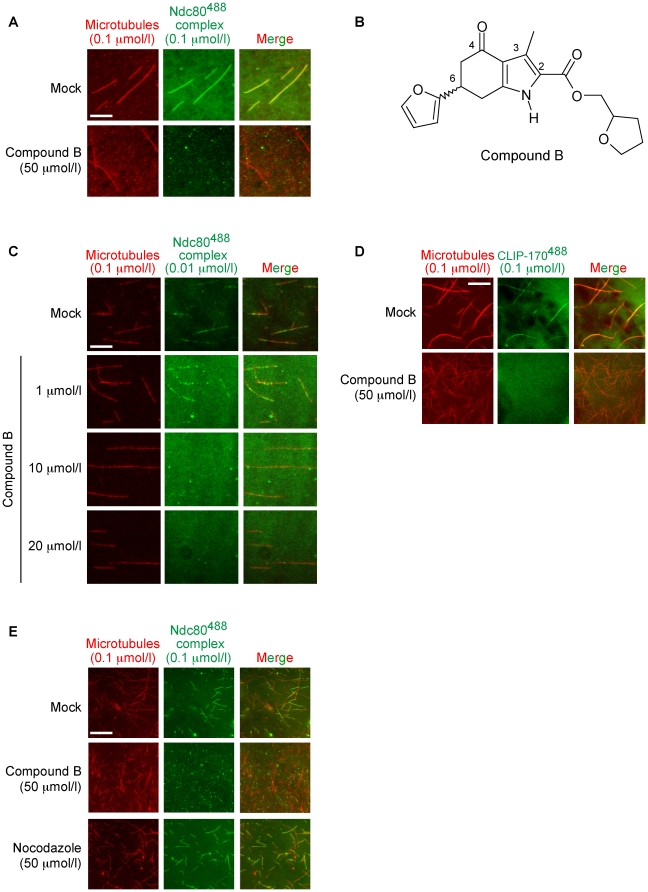
METHODOLOGY/PRINCIPAL FINDINGS: A fluorescence microscopy-based in vitro assay was developed to screen compound libraries for molecules that prevented the binding of a recombinant human Ndc80 kinetochore complex to taxol-stabilized microtubules. An active compound was identified that acted at the microtubule level. More specifically, by localizing to the colchicine-binding site in alphabeta-tubulin the hit compound prevented the Ndc80 complex from binding to the microtubule surface. Next, structure-activity analyses distinguished active regions in the compound and led to the identification of highly potent analogs that killed cancer cells with an efficacy equaling that of established spindle drugs.
CONCLUSIONS/SIGNIFICANCE: The compound identified in our screen and its subsequently identified analogs represent new antitubulin chemotypes that can be synthetically developed into a novel class of antimitotic spindle drugs. In addition, they are stereochemically unique as their R- and S-isomers mimic binding of colchicine and podophyllotoxin, respectively, two antitubulin drugs that interact differently with the tubulin interface. Model-driven manipulation of our compounds promises to advance insight into how antitubulin drugs act upon tubulin. These advances in turn may lead to tailor-made colchicine site agents which would be valuable new assets to fight a variety of tumors, including those that have become resistant to the (antispindle) drugs used today.
名为着丝粒的蛋白组装体将姐妹染色单体与有丝分裂纺锤体结合,并协调姐妹染色单体的分离。干扰着丝粒活性会触发纺锤体检查点介导的有丝分裂停滞,这通常会导致细胞死亡。我们着手寻找抑制着丝粒-微管结合的小分子化合物,用于着丝粒-纺锤体相互作用研究,并将其开发成新型抗癌药物。
方法/主要发现:开发了一种基于荧光显微镜的体外测定法,用于筛选化合物文库中的分子,这些分子可阻止重组人 Ndc80 着丝粒复合物与紫杉醇稳定的微管结合。鉴定出一种活性化合物,该化合物在微管水平上起作用。更具体地说,通过定位到微管蛋白的秋水仙碱结合部位,该作用物阻止了 Ndc80 复合物与微管表面的结合。接下来,结构活性分析区分了化合物中的活性区域,并导致鉴定出高效能的类似物,其对癌细胞的杀伤效力与已建立的纺锤体药物相当。
结论/意义:我们在筛选中鉴定出的化合物及其随后鉴定出的类似物代表了新的抗微管化学型,可通过合成开发成一类新型抗有丝分裂纺锤体药物。此外,它们在立体化学上是独特的,因为它们的 R-和 S-异构体分别模拟秋水仙碱和鬼臼毒素的结合,鬼臼毒素是两种与微管界面相互作用方式不同的抗微管药物。基于模型的化合物操作有望深入了解抗微管药物如何作用于微管。这些进展反过来又可能导致定制的秋水仙碱结合剂,这将是对抗各种肿瘤的宝贵新资产,包括那些对当今使用的(抗纺锤体)药物产生耐药性的肿瘤。