Katoli Parvaneh, Sharif Najam A, Sule Anupam, Dimitrijevich Slobodan D
Pharmaceutical Research, Alcon Research, Ltd., Fort Worth, TX 76134, USA.
Mol Vis. 2010 Jul 7;16:1241-52.
To demonstrate the presence of natriuretic peptide receptors (NPRs) in primary human corneal epithelial cells (p-CEPI), SV40-immortalized CEPI cells (CEPI-17-CL4) and in human corneal epithelium, and to define the pharmacology of natriuretic peptide (NP)-induced cGMP accumulation.
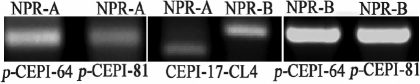
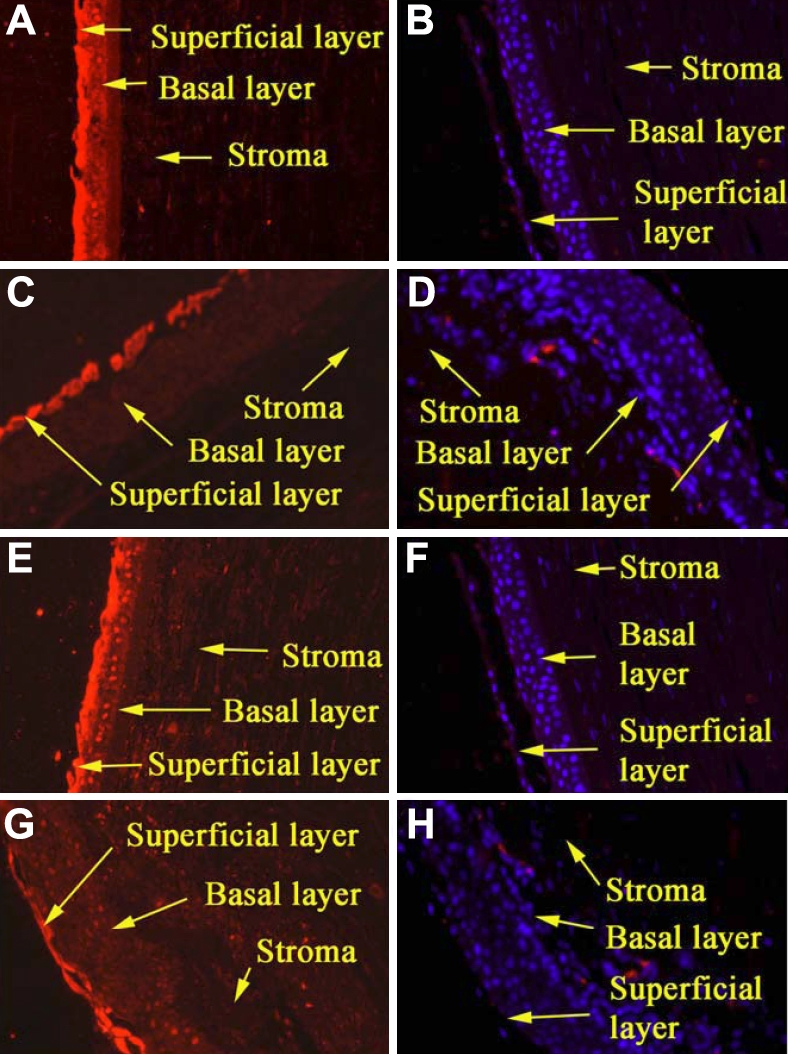
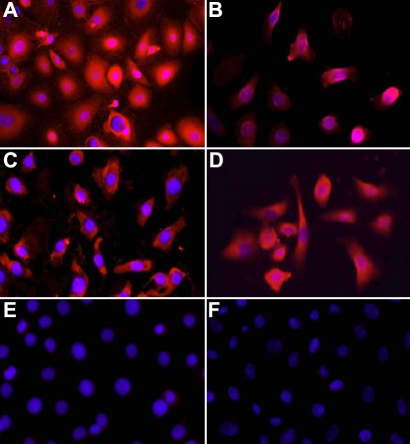
NPR presence was shown by RT-PCR, western blot analysis, and indirect immunofluoresence. cGMP accumulation was determined using an enzyme immunoassay.
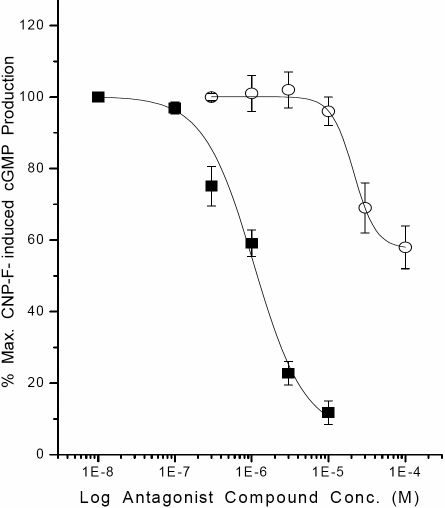
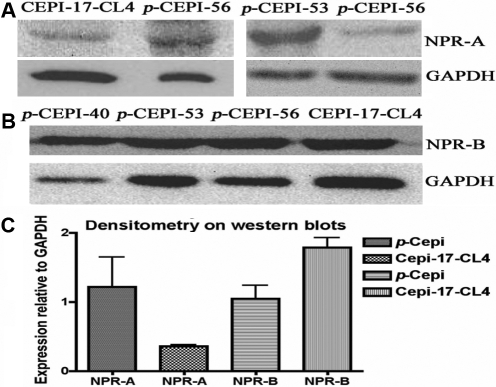
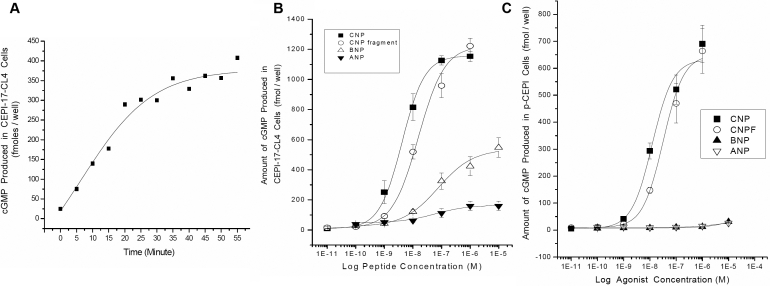
p-CEPI and CEPI-17-CL4 cells expressed mRNAs for NPR-A and NPR-B. Proteins for both NPRs were present in these cells and in human corneal epithelium. C-type NP (CNP), atrial NP (ANP) and brain NP (BNP) stimulated the accumulation of cGMP in a concentration-dependent manner in p-CEPI cells (potency; EC(50s)): CNP (1-53 amino acids) EC(50)=24+/-5 nM; CNP fragment (32-53 amino acids) EC(50)=51+/-8 nM; ANP (1-28 amino acids) EC(50)=>10 microM; BNP (32 amino acids) EC(50)>10 microM (all n=3-4). While the NPs were generally more potent in the CEPI-17-CL4 cells than in p-CEPI cells (n=4-9; p<0.01), the rank order of potency of the peptides was essentially the same in both cell types. Effects of CNP fragment in p-CEPI and CEPI-17-CL4 cells were potently blocked by HS-142-1, an NPR-B receptor subtype-selective antagonist (K(i)=0.25+/-0.05 microM in CEPI-CL4-17; K(i)=0.44+/-0.09 microM in p-CEPIs; n=6-7) but less so by an NPR-A receptor antagonist, isatin (K(i)=5.3-7.8 microM, n=3-7).
Our studies showed the presence of NPR-A and NPR-B (mRNAs and protein) in p-CEPI and CEPI-17-CL4 cells and in human corneal epithelial tissue. However, detailed pharmacological studies revealed NPR-B to be the predominant functionally active receptor in both cell-types whose activation leads to the generation of cGMP. While the physiologic role(s) of the NP system in corneal function remains to be delineated, our multidisciplinary findings pave the way for such future investigations.
证明利钠肽受体(NPRs)在原代人角膜上皮细胞(p-CEPI)、SV40永生化CEPI细胞(CEPI-17-CL4)以及人角膜上皮中的存在,并确定利钠肽(NP)诱导的环磷酸鸟苷(cGMP)积累的药理学特性。
通过逆转录聚合酶链反应(RT-PCR)、蛋白质印迹分析和间接免疫荧光法显示NPR的存在。使用酶免疫测定法测定cGMP积累。
p-CEPI和CEPI-17-CL4细胞表达NPR-A和NPR-B的信使核糖核酸(mRNAs)。这两种NPR的蛋白质存在于这些细胞以及人角膜上皮中。C型NP(CNP)、心房NP(ANP)和脑NP(BNP)以浓度依赖性方式刺激p-CEPI细胞中cGMP的积累(效力;半数有效浓度(EC50s)):CNP(1-53个氨基酸)EC50 = 24±5 nM;CNP片段(32-53个氨基酸)EC50 = 51±8 nM;ANP(1-28个氨基酸)EC50>10 μM;BNP(32个氨基酸)EC50>10 μM(所有n = 3-4)。虽然NP在CEPI-17-CL4细胞中通常比在p-CEPI细胞中更有效(n = 4-9;p<0.01),但肽的效力顺序在两种细胞类型中基本相同。HS-142-1(一种NPR-B受体亚型选择性拮抗剂)能有效阻断CNP片段在p-CEPI和CEPI-17-CL4细胞中的作用(在CEPI-CL4-17中抑制常数(Ki)= 0.25±0.05 μM;在p-CEPI中Ki = 0.44±0.09 μM;n = 6-7),但NPR-A受体拮抗剂异吲哚酮的阻断作用较小(Ki = 5.3-7.8 μM,n = 3-7)。
我们的研究表明p-CEPI和CEPI-17-CL4细胞以及人角膜上皮组织中存在NPR-A和NPR-B(mRNAs和蛋白质)。然而,详细的药理学研究表明NPR-B是两种细胞类型中主要的功能活性受体,其激活导致cGMP的产生。虽然NP系统在角膜功能中的生理作用仍有待阐明,但我们的多学科研究结果为未来的此类研究铺平了道路。