Faculty of Veterinary Science, University of Sydney, Sydney, New South Wales, Australia.
PLoS One. 2010 Jul 26;5(7):e11946. doi: 10.1371/journal.pone.0011946.
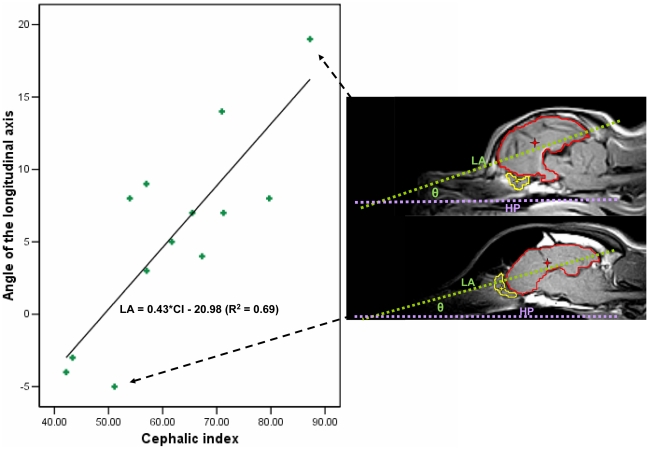
Domestic dogs exhibit an extraordinary degree of morphological diversity. Such breed-to-breed variability applies equally to the canine skull, however little is known about whether this translates to systematic differences in cerebral organization. By looking at the paramedian sagittal magnetic resonance image slice of canine brains across a range of animals with different skull shapes (N = 13), we found that the relative reduction in skull length compared to width (measured by Cephalic Index) was significantly correlated to a progressive ventral pitching of the primary longitudinal brain axis (r = 0.83), as well as with a ventral shift in the position of the olfactory lobe (r = 0.81). Furthermore, these findings were independent of estimated brain size or body weight. Since brachycephaly has arisen from generations of highly selective breeding, this study suggests that the remarkable diversity in domesticated dogs' body shape and size appears to also have led to human-induced adaptations in the organization of the canine brain.
家犬表现出极高程度的形态多样性。这种品种间的可变性同样适用于犬类头骨,但对于这种变化是否会转化为大脑组织的系统差异,人们知之甚少。通过观察一系列具有不同头骨形状的动物的正中矢状面磁共振图像切片(N = 13),我们发现头骨长度相对于宽度的相对缩短(用头颅指数衡量)与主要纵向脑轴的逐渐向前倾斜(r = 0.83)以及嗅叶位置的向前移位(r = 0.81)显著相关。此外,这些发现与估计的脑大小或体重无关。由于短头畸形是经过数代高度选择性繁殖而来的,因此这项研究表明,家犬在体型和大小上的显著多样性似乎也导致了犬类大脑组织的人为适应性变化。