Angiogenesis Research Laboratory, Department of Restorative Sciences, University of Michigan School of Dentistry, Ann Arbor, MI.
Int J Radiat Oncol Biol Phys. 2010 Nov 1;78(3):879-87. doi: 10.1016/j.ijrobp.2010.04.024. Epub 2010 Aug 1.
To investigate the effect of a metronomic (low-dose, high-frequency) small-molecule inhibitor of Bcl-2 (TW-37) in combination with radiotherapy on microvascular endothelial cells in vitro and in tumor angiogenesis in vivo.
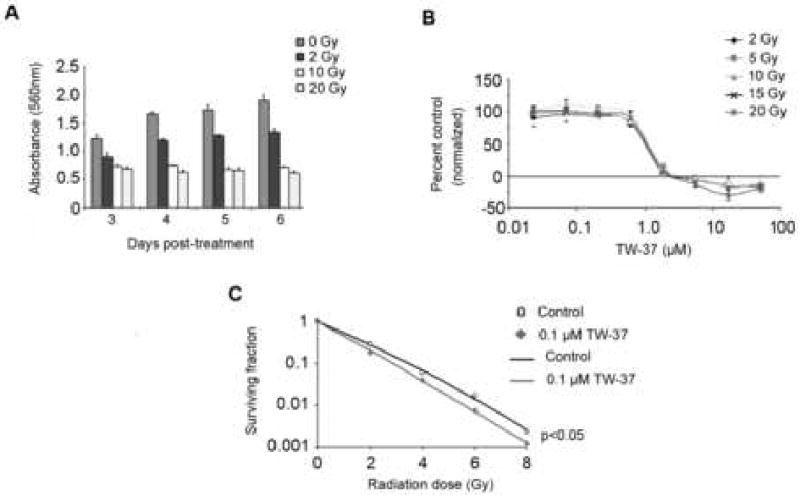
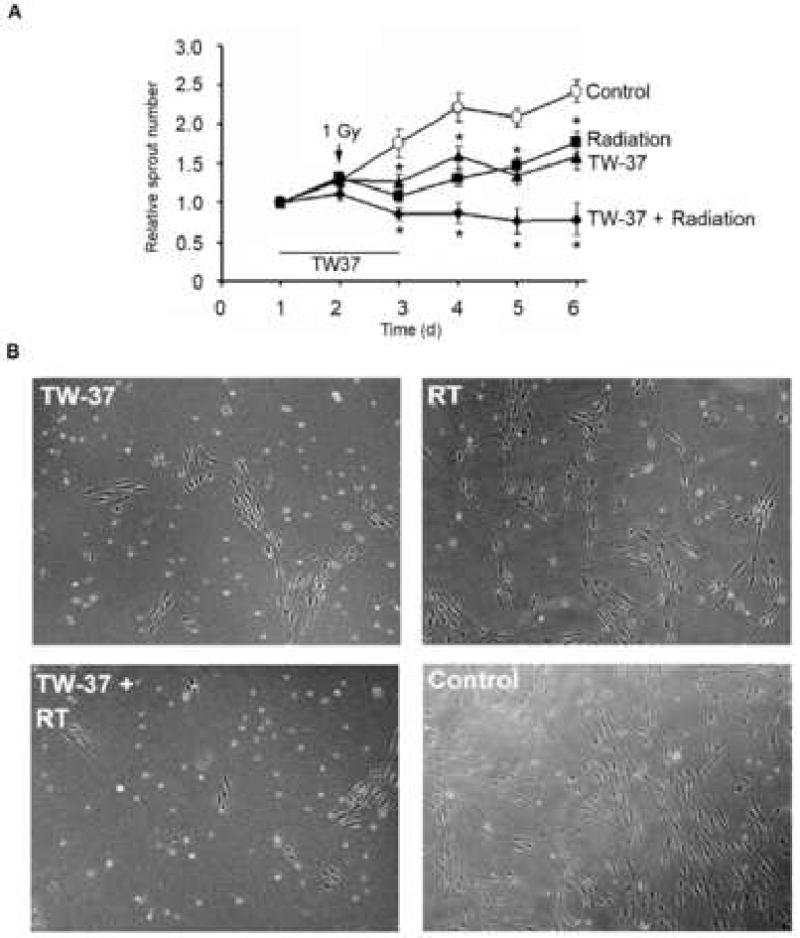
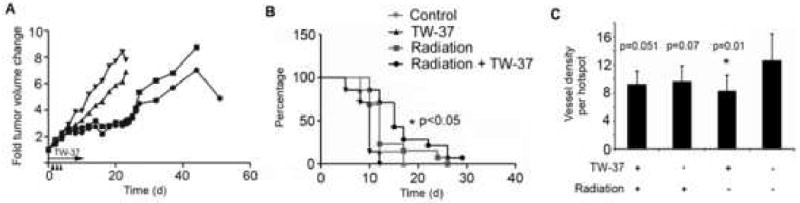
Primary human dermal microvascular endothelial cells were exposed to ionizing radiation and/or TW-37 and colony formation, as well as capillary sprouting in three-dimensional collagen matrices, was evaluated. Xenografts vascularized with human blood vessels were engineered by cotransplantation of human squamous cell carcinoma cells (OSCC3) and human dermal microvascular endothelial cells seeded in highly porous biodegradable scaffolds into the subcutaneous space of immunodeficient mice. Mice were treated with metronomic TW-37 and/or radiation, and tumor growth was evaluated.
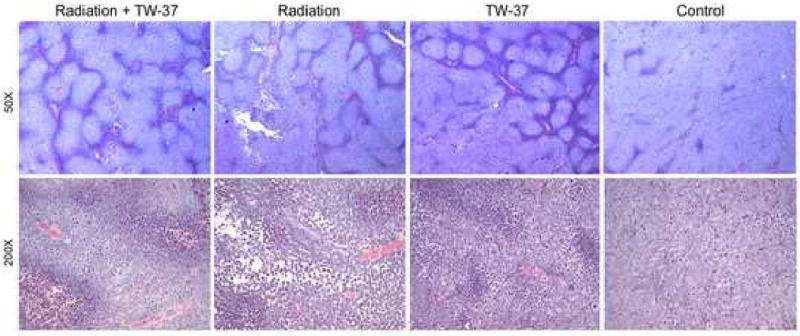
Low-dose TW-37 sensitized primary endothelial cells to radiation-induced inhibition of colony formation. Low-dose TW-37 or radiation partially inhibited endothelial cell sprout formation, and in combination, these therapies abrogated new sprouting. Combination of metronomic TW-37 and low-dose radiation inhibited tumor growth and resulted in significant increase in time to failure compared with controls, whereas single agents did not. Notably, histopathologic analysis revealed that tumors treated with TW-37 (with or without radiation) are more differentiated and showed more cohesive invasive fronts, which is consistent with less aggressive phenotype.
These results demonstrate that metronomic TW-37 potentiates the antitumor effects of radiotherapy and suggest that patients with head and neck cancer might benefit from the combination of small molecule inhibitor of Bcl-2 and radiation therapy.
研究低剂量、高频小分子 Bcl-2 抑制剂(TW-37)联合放疗对体外微血管内皮细胞和体内肿瘤血管生成的影响。
原代人真皮微血管内皮细胞暴露于电离辐射和/或 TW-37,并评估集落形成以及三维胶原基质中的毛细血管发芽。通过将人鳞状细胞癌细胞(OSCC3)和接种在高多孔可生物降解支架中的人真皮微血管内皮细胞共移植到免疫缺陷小鼠的皮下空间,构建了血管化的异种移植物。用 TW-37 的节拍疗法和/或辐射处理小鼠,并评估肿瘤生长。
低剂量 TW-37 使原代内皮细胞对辐射诱导的集落形成抑制作用敏感。低剂量 TW-37 或辐射部分抑制内皮细胞芽形成,而联合使用这些治疗方法则消除了新的芽形成。TW-37 的节拍疗法和低剂量辐射联合抑制肿瘤生长,并导致与对照组相比失效时间显著增加,而单一药物则没有。值得注意的是,组织病理学分析显示,用 TW-37(联合或不联合辐射)治疗的肿瘤更分化,侵袭前沿更具凝聚力,这与侵袭性较弱的表型一致。
这些结果表明,TW-37 的节拍疗法增强了放疗的抗肿瘤作用,并提示头颈部癌症患者可能受益于 Bcl-2 小分子抑制剂和放疗的联合治疗。