Ding Zhengping, Zhang Jie, Shao Jinchen
Department of Thoracic Surgery, Shanghai Chest Hospital/Shanghai Lung Tumor Clinical Medical Center, Shanghai 200030, China.
Zhongguo Fei Ai Za Zhi. 2010 May;13(5):522-5. doi: 10.3779/j.issn.1009-3419.2010.05.26.
Proteins of the nucleotide excision repair pathway can repair DNA damage. The excision repair cross-complementing (ERCC) gene family reduce damagement of DNA by nucleotide excision and repair. The aim of this study is to investigate the expressions of ERCC1 (members of DNA repair gene family) in patients with non-small cell lung cancer (NSCLC) as well as their clinical prognostic significance.
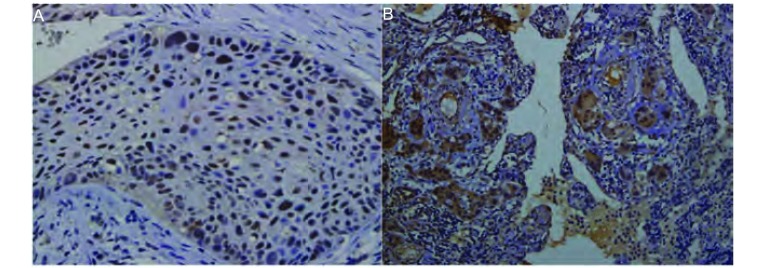
Expression levels ofERCC1 were detected by IHC in 118 stage I NSCLC patients. Kaplan-Meier survival curve, and Cox multivariate regression analysis were used for statistical analysis.
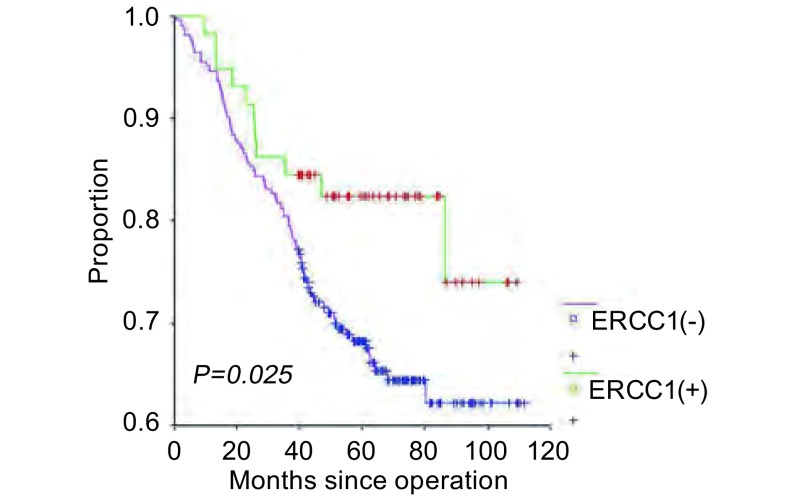
The patients with high expression of ERCC1 had significantly longer survival time than those with low expression of ERCC1, and Cox multivariate regression analysis showed that expression of RRM1 was an independent prognostic factor for NSCLC patients.
NSCLC patients with high ERCC1 expression have a better survival when compared to patients with low ERCC1 expression. Therefore, an intact DNA repair mechanism may reduce the accumulation of genetic aberrations that are thought to contribute to a tumor malignant potential and therefore the risk of relapse after definitive treatment.
核苷酸切除修复途径的蛋白质可修复DNA损伤。切除修复交叉互补(ERCC)基因家族通过核苷酸切除和修复减少DNA损伤。本研究旨在探讨DNA修复基因家族成员ERCC1在非小细胞肺癌(NSCLC)患者中的表达及其临床预后意义。
采用免疫组化法检测118例Ⅰ期NSCLC患者的ERCC1表达水平。采用Kaplan-Meier生存曲线和Cox多因素回归分析进行统计学分析。
ERCC1高表达患者的生存时间明显长于ERCC1低表达患者,Cox多因素回归分析显示ERCC1表达是NSCLC患者的独立预后因素。
与ERCC1低表达患者相比,ERCC1高表达的NSCLC患者生存情况更好。因此,完整的DNA修复机制可能减少遗传畸变的积累,而遗传畸变被认为会导致肿瘤的恶性潜能,从而增加根治性治疗后复发的风险。