Tesfazghi Elsa Sereke, Martinez J A, Verplanke J J
Soc Indic Res. 2010 Aug;98(1):73-88. doi: 10.1007/s11205-009-9518-6. Epub 2009 Sep 26.
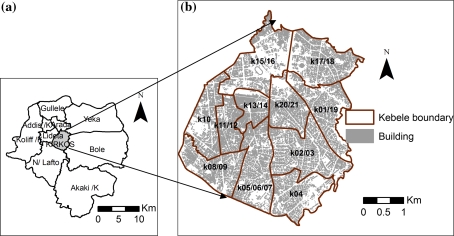
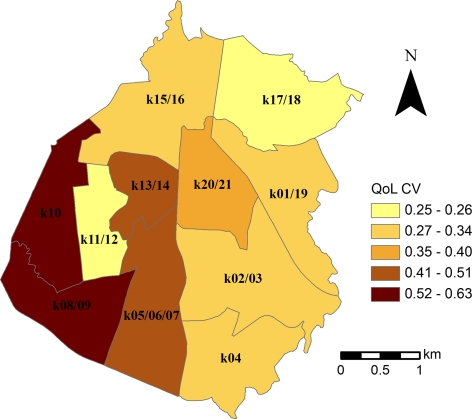
Urban quality of life (QoL) is becoming a subject of urban research mainly for western and Asian countries. Such attention is due to an increasing awareness of the contribution of QoL studies in identifying intervention areas and in monitoring urban planning policies. However, most studies are carried out at city or country level that can average out details at small scales. In this paper we present a case study where the urban QoL at small scale is measured and its variability is evaluated for Kirkos sub-city of Addis Ababa, Ethiopia. The study is based on data from a household survey and some secondary data. Geographic information system (GIS) is applied to extract proximity information (e.g., distance to school facilities) and visualize the spatial distribution of QoL. Statistical methods such as factor analysis are applied to establish an index of objective QoL while coefficient of variation is applied to evaluate spatial variability of subjective QoL. The results of this study reveal that the subjective quality of life (QoL) scores show large variation in the sub-city. The mean QoL score also indicates that the respondents in the sub-city, on average, are dissatisfied with the quality of their life. Respondents with higher education level and income are on average, however, more satisfied with their QoL in the sub-city. The results reveal that the lower the QoL in the Kebele, the larger the variability of QoL within the Kebele. Such indicates how aggregation at large scale can average out the variation of QoL at small scales. The results reveal the presence of QoL variability at small scales. The comparison between the subjective and the objective QoL at Kebele level indicated a state of dissonance, adaptation, deprivation or well-being. Such results suggest that the two measures do not always indicate the same level of QoL.
城市生活质量(QoL)主要在西方国家和亚洲国家正成为城市研究的一个主题。这种关注源于对生活质量研究在确定干预领域和监测城市规划政策方面贡献的认识不断提高。然而,大多数研究是在城市或国家层面进行的,这可能会使小尺度的细节平均化。在本文中,我们展示了一个案例研究,其中对埃塞俄比亚亚的斯亚贝巴柯尔科斯次城的小尺度城市生活质量进行了测量,并评估了其变异性。该研究基于一项家庭调查的数据和一些二手数据。应用地理信息系统(GIS)来提取邻近信息(例如,到学校设施的距离)并可视化生活质量的空间分布。应用因子分析等统计方法来建立客观生活质量指数,同时应用变异系数来评估主观生活质量的空间变异性。这项研究的结果表明,次城内主观生活质量(QoL)得分显示出很大的差异。平均生活质量得分还表明,次城内的受访者总体上对他们的生活质量不满意。然而,平均而言,受过高等教育和收入较高的受访者对次城内的生活质量更满意。结果表明,凯贝勒的生活质量越低,凯贝勒内生活质量的变异性就越大。这表明大规模的汇总如何能使小尺度上生活质量的变化平均化。结果揭示了小尺度上生活质量变异性的存在。在凯贝勒层面上主观和客观生活质量之间的比较表明存在失调、适应、匮乏或幸福的状态。这些结果表明,这两种衡量方法并不总是表明相同水平的生活质量。