Department of Orthopaedics, Oslo University Hospital, Oslo, Norway.
J Orthop Sports Phys Ther. 2010 Nov;40(11):705-21. doi: 10.2519/jospt.2010.3345.
Prospective cohort study without a control group.
Firstly, to present our 5-week progressive exercise therapy program in the early stage after anterior cruciate ligament (ACL) injury. Secondly, to evaluate changes in knee function after completion of the program for patients with ACL injury in general and also when classified as potential copers or noncopers, and, finally, to examine potential adverse events.
Few studies concerning early-stage ACL rehabilitation protocols exist. Consequently, little is known about the tolerance for, and outcomes from, short-term exercise therapy programs in the early stage after injury.
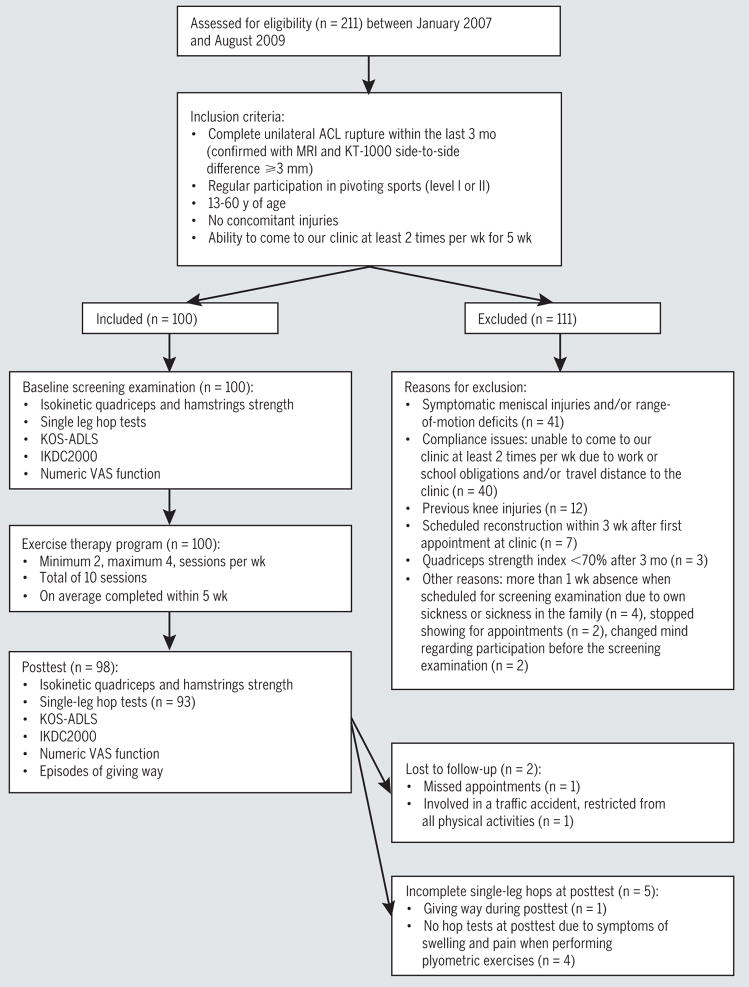
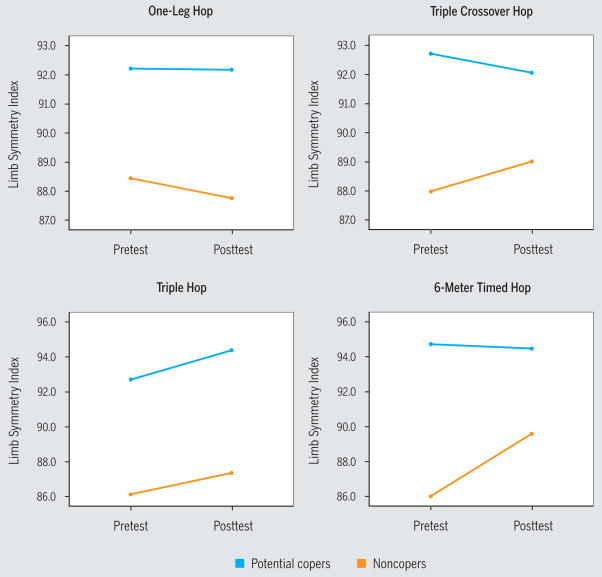
One-hundred patients were included in a 5-week progressive exercise therapy program, within 3 months after injury. Knee function before and after completion of the program was evaluated from isokinetic quadriceps and hamstrings muscle strength tests, 4 single-leg hop tests, 2 different self-assessment questionnaires, and a global rating of knee function. A 2-way mixed-model analysis of variance was conducted to evaluate changes from pretest to posttest for the limb symmetry index for muscle strength and single-leg hop tests, and the change in scores for the patient-reported questionnaires. In addition, absolute values and the standardized response mean for muscle strength and single-leg hop tests were calculated at pretest and posttest for the injured and uninjured limb. Adverse events during the 5-week period were recorded.
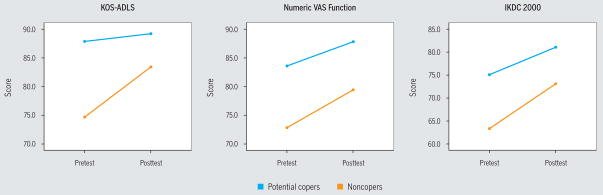
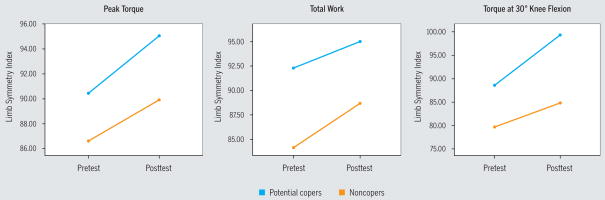
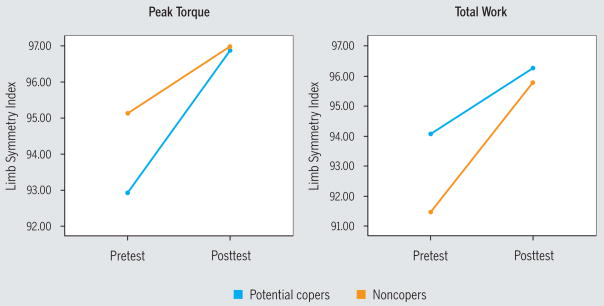
The progressive 5-week exercise therapy program led to significant improvements (P<.05) in knee function from pretest to posttest both for patients classified as potential copers and noncopers. Standardized response mean values for changes in muscle strength and single-leg hop performance from pretest to posttest for the injured limb were moderate to strong (0.49-0.84), indicating the observed improvements to be clinically relevant. Adverse events occurred in 3.9% of the patients.
Short-term progressive exercise therapy programs are well tolerated and should be incorporated in early-stage ACL rehabilitation, either to improve knee function before ACL reconstruction or as a first step in further nonoperative management.
Therapy, level 2b.
无对照组的前瞻性队列研究。
首先,介绍我们在前交叉韧带(ACL)损伤后早期的 5 周渐进式运动疗法方案。其次,评估 ACL 损伤患者完成该方案后的膝关节功能变化,以及将患者分为潜在适应者和非适应者时的变化,并最终检查潜在的不良事件。
关于早期 ACL 康复方案的研究很少。因此,对于伤后早期短期运动疗法方案的耐受性和效果知之甚少。
100 例患者在伤后 3 个月内纳入 5 周渐进式运动疗法方案。在方案完成前后,通过等速股四头肌和腘绳肌肌力测试、4 种单腿跳跃测试、2 种不同的自我评估问卷和膝关节功能总体评分来评估膝关节功能。采用 2 因素混合模型方差分析评估肌肉力量和单腿跳跃测试的肢体对称性指数以及患者报告问卷评分的测试前后变化。此外,在测试前后计算了受伤和未受伤肢体的肌肉力量和单腿跳跃测试的绝对值和标准化反应均值。记录 5 周期间的不良事件。
对于潜在适应者和非适应者,渐进式 5 周运动疗法方案导致膝关节功能从测试前到测试后均显著改善(P<.05)。受伤肢体从测试前到测试后肌肉力量和单腿跳跃表现的变化的标准化反应均值为中度至强(0.49-0.84),表明观察到的改善具有临床意义。3.9%的患者发生了不良事件。
短期渐进式运动疗法方案具有良好的耐受性,应纳入 ACL 康复的早期阶段,以改善 ACL 重建前的膝关节功能,或作为进一步非手术管理的第一步。
治疗,2b 级。