Key laboratory of Nutrition and Metabolism, Institute for Nutritional Sciences, Shanghai Institutes for Biological Sciences, Chinese Academy of Sciences, Shanghai, China.
J Neuroinflammation. 2010 Aug 17;7:46. doi: 10.1186/1742-2094-7-46.
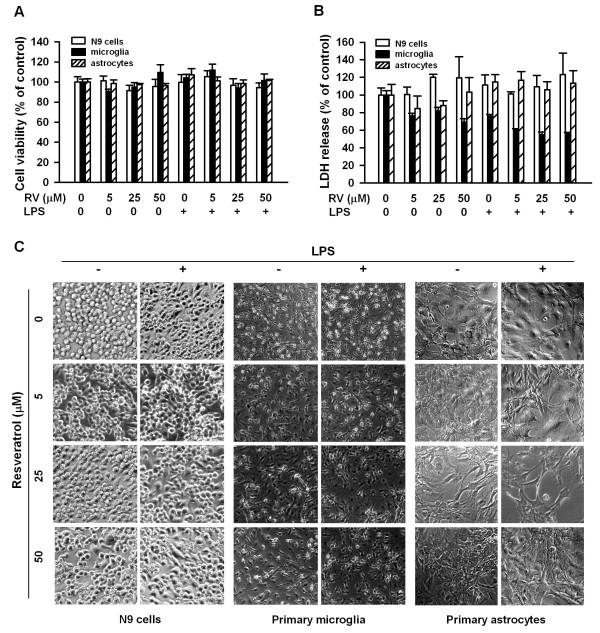
Inflammatory responses in the CNS mediated by activated glial cells play an important role in host-defense but are also involved in the development of neurodegenerative diseases. Resveratrol is a natural polyphenolic compound that has cardioprotective, anticancer and anti-inflammatory properties. We investigated the capacity of resveratrol to protect microglia and astrocyte from inflammatory insults and explored mechanisms underlying different inhibitory effects of resveratrol on microglia and astrocytes.
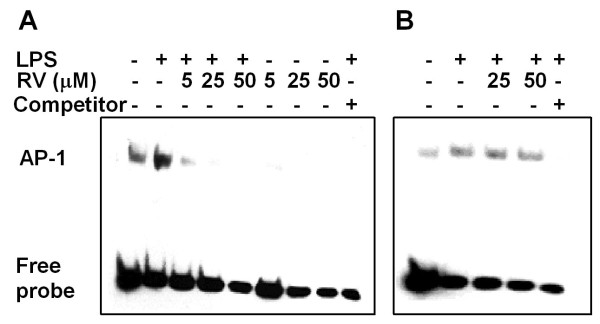
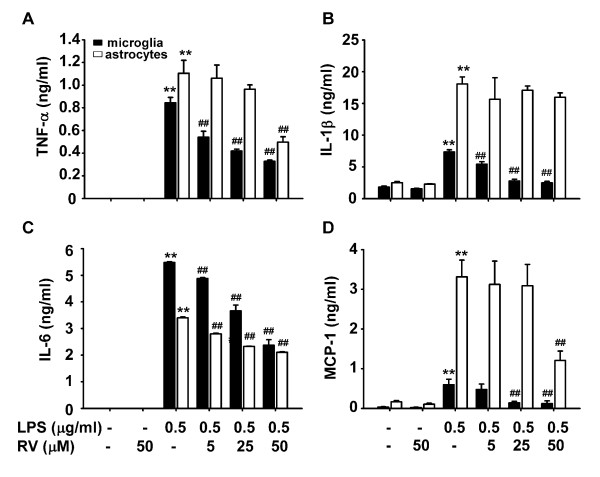
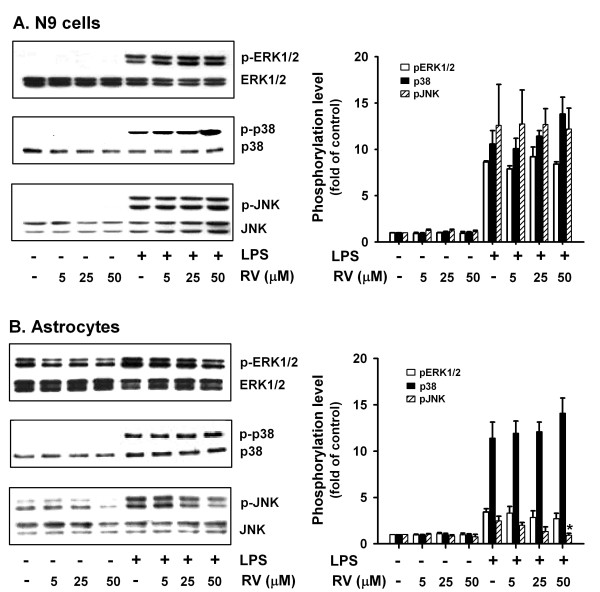
A murine microglia cell line (N9), primary microglia, or astrocytes were stimulated by LPS with or without different concentrations of resveratrol. The expression and release of proinflammatory cytokines (TNF-alpha, IL-1beta, IL-6, MCP-1) and iNOS/NO by the cells were measured by PCR/real-time PCR and ELISA, respectively. The phosphorylation of the MAP kinase superfamily was analyzed by western blotting, and activation of NF-kappaB and AP-1 was measured by luciferase reporter assay and/or electrophoretic mobility shift assay.
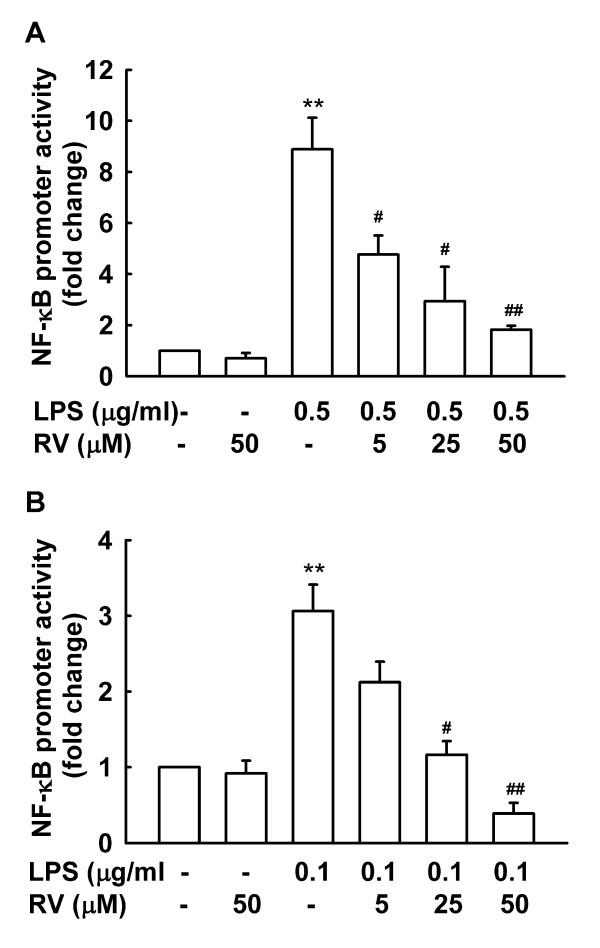
We found that LPS stimulated the expression of TNF-alpha, IL-1beta, IL-6, MCP-1 and iNOS in murine microglia and astrocytes in which MAP kinases, NF-kappaB and AP-1 were differentially involved. Resveratrol inhibited LPS-induced expression and release of TNF-alpha, IL-6, MCP-1, and iNOS/NO in both cell types with more potency in microglia, and inhibited LPS-induced expression of IL-1beta in microglia but not astrocytes. Resveratrol had no effect on LPS-stimulated phosphorylation of ERK1/2 and p38 in microglia and astrocytes, but slightly inhibited LPS-stimulated phosphorylation of JNK in astrocytes. Resveratrol inhibited LPS-induced NF-kappaB activation in both cell types, but inhibited AP-1 activation only in microglia.
These results suggest that murine microglia and astrocytes produce proinflammatory cytokines and NO in response to LPS in a similar pattern with some differences in signaling molecules involved, and further suggest that resveratrol exerts anti-inflammatory effects in microglia and astrocytes by inhibiting different proinflammatory cytokines and key signaling molecules.
中枢神经系统中被激活的神经胶质细胞介导的炎症反应在宿主防御中发挥着重要作用,但也参与了神经退行性疾病的发生。白藜芦醇是一种天然多酚化合物,具有心脏保护、抗癌和抗炎特性。我们研究了白藜芦醇保护小胶质细胞和星形胶质细胞免受炎症侵袭的能力,并探讨了白藜芦醇对小胶质细胞和星形胶质细胞产生不同抑制作用的机制。
用 LPS 刺激鼠小胶质细胞系(N9)、原代小胶质细胞或星形胶质细胞,并用不同浓度的白藜芦醇处理。通过 PCR/实时 PCR 和 ELISA 分别测量细胞中促炎细胞因子(TNF-α、IL-1β、IL-6、MCP-1)和 iNOS/NO 的表达和释放。通过 Western blot 分析 MAP 激酶超家族的磷酸化,通过荧光素酶报告基因测定和/或电泳迁移率变动分析测量 NF-κB 和 AP-1 的激活。
我们发现 LPS 刺激鼠小胶质细胞和星形胶质细胞中 TNF-α、IL-1β、IL-6、MCP-1 和 iNOS 的表达,其中 MAP 激酶、NF-κB 和 AP-1 不同程度地参与其中。白藜芦醇抑制 LPS 诱导的两种细胞类型中 TNF-α、IL-6、MCP-1 和 iNOS/NO 的表达和释放,在小胶质细胞中更有效,并抑制 LPS 诱导的小胶质细胞中但不星形胶质细胞中 IL-1β的表达。白藜芦醇对 LPS 刺激的 ERK1/2 和 p38 在小胶质细胞和星形胶质细胞中的磷酸化没有影响,但轻度抑制 LPS 刺激的 JNK 在星形胶质细胞中的磷酸化。白藜芦醇抑制两种细胞类型中 LPS 诱导的 NF-κB 激活,但仅抑制小胶质细胞中 AP-1 的激活。
这些结果表明,鼠小胶质细胞和星形胶质细胞以类似的模式对 LPS 产生促炎细胞因子和 NO,但涉及的信号分子存在一些差异,进一步表明白藜芦醇通过抑制不同的促炎细胞因子和关键信号分子在小胶质细胞和星形胶质细胞中发挥抗炎作用。