Institute for Oral and Musculoskeletal Biology, Department of Dermatology, Center for Biochemistry, Center for Molecular Medicine Cologne, Medical Faculty, University of Cologne, 50931 Cologne, Germany.
Breast Cancer Res Treat. 2011 Jul;128(2):337-46. doi: 10.1007/s10549-010-1085-7. Epub 2010 Aug 17.
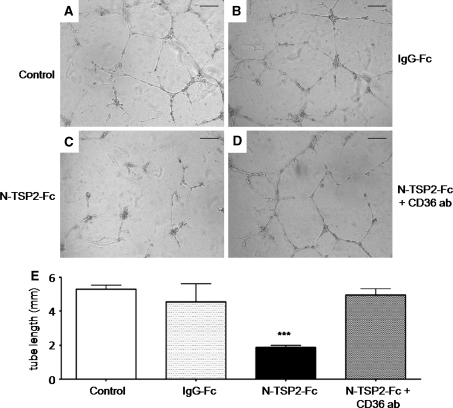
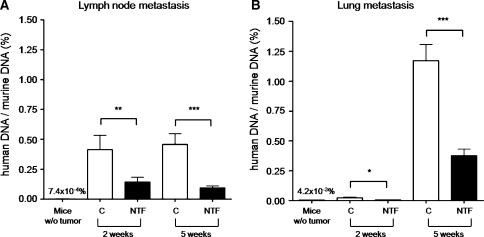
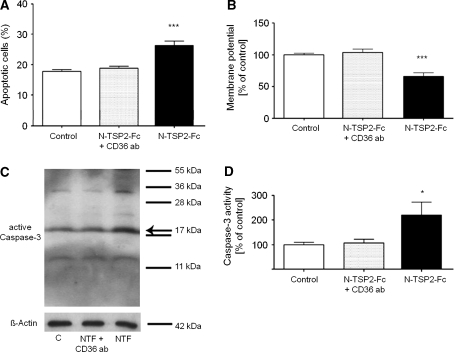
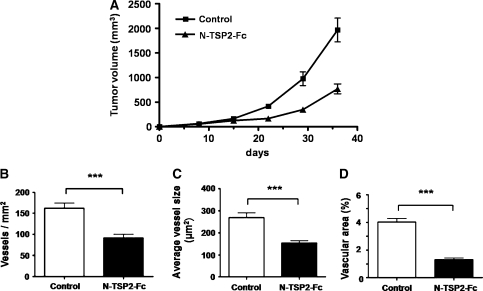
Thus far the clinical benefits seen in breast cancer patients treated with drugs targeting the vascular endothelial growth factor (VEGF) pathway are only modest. Consequently, additional antiangiogenic approaches for treatment of breast cancer need to be investigated. Thrombospondin-2 (TSP-2) has been shown to inhibit tumor growth and angiogenesis with a greater potency than the related molecule TSP-1. The systemic effects of TSP-2 on tumor metastasis and the underlying molecular mechanisms of the antiangiogenic activity of TSP-2 have remained poorly understood. We generated a recombinant fusion protein consisting of the N-terminal region of TSP-2 and the IgG-Fc1 fragment (N-TSP2-Fc) and could demonstrate that the antiangiogenic activity of N-TSP2-Fc is dependent on the CD36 receptor. We found that N-TSP2-Fc inhibited VEGF-induced tube formation of human dermal microvascular endothelial cells (HDMEC) on matrigel in vitro and that concurrent incubation of anti-CD36 antibody with N-TSP2-Fc resulted in tube formation that was comparable to untreated control. N-TSP2-Fc potently induced apoptosis of HDMEC in vitro in a CD36-dependent manner. Moreover, we could demonstrate a CD36 receptor-mediated loss of mitochondrial membrane potential and activation of caspase-3 in HDMEC in vitro. Daily intraperitoneal injections of N-TSP2-Fc resulted in a significant inhibition of the growth of human MDA-MB-435 and MDA-MB-231 tumor cells grown in the mammary gland of immunodeficient nude mice and in reduced tumor vascularization. Finally, increased serum concentrations of N-TSP2-Fc significantly inhibited regional metastasis to lymph nodes and distant metastasis to lung as shown by quantitative real-time alu PCR. These results identify N-TSP2-Fc as a potent systemic inhibitor of tumor metastasis and provide strong evidence for an important role of the CD36 receptor in mediating the antiangiogenic activity of TSP-2.
迄今为止,针对血管内皮生长因子(VEGF)途径的药物治疗乳腺癌患者所观察到的临床益处仅为适度。因此,需要研究其他用于治疗乳腺癌的抗血管生成方法。 血小板反应蛋白-2(TSP-2)已被证明比相关分子 TSP-1 更有效地抑制肿瘤生长和血管生成。 TSP-2 对肿瘤转移的全身影响以及 TSP-2 抗血管生成活性的潜在分子机制仍知之甚少。 我们生成了一种由 TSP-2 的 N 端区域和 IgG-Fc1 片段组成的重组融合蛋白(N-TSP2-Fc),并能够证明 N-TSP2-Fc 的抗血管生成活性依赖于 CD36 受体。 我们发现 N-TSP2-Fc 在体外抑制 VEGF 诱导的人真皮微血管内皮细胞(HDMEC)在 Matrigel 上的管状形成,并且在与 N-TSP2-Fc 同时孵育抗 CD36 抗体的情况下,管形成与未处理的对照相当。 N-TSP2-Fc 在体外以 CD36 依赖性方式强烈诱导 HDMEC 的细胞凋亡。 此外,我们可以证明在体外 CD36 受体介导的线粒体膜电位丧失和 caspase-3 的激活。 每天腹腔内注射 N-TSP2-Fc 导致免疫缺陷裸鼠乳腺中生长的人 MDA-MB-435 和 MDA-MB-231 肿瘤细胞的生长显著抑制,并且肿瘤血管生成减少。 最后,通过定量实时 alu PCR 显示,血清中 N-TSP2-Fc 浓度的增加显著抑制了淋巴结的局部转移和肺的远处转移。 这些结果将 N-TSP2-Fc 鉴定为肿瘤转移的有效系统性抑制剂,并为 CD36 受体在介导 TSP-2 的抗血管生成活性中起重要作用提供了有力证据。