Shemyakin-Ovchinnikov Institute of Bioorganic Chemistry, Moscow, Russia.
BMC Biotechnol. 2010 Aug 17;10:58. doi: 10.1186/1472-6750-10-58.
Tissue specific promoters may be utilized for a variety of applications, including programmed gene expression in cell types, tissues and organs of interest, for developing different cell culture models or for use in gene therapy. We report a novel, tissue-specific promoter that was identified and engineered from the native upstream regulatory region of the human gene NDUFV1 containing an endogenous retroviral sequence.
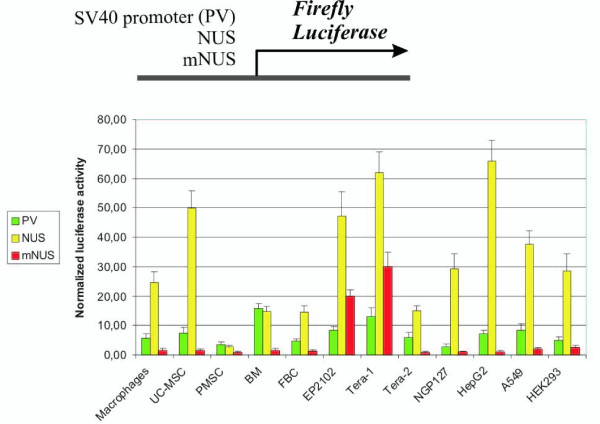
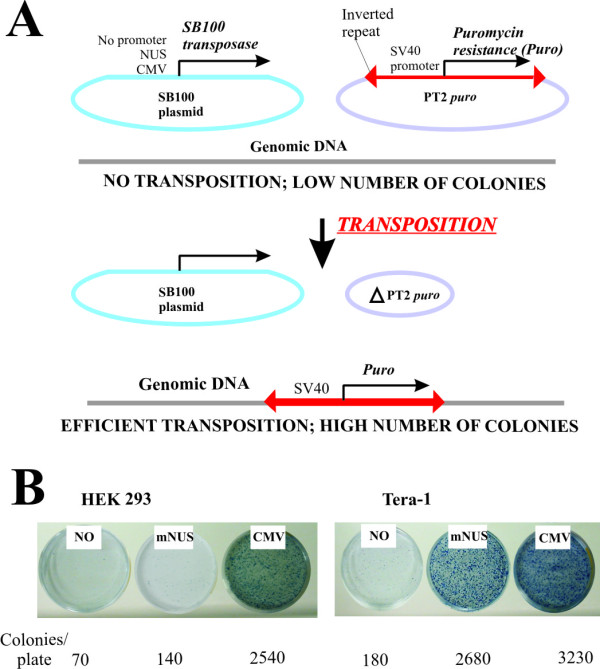
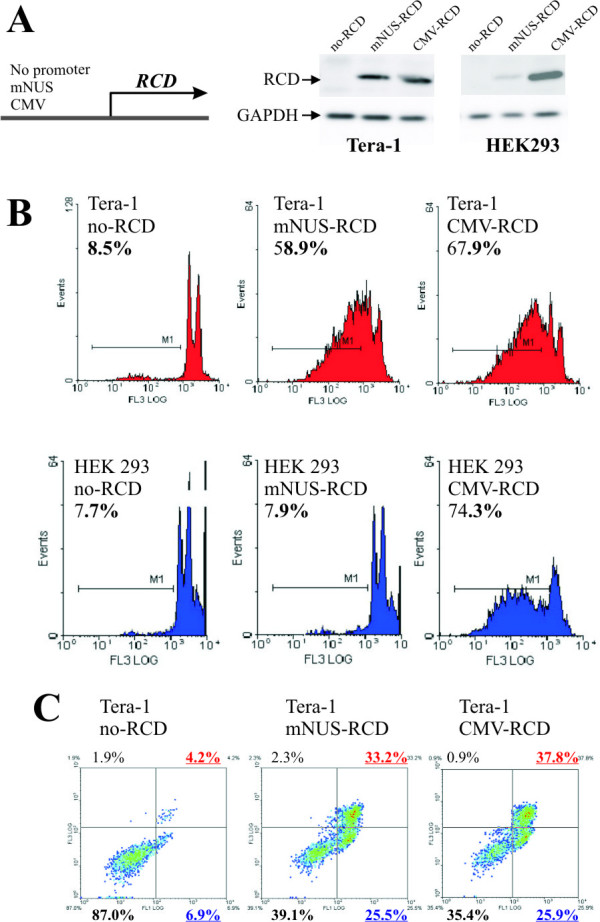
Among seven established human cell lines and five primary cultures, this modified NDUFV1 upstream sequence (mNUS) was active only in human undifferentiated germ-derived cells (lines Tera-1 and EP2102), where it demonstrated high promoter activity (approximately twice greater than that of the SV40 early promoter, and comparable to the routinely used cytomegaloviral promoter). To investigate the potential applicability of the mNUS promoter for biotechnological needs, a construct carrying a recombinant cytosine deaminase (RCD) suicide gene under the control of mNUS was tested in cell lines of different tissue origin. High cytotoxic effect of RCD with a cell-death rate approximately 60% was observed only in germ-derived cells (Tera-1), whereas no effect was seen in a somatic, kidney-derived control cell line (HEK293). In further experiments, we tested mNUS-driven expression of a hyperactive Sleeping Beauty transposase (SB100X). The mNUS-SB100X construct mediated stable transgene insertions exclusively in germ-derived cells, thereby providing further evidence of tissue-specificity of the mNUS promoter.
We conclude that mNUS may be used as an efficient promoter for tissue-specific gene expression in human germ-derived cells in many applications. Our data also suggest that the 91 bp-long sequence located exactly upstream NDUFV1 transcriptional start site plays a crucial role in the activity of this gene promoter in vitro in the majority of tested cell types (10/12), and an important role--in the rest two cell lines.
组织特异性启动子可用于多种应用,包括在感兴趣的细胞类型、组织和器官中进行程序性基因表达,用于开发不同的细胞培养模型或用于基因治疗。我们报告了一种新的组织特异性启动子,它是从含有内源性逆转录病毒序列的人 NDUFV1 基因的天然上游调控区中鉴定和构建的。
在七种已建立的人类细胞系和五种原代培养物中,这种修饰的 NDUFV1 上游序列(mNUS)仅在人类未分化的生殖来源细胞(Tera-1 和 EP2102 细胞系)中具有活性,其启动子活性很高(大约是 SV40 早期启动子的两倍,与常规使用的巨细胞病毒启动子相当)。为了研究 mNUS 启动子在生物技术需求方面的潜在适用性,我们在不同组织来源的细胞系中测试了携带重组胞嘧啶脱氨酶(RCD)自杀基因的构建体。仅在生殖来源的细胞(Tera-1)中观察到 RCD 的高细胞毒性作用,细胞死亡率约为 60%,而在体细胞、肾脏来源的对照细胞系(HEK293)中未见作用。在进一步的实验中,我们测试了 mNUS 驱动的 hyperactive Sleeping Beauty 转座酶(SB100X)的表达。mNUS-SB100X 构建体仅在生殖来源的细胞中介导稳定的转基因插入,从而进一步证明了 mNUS 启动子的组织特异性。
我们得出结论,mNUS 可用于在许多应用中在人类生殖来源细胞中进行组织特异性基因表达。我们的数据还表明,位于 NDUFV1 转录起始位点上游的确切位置的 91bp 长序列在体外测试的 12 种细胞类型中的 10/12 中发挥着关键作用,并且在其余两种细胞系中也起着重要作用。