Department of Psychology, University of Pittsburgh, Pittsburgh, PA 15213, USA.
Psychophysiology. 2011 Apr;48(4):488-94. doi: 10.1111/j.1469-8986.2010.01086.x. Epub 2010 Aug 16.
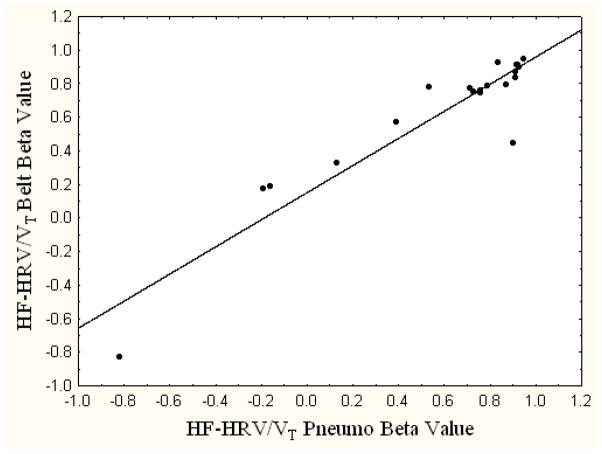
Researchers are interested in respiratory sinus arrhythmia (RSA) as an index of cardiac vagal activity. Yet, debate exists about how to account for respiratory influences on quantitative indices of RSA. T. Ritz, M. Thons, and B. Dahme (2001) developed a within-individual correction procedure by which the effects of respiration on RSA may be estimated using regression models. We replicated their procedure substituting a spectral high-frequency measure of RSA for a time-domain statistic and a respiratory belt's relative measure of tidal volume for the direct assessment provided by a pneumotachograph. The standardized slopes from the respiratory belt and pneumotachography-derived regression equations (estimated across a 6-min paced breathing protocol) were positively correlated (r=0.93, p<.001); correlations were similar across 2- and 4-min time courses parsed from the 6-min protocol. Our results offer methodological alternatives to the research community.
研究人员对呼吸窦性心律失常(RSA)作为心脏迷走神经活动的指标很感兴趣。然而,对于如何解释呼吸对 RSA 定量指标的影响,仍存在争议。T. Ritz、M. Thons 和 B. Dahme(2001 年)开发了一种个体内校正程序,通过该程序可以使用回归模型来估计呼吸对 RSA 的影响。我们复制了他们的程序,用 RSA 的频谱高频测量值代替时域统计量,用呼吸带的潮气量相对测量值代替呼吸量计提供的直接评估。从呼吸带和呼吸量计衍生的回归方程得出的标准化斜率呈正相关(r=0.93,p<.001);在从 6 分钟方案中解析的 2 分钟和 4 分钟时间过程中,相关性相似。我们的结果为研究界提供了方法上的选择。