Tampellini Davide, Gouras Gunnar K
Department of Neurology and Neuroscience, Weill Cornell Medical College New York, NY, USA.
Front Aging Neurosci. 2010 May 21;2. doi: 10.3389/fnagi.2010.00013. eCollection 2010.
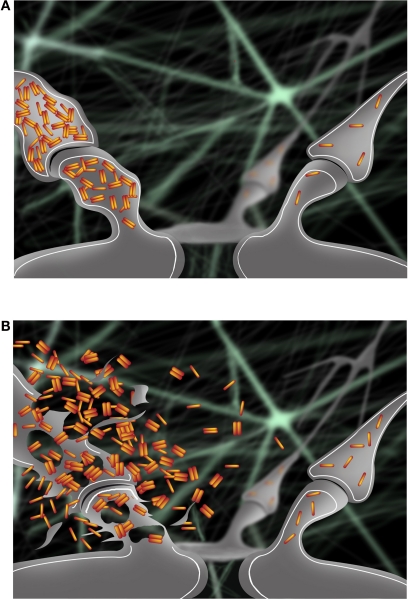
beta-Amyloid peptide accumulation plays a central role in the pathogenesis of Alzheimer's disease. Aberrant beta-amyloid buildup in the brain has been shown to be present both in the extracellular space and within neurons. Synapses are important targets of beta-amyloid, and alterations in synapses better correlate with cognitive impairment than amyloid plaques or neurofibrillary tangles. The link between beta-amyloid and synapses became even tighter when it was discovered that beta-amyloid accumulates within synapses and that synaptic activity modulates beta-amyloid secretion. Currently, a central question in Alzheimer's disease research is what role synaptic activity plays in the disease process, and how specifically beta-amyloid is involved in the synaptic dysfunction that characterizes the disease.
β-淀粉样肽的积累在阿尔茨海默病的发病机制中起着核心作用。大脑中异常的β-淀粉样蛋白积累已被证明存在于细胞外空间和神经元内。突触是β-淀粉样蛋白的重要靶点,与认知障碍的相关性比淀粉样斑块或神经原纤维缠结更好。当发现β-淀粉样蛋白在突触内积累且突触活动调节β-淀粉样蛋白分泌时,β-淀粉样蛋白与突触之间的联系变得更加紧密。目前,阿尔茨海默病研究中的一个核心问题是突触活动在疾病过程中起什么作用,以及β-淀粉样蛋白如何具体参与到该疾病特征性的突触功能障碍中。