Randall Division of Cell and Molecular Biophysics, King's College London, London, England, UK.
J Cell Biol. 2010 Aug 23;190(4):553-63. doi: 10.1083/jcb.201002067.
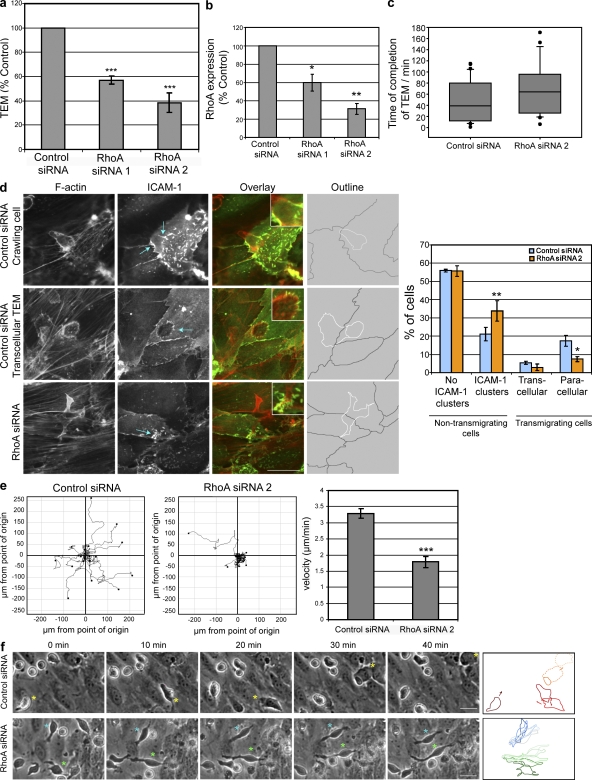
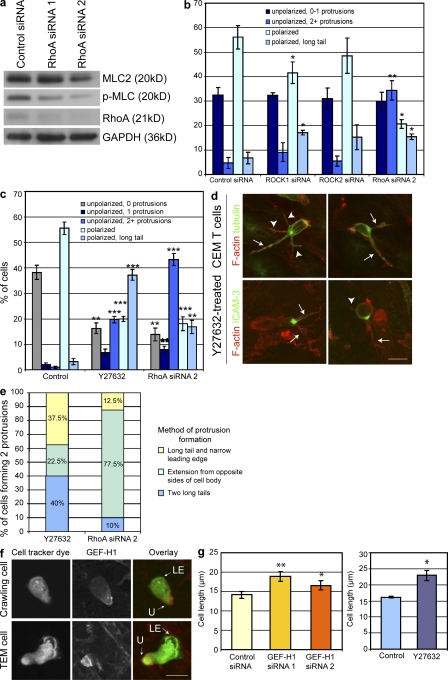
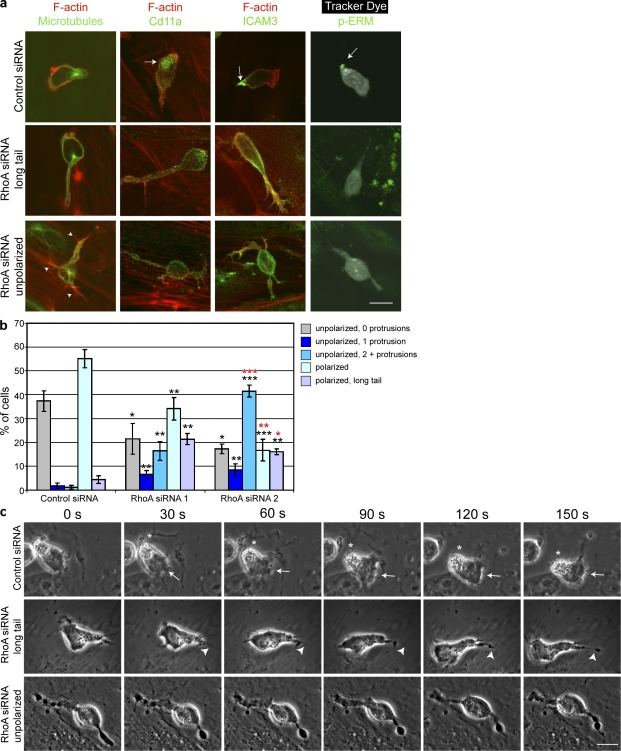
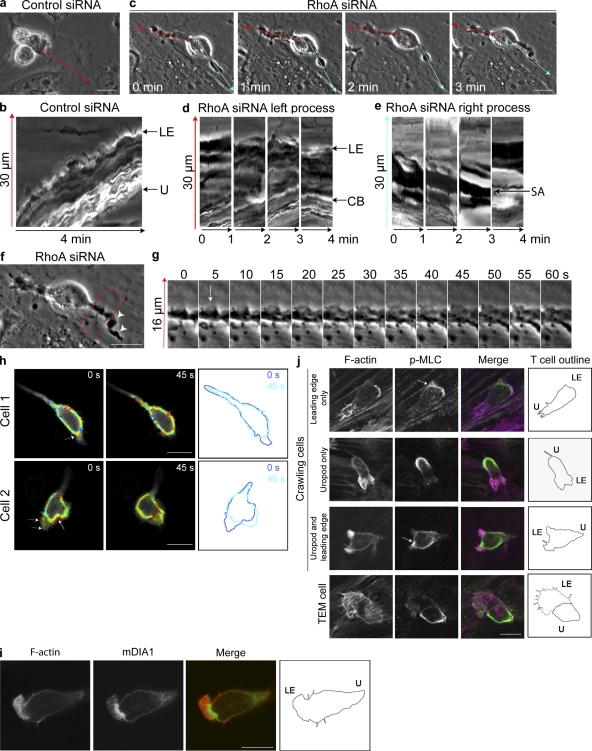
Transendothelial migration (TEM) is a tightly regulated process whereby leukocytes migrate from the vasculature into tissues. Rho guanosine triphosphatases (GTPases) are implicated in TEM, but the contributions of individual Rho family members are not known. In this study, we use an RNA interference screen to identify which Rho GTPases affect T cell TEM and demonstrate that RhoA is critical for this process. RhoA depletion leads to loss of migratory polarity; cells lack both leading edge and uropod structures and, instead, have stable narrow protrusions with delocalized protrusions and contractions. By imaging a RhoA activity biosensor in transmigrating T cells, we find that RhoA is locally and dynamically activated at the leading edge, where its activation precedes both extension and retraction events, and in the uropod, where it is associated with ROCK-mediated contraction. The Rho guanine nucleotide exchange factor (GEF) GEF-H1 contributes to uropod contraction but does not affect the leading edge. Our data indicate that RhoA activity is dynamically regulated at the front and back of T cells to coordinate TEM.
细胞跨内皮迁移(TEM)是一个严格调控的过程,在此过程中白细胞从血管迁移到组织中。Rho 鸟苷三磷酸酶(GTPases)与 TEM 有关,但单个 Rho 家族成员的贡献尚不清楚。在这项研究中,我们使用 RNA 干扰筛选来确定哪些 Rho GTPases 影响 T 细胞 TEM,并证明 RhoA 对这一过程至关重要。RhoA 耗竭导致迁移极性丧失;细胞既没有前缘也没有后足结构,而是具有稳定的狭窄突起,突起和收缩不均匀。通过对穿越的 T 细胞中的 RhoA 活性生物传感器进行成像,我们发现 RhoA 在前沿局部和动态激活,其激活先于延伸和回缩事件,在后足中,它与 ROCK 介导的收缩有关。Rho 鸟苷核苷酸交换因子(GEF)GEF-H1 有助于后足收缩,但不影响前缘。我们的数据表明,RhoA 活性在 T 细胞的前后部被动态调节,以协调 TEM。