Youn Chang Shik, Shin Ju Hyun, Na Yong Gil
Department of Urology, School of Medicine, Chungnam National University, Daejeon, Korea.
Korean J Urol. 2010 Aug;51(8):544-9. doi: 10.4111/kju.2010.51.8.544. Epub 2010 Aug 18.
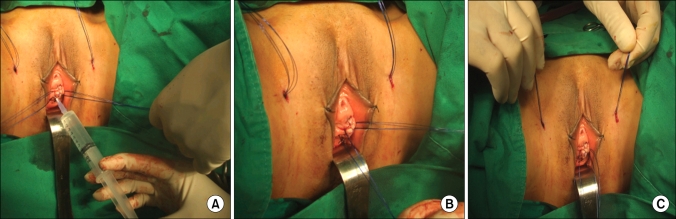
The transobturator adjustable tape (TOA) sling operation is a new procedure that allows for the adjustment of tension after surgical intervention, thus permitting correction of postoperative incontinence or obstruction. The aim of this study was to compare the efficacy and safety of TOA with that of the transobturator tape (TOT) procedure.
Between 2008 and 2009, women with stress urinary incontinence (SUI) underwent TOT (n=63) or TOA (n=40). The preoperative evaluation included history taking, physical examination, voiding diary, stress and 1-hour pad tests, and a comprehensive urodynamic examination. Postoperative evaluation was performed at the 1-week and 3-month postoperative follow-up visits.
The overall cure rate was 90.0% for the TOA group and 85.7% for the TOT group. The rate of satisfaction was higher in the TOA group than in the TOT group (95.0% vs. 85.6%). Four patients in the TOA group needed reduced tension as the result of urinary obstruction. The tension of the mesh was tightened in 1 patient because of a certain degree of continuing incontinence. The residual urine volume was significantly lower in the TOA group than in the TOT group (7.8 ml vs. 43 ml, p=0.01).
TOA allowed postoperative readjustment for a number of days after surgical intervention, which allowed for good short-term treatment outcomes. These data suggest that better subjective and objective results and residual urine volume can be obtained in the TOA group than those achieved with the traditional non-adjustable mesh and without significant postoperative complications.
经闭孔可调节吊带(TOA)手术是一种新的手术方法,可在手术干预后调节张力,从而纠正术后尿失禁或梗阻。本研究的目的是比较TOA与经闭孔吊带(TOT)手术的疗效和安全性。
2008年至2009年期间,压力性尿失禁(SUI)女性患者接受了TOT手术(n = 63)或TOA手术(n = 40)。术前评估包括病史采集、体格检查、排尿日记、压力试验和1小时尿垫试验,以及全面的尿动力学检查。术后评估在术后1周和3个月的随访中进行。
TOA组的总体治愈率为90.0%,TOT组为85.7%。TOA组的满意度高于TOT组(95.0%对85.6%)。TOA组有4例患者因尿路梗阻需要降低张力。1例患者因仍有一定程度的尿失禁而收紧了网片的张力。TOA组的残余尿量明显低于TOT组(7.8 ml对43 ml,p = 0.01)。
TOA允许在手术干预后的数天内进行术后重新调整,从而获得良好的短期治疗效果。这些数据表明,与传统的不可调节网片相比,TOA组能获得更好的主观和客观结果以及残余尿量,且术后无明显并发症。