Department of Psychology, The University of British Columbia, Vancouver, British Columbia, Canada.
Horm Behav. 2010 Nov;58(5):835-43. doi: 10.1016/j.yhbeh.2010.08.007. Epub 2010 Aug 22.
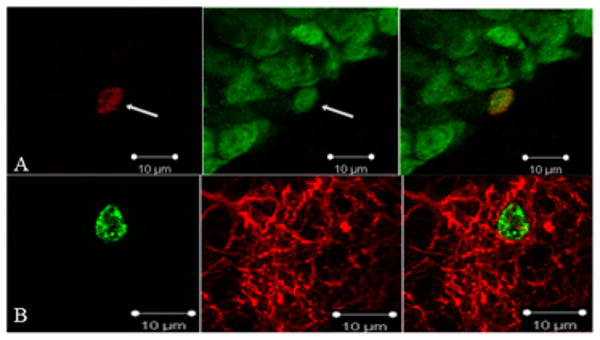
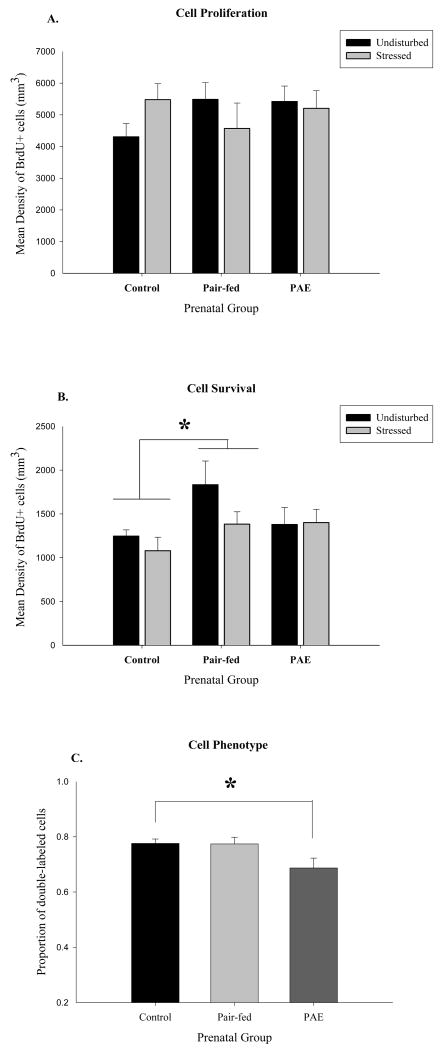
Prenatal alcohol exposure (PAE) alters adult neurogenesis and the neurogenic response to stress in male rats. As the effects of stress on neurogenesis are sexually dimorphic, the present study investigated the effects of PAE on adult hippocampal neurogenesis under both nonstressed and stressed conditions in female rats. Pregnant females were assigned to one of three prenatal treatments: (1) alcohol (PAE)-liquid alcohol (ethanol) diet ad libitum (36% ethanol-derived calories); (2) pair-fed-isocaloric liquid diet, with maltose-dextrin substituted for ethanol, in the amount consumed by a PAE partner (g/kg body wt/day of gestation); and (3) control-lab chow ad libitum. Female offspring were assigned to either nonstressed (undisturbed) or stressed (repeated restraint stress for 9 days) conditions. On day 10, all rats were injected with bromodeoxyuridine (BrdU) and perfused either 24 hours (cell proliferation) or 3 weeks (cell survival) later. We found that PAE did not significantly alter cell proliferation or survival, whereas females from the pair-fed condition exhibited elevated levels of cell survival compared to control females. Importantly, however, the proportion of both new neurons and new glial cells in the hippocampal dentate gyrus was reduced in PAE compared to control females. Exposure to stress did not alter neurogenesis in any of the prenatal treatment groups. In summary, compared to females from the control condition, prenatal dietary restriction enhanced the survival of new neurons, whereas PAE altered the differentiation of newly produced cells in the adult dentate gyrus. Alterations in hippocampal neurogenesis following PAE may contribute to learning and memory deficits seen in individuals with fetal alcohol spectrum disorders.
产前酒精暴露 (PAE) 改变雄性大鼠的成年神经发生和神经发生对压力的反应。由于压力对神经发生的影响存在性别二态性,因此本研究在雌性大鼠中研究了 PAE 在非应激和应激条件下对成年海马神经发生的影响。将怀孕的雌性动物分为三种产前处理之一:(1)酒精 (PAE)-自由摄取含酒精 (乙醇) 的液体饮食 (36% 来自乙醇的卡路里);(2) 配对喂养-用麦芽糖糊精替代乙醇,数量与 PAE 伴侣消耗的量相同 (妊娠期间每克体重/天);和 (3) 对照-实验室饲料自由摄取。雌性后代被分配到非应激 (未受干扰) 或应激 (重复束缚应激 9 天) 条件下。在第 10 天,所有大鼠均注射溴脱氧尿苷 (BrdU),并在 24 小时 (细胞增殖) 或 3 周 (细胞存活) 后灌注。我们发现,PAE 并没有显著改变细胞增殖或存活,而来自配对喂养条件的雌性动物的细胞存活水平比对照雌性动物高。然而,重要的是,与对照雌性动物相比,PAE 组的海马齿状回中新神经元和新神经胶质细胞的比例降低。应激暴露没有改变任何产前处理组的神经发生。总之,与对照条件下的雌性动物相比,产前饮食限制增强了新神经元的存活,而 PAE 改变了成年齿状回中新产生细胞的分化。PAE 后海马神经发生的改变可能导致胎儿酒精谱系障碍患者的学习和记忆缺陷。