Division of Genetics, Cell and Developmental Biology, Department of Biology, University of Patras, Greece.
Mol Cancer. 2010 Aug 25;9:224. doi: 10.1186/1476-4598-9-224.
Pleiotrophin, also known as HARP (Heparin Affin Regulatory Peptide) is a growth factor expressed in various tissues and cell lines. Pleiotrophin participates in multiple biological actions including the induction of cellular proliferation, migration and angiogenesis, and is involved in carcinogenesis. Recently, we identified and characterized several pleiotrophin proteolytic fragments with biological activities similar or opposite to that of pleiotrophin. Here, we investigated the biological actions of P(122-131), a synthetic peptide corresponding to the carboxy terminal region of this growth factor.
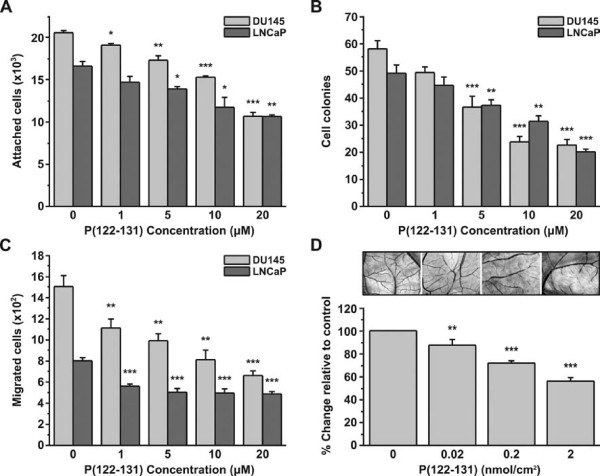
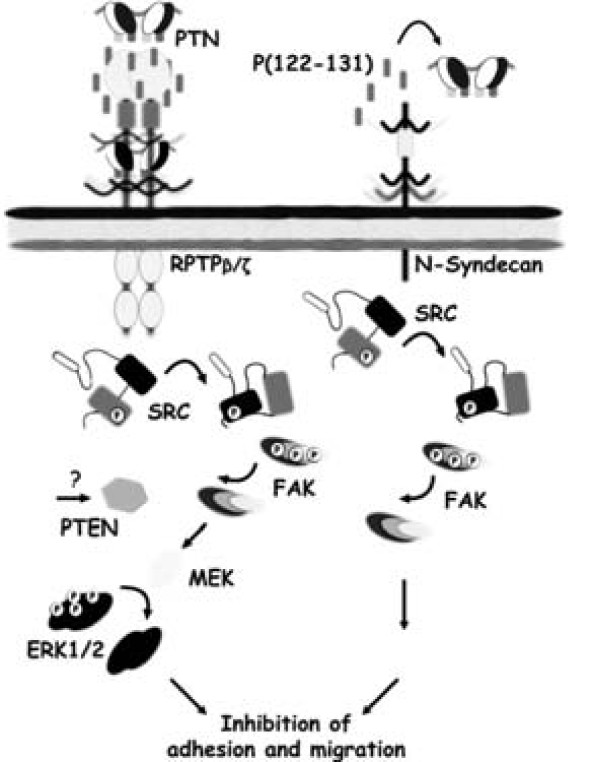
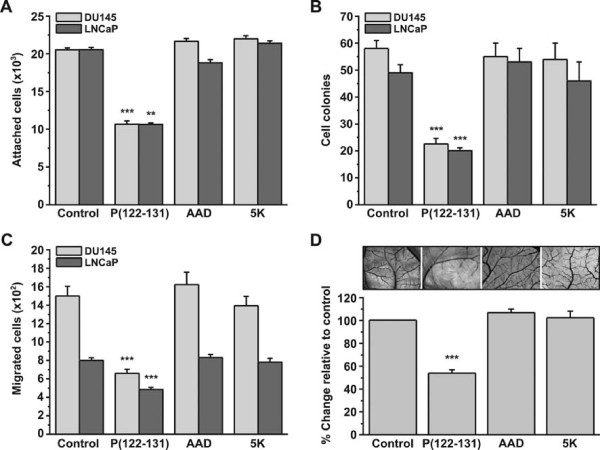
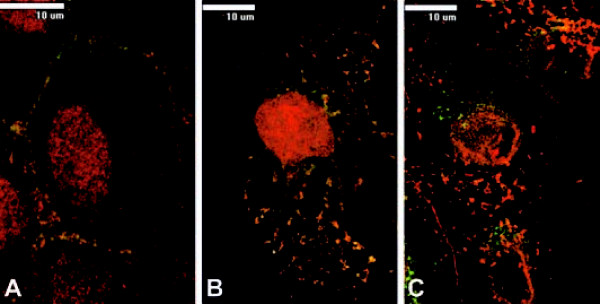
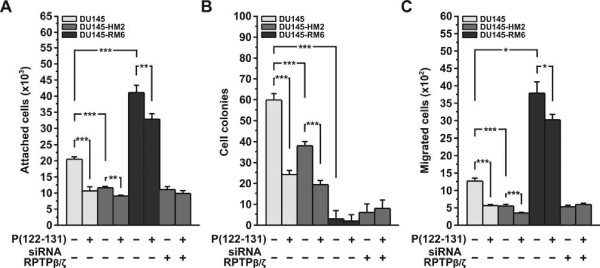
Our results show that P(122-131) inhibits in vitro adhesion, anchorage-independent proliferation, and migration of DU145 and LNCaP cells, which express pleiotrophin and its receptor RPTPβ/ζ. In addition, P(122-131) inhibits angiogenesis in vivo, as determined by the chicken embryo CAM assay. Investigation of the transduction mechanisms revealed that P(122-131) reduces the phosphorylation levels of Src, Pten, Fak, and Erk1/2. Finally, P(122-131) not only interacts with RPTPβ/ζ, but also interferes with other pleiotrophin receptors, as demonstrated by selective knockdown of pleiotrophin or RPTPβ/ζ expression with the RNAi technology.
In conclusion, our results demonstrate that P(122-131) inhibits biological activities that are related to the induction of a transformed phenotype in PCa cells, by interacing with RPTPβ/ζ and interfering with other pleiotrophin receptors. Cumulatively, these results indicate that P(122-131) may be a potential anticancer agent, and they warrant further study of this peptide.
多效蛋白聚糖(也称为 HARP,即肝素结合调节肽)是一种在多种组织和细胞系中表达的生长因子。多效蛋白聚糖参与多种生物学作用,包括诱导细胞增殖、迁移和血管生成,并参与癌变。最近,我们鉴定并表征了几种具有与多效蛋白聚糖相似或相反生物学活性的多效蛋白聚糖蛋白水解片段。在这里,我们研究了对应于该生长因子羧基末端区域的合成肽 P(122-131)的生物学作用。
我们的结果表明,P(122-131)抑制表达多效蛋白聚糖及其受体 RPTPβ/ζ的 DU145 和 LNCaP 细胞的体外黏附、无锚定依赖性增殖和迁移。此外,P(122-131)通过鸡胚 CAM 测定抑制体内血管生成。对转导机制的研究表明,P(122-131)降低了Src、Pten、 Fak 和 Erk1/2 的磷酸化水平。最后,P(122-131)不仅与 RPTPβ/ζ相互作用,还与其他多效蛋白聚糖受体相互作用,如通过 RNAi 技术选择性敲低多效蛋白聚糖或 RPTPβ/ζ表达所证明的那样。
总之,我们的结果表明,P(122-131)通过与 RPTPβ/ζ相互作用并干扰其他多效蛋白聚糖受体,抑制与诱导前列腺癌细胞转化表型相关的生物学活性。总之,这些结果表明 P(122-131)可能是一种潜在的抗癌剂,值得进一步研究该肽。