Immunogenetics Laboratory, University of Turku, Turku, Finland.
Diabetes. 2010 Dec;59(12):3253-6. doi: 10.2337/db10-0167. Epub 2010 Aug 25.
Class II alleles define the main HLA effect on type 1 diabetes, but there is an independent effect of certain class I alleles. Class II and class I molecules are differently involved in the initiation and effector phases of the immune response, suggesting that class I alleles would be important determinants in the rate of β-cell destruction. To test this hypothesis we analyzed the role of HLA class I and class II gene polymorphisms in the progression from diabetes-associated autoimmunity to clinical disease.
The effect of HLA-DR-DQ haplotypes and a panel of class I HLA-A and -B alleles on the progression from autoantibody seroconversion to clinical diabetes was studied in 249 children persistently positive for at least one biochemical diabetes-associated autoantibody in addition to islet cell autoantibody.
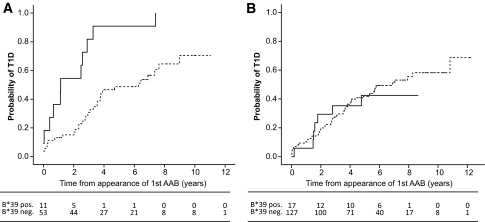
The progression to clinical disease was separately analyzed after the appearance of the first and the second persistent biochemical autoantibody using Cox regression. Multivariate analysis demonstrated a significant protective effect of the A03 allele (odds ratio [OR] 0.61, P = 0.042 after the first and OR 0.55, P = 0.027 after the second autoantibody), whereas the B39 allele had a promoting effect after seroconversion for the second autoantibody (OR 2.4, P = 0.014). When children with the DR3/DR4 genotype were separately analyzed, HLA-B39 had a strong effect (OR 6.6, P = 0.004 and OR 7.5, P = 0.007, after the appearance of the first and the second autoantibody, respectively). The protective effect of A03 was seen only among children without the DR3/DR4 combination.
These results confirm that class I alleles affect the progression of diabetes-associated autoimmunity and demonstrate interactions between class I and class II alleles.
II 类等位基因定义了 1 型糖尿病的主要 HLA 效应,但某些 I 类等位基因也具有独立的作用。II 类和 I 类分子在免疫反应的启动和效应阶段有不同的参与,这表明 I 类等位基因将是β细胞破坏率的重要决定因素。为了验证这一假设,我们分析了 HLA I 类和 II 类基因多态性在从糖尿病相关自身免疫到临床疾病进展中的作用。
在 249 名除胰岛细胞自身抗体外,至少有一种生化糖尿病相关自身抗体持续阳性的儿童中,分析了 HLA-DR-DQ 单倍型以及一组 I 类 HLA-A 和 -B 等位基因对从自身抗体血清转化到临床糖尿病进展的影响。
使用 Cox 回归分别分析了首次和第二次持续生化自身抗体出现后的疾病进展。多变量分析表明,A03 等位基因具有显著的保护作用(首次自身抗体后 OR 0.61,P = 0.042;第二次自身抗体后 OR 0.55,P = 0.027),而 B39 等位基因在第二次自身抗体血清转化后具有促进作用(OR 2.4,P = 0.014)。当对 DR3/DR4 基因型的儿童进行单独分析时,HLA-B39 具有很强的作用(首次和第二次自身抗体出现后 OR 分别为 6.6,P = 0.004 和 OR 7.5,P = 0.007)。A03 的保护作用仅见于没有 DR3/DR4 组合的儿童中。
这些结果证实了 I 类等位基因影响糖尿病相关自身免疫的进展,并证明了 I 类和 II 类等位基因之间的相互作用。