Department of Biology, College of Staten Island, The City University of New York, 2800 Victory Boulevard, Staten Island, NY 10314, USA.
J Biomed Sci. 2010 Aug 24;17 Suppl 1(Suppl 1):S8. doi: 10.1186/1423-0127-17-S1-S8.
The fragile X mouse model shows an increase in seizure susceptibility, indicating an involvement of the GABAergic system via an alteration in cellular excitability. In the brain, we have previously described a reduction in GABAA receptor expression as a likely basis for this susceptibility. In the brains of fragile X mice, this reduction in receptor expression culminates with a concomitant increase in the expression of glutamic acid decarboxylase (GAD), the enzyme responsible for GABA synthesis. Further, voltage-sensitive calcium channel expression is reduced in the pancreas of the fragile X mouse. Since there are considerable similarities in the GABAergic system in the brain and pancreas, we evaluated the protective role of taurine in pancreatic islet development in both wild type (WT) and fragile X mice (KO).
One-month-old FVB/NJ males or age-matched fmr1-knockout (KO) mice were supplemented with taurine in drinking water (0.05% w/v) for four weeks. Age-matched controls were fed water only for the same duration. At four weeks, mice were sacrificed and pancreases processed for histology and immunohistochemical studies on changes of insulin, glucagon and somatostatin expression. Additional mice were subjected to a glucose tolerance test.
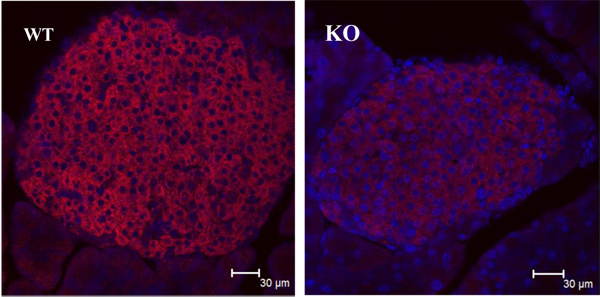
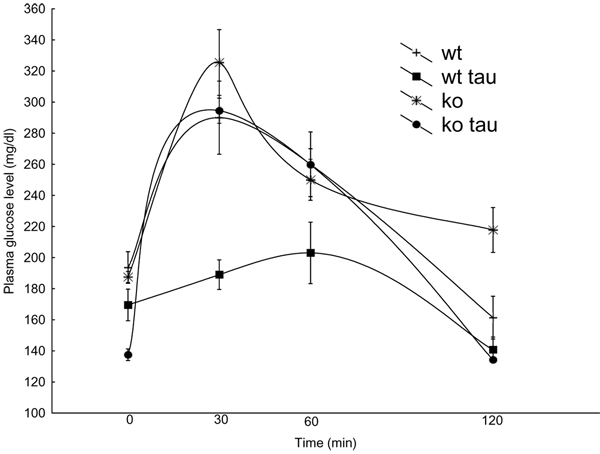
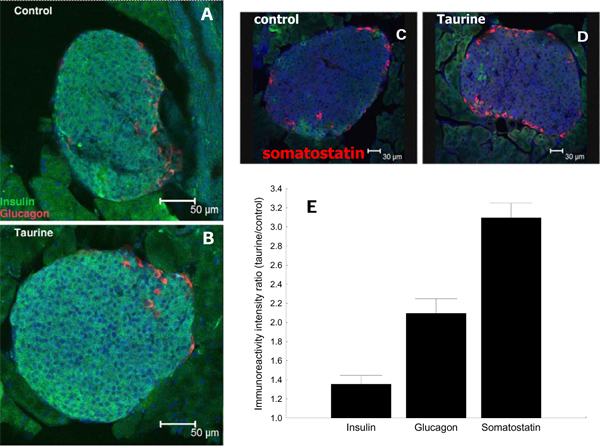
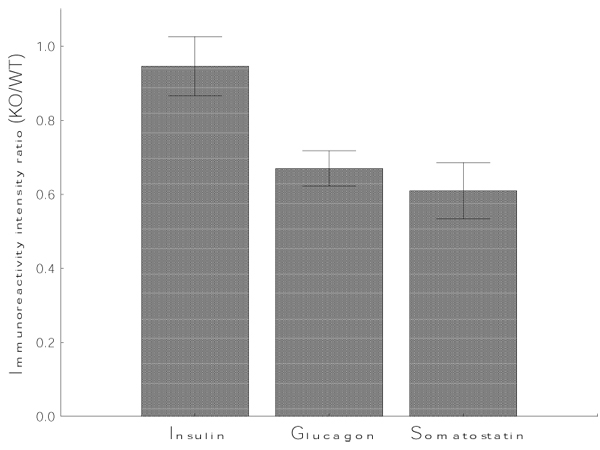
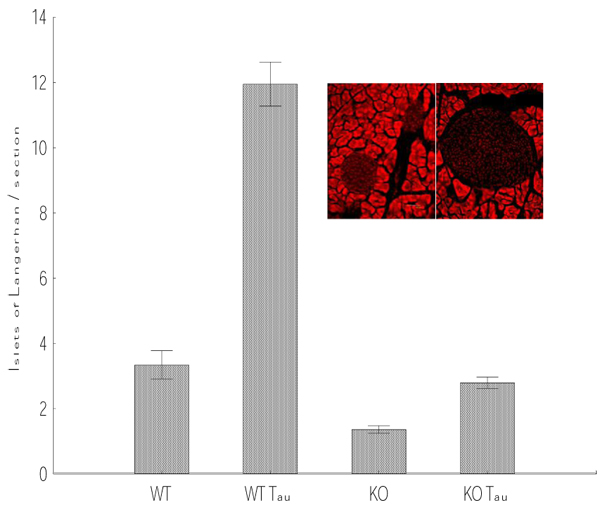
Taurine treatment resulted in a significant increase in the number and size of islets. WT taurine-fed mice, slightly hypoglycemic prior to glucose injection, showed significantly reduced plasma glucose at 30 min post-injection when compared to control mice. KO mice had normal baseline plasma glucose concentration; however, following glucose injection they had higher plasma glucose levels at 30 min when compared to controls. Supplementation of taurine to KO mice resulted in reduced baseline levels of plasma glucose. After glucose injection, the taurine-fed KO mice had reduced plasma glucose at 30 min compared to KO. Concomitant with the increased islets size and glucose tolerance observed in taurine-fed mice there was an increase in insulin, glucagon and somatostatin immunoreactivity in the islets of WT mice. In the KO mice however, insulin levels were not affected whereas glucagon and somatostatin levels were reduced. Exocytosis of these hormones is calcium-dependent, therefore any exacerbation of calcium homeostasis could affect hormone release. We found the expression of the voltage sensitive calcium channels (VSCC) is drastically reduced in the pancreas of fragile X mice.
During early development, the VSCC play an important role in calcium-dependent gene expression. Since these channels are also involved in depolarization and calcium-mediated vesicular release of neurotransmitters and pancreatic hormones, alterations in the expression of VSCC not only will affect calcium-mediated gene expression but also hormonal and neurotransmitter release creating therefore a neuroendocrine perturbation in the fragile X that may potentially affect other organ systems. We find that in the fragile X mouse, taurine treatment may partially restore functionality of the neuro-endocrine pancreas.
脆性 X 小鼠模型表现出易发性癫痫增加,表明 GABA 能系统通过细胞兴奋性的改变而参与其中。在大脑中,我们之前描述过 GABAA 受体表达减少,这可能是易感性的基础。在脆性 X 小鼠的大脑中,这种受体表达的减少最终伴随着谷氨酸脱羧酶(GAD)表达的增加,GAD 是 GABA 合成的酶。此外,脆性 X 小鼠的胰腺中电压敏感钙通道的表达减少。由于大脑和胰腺中的 GABA 能系统有相当多的相似之处,我们评估了牛磺酸在两种野生型(WT)和脆性 X 小鼠(KO)胰岛发育中的保护作用。
1 个月大的 FVB/NJ 雄性或年龄匹配的脆性 X 敲除(KO)小鼠用牛磺酸饮水(0.05%w/v)补充 4 周。同期对照组仅用水喂养相同时间。4 周后,处死小鼠,处理胰腺进行胰岛素、胰高血糖素和生长抑素表达的组织学和免疫组织化学研究。另外一些小鼠进行葡萄糖耐量试验。
牛磺酸处理导致胰岛数量和大小显著增加。WT 牛磺酸喂养的小鼠在注射葡萄糖前有轻微的低血糖,与对照组相比,在注射后 30 分钟时,血浆葡萄糖水平显著降低。KO 小鼠的基础血浆葡萄糖浓度正常;然而,注射葡萄糖后,KO 小鼠的血浆葡萄糖水平在 30 分钟时比对照组更高。KO 小鼠补充牛磺酸可降低基础血糖水平。KO 小鼠注射葡萄糖后,牛磺酸喂养的 KO 小鼠在 30 分钟时的血浆葡萄糖水平降低。在 WT 小鼠中,与观察到的胰岛增大和葡萄糖耐量增加同时发生的是胰岛素、胰高血糖素和生长抑素免疫反应性在胰岛中增加。然而,在 KO 小鼠中,胰岛素水平不受影响,而胰高血糖素和生长抑素水平降低。这些激素的胞吐作用依赖于钙,因此钙稳态的任何恶化都可能影响激素的释放。我们发现脆性 X 小鼠的胰腺中电压敏感钙通道(VSCC)的表达明显减少。
在早期发育过程中,VSCC 在钙依赖性基因表达中起着重要作用。由于这些通道还参与去极化和钙介导的神经递质和胰腺激素的囊泡释放,VSCC 表达的改变不仅会影响钙介导的基因表达,还会影响激素和神经递质的释放,从而在脆性 X 中产生神经内分泌紊乱,可能会影响其他器官系统。我们发现,在脆性 X 小鼠中,牛磺酸治疗可能部分恢复神经内分泌胰腺的功能。