CONICET-División Paleontología Vertebrados, Facultad de Ciencias Naturales y Museo, Museo de La Plata, Universidad Nacional de La Plata, La Plata, Argentina.
PLoS One. 2010 Aug 18;5(8):e11856. doi: 10.1371/journal.pone.0011856.
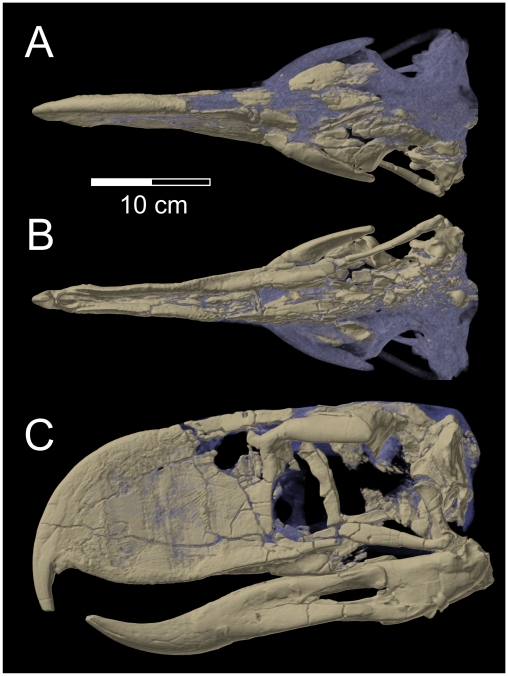
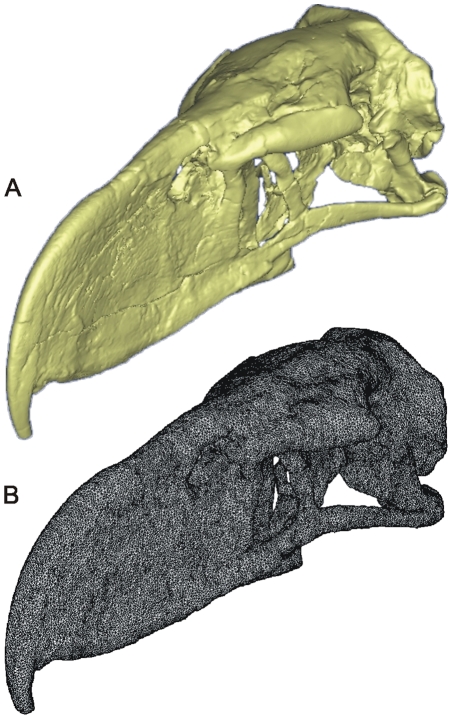
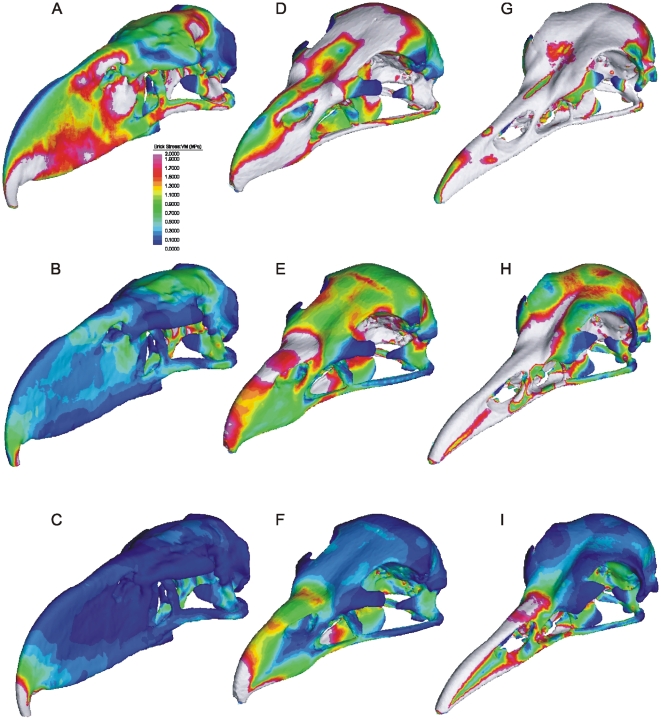
The South American phorusrhacid bird radiation comprised at least 18 species of small to gigantic terrestrial predators for which there are no close modern analogs. Here we perform functional analyses of the skull of the medium-sized (approximately 40 kg) patagornithine phorusrhacid Andalgalornis steulleti (upper Miocene-lower Pliocene, Andalgalá Formation, Catamarca, Argentina) to assess its mechanical performance in a comparative context. Based on computed tomographic (CT) scanning and morphological analysis, the skull of Andalgalornis steulleti is interpreted as showing features reflecting loss of intracranial immobility. Discrete anatomical attributes permitting such cranial kinesis are widespread phorusrhacids outgroups, but this is the first clear evidence of loss of cranial kinesis in a gruiform bird and may be among the best documented cases among all birds. This apomorphic loss is interpreted as an adaptation for enhanced craniofacial rigidity, particularly with regard to sagittal loading. We apply a Finite Element approach to a three-dimensional (3D) model of the skull. Based on regression analysis we estimate the bite force of Andalgalornis at the bill tip to be 133 N. Relative to results obtained from Finite Element Analysis of one of its closest living relatives (seriema) and a large predatory bird (eagle), the phorusrhacid's skull shows relatively high stress under lateral loadings, but low stress where force is applied dorsoventrally (sagittally) and in "pullback" simulations. Given the relative weakness of the skull mediolaterally, it seems unlikely that Andalgalornis engaged in potentially risky behaviors that involved subduing large, struggling prey with its beak. We suggest that it either consumed smaller prey that could be killed and consumed more safely (e.g., swallowed whole) or that it used multiple well-targeted sagittal strikes with the beak in a repetitive attack-and-retreat strategy.
南美恐鹤类鸟类辐射包括至少 18 种小型到巨大的陆地捕食者,它们没有现代的近亲。在这里,我们对中体型(约 40 公斤)的 patagornithine 恐鹤类 Andalgalornis steulleti(中新世晚期-上新世早期,阿根廷 Catamarca 的 Andalgalá 组)的头骨进行功能分析,以在比较的背景下评估其力学性能。基于计算机断层扫描(CT)扫描和形态分析,Andalgalornis steulleti 的头骨被解释为具有反映颅内不稳定性丧失的特征。离散的解剖特征允许这种颅腔运动的是广泛的恐鹤类外群,但这是Gruiformes 鸟类中首次明确失去颅腔运动的证据,并且可能是所有鸟类中记录最好的案例之一。这种特化的丧失被解释为增强颅面刚性的适应,特别是在矢状负荷方面。我们将有限元方法应用于头骨的三维(3D)模型。基于回归分析,我们估计 Andalgalornis 的喙尖咬合力为 133 N。与从最接近的近亲之一(Seriema)和大型掠食性鸟类(鹰)的有限元分析结果相比,恐鹤类的头骨在侧向载荷下显示出相对较高的应力,但在力沿背腹方向(矢状方向)和“拉回”模拟施加时,应力较低。鉴于头骨在中侧方向上相对较弱,Andalgalornis 不太可能从事涉及用喙制服大型、挣扎的猎物的潜在危险行为。我们认为,它要么食用更小的猎物,可以更安全地杀死和食用(例如,整个吞下),要么使用喙进行多次靶向良好的矢状打击,采用重复攻击和撤退的策略。