Karunakaran Udayakumar, Jeoung Nam Ho
Department of Medical Sciences, Kyungpook National University School of Medicine, Daegu, Korea.
Korean Diabetes J. 2010 Aug;34(4):211-9. doi: 10.4093/kdj.2010.34.4.211. Epub 2010 Aug 31.
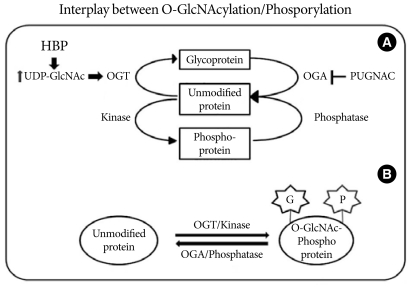
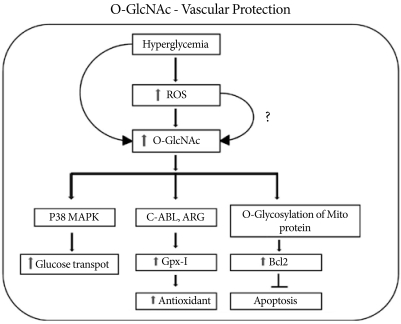
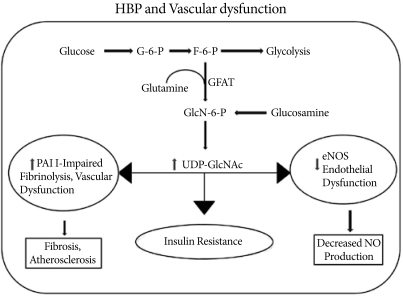
O-Linked β-N-acetyl glucosaminylation (O-GlcNAcylation) is a dynamic post-translational modification that occurs on serine and threonine residues of cytosolic and nuclear proteins in all cell types, including those involved in the cardiovascular system. O-GlcNAcylation is thought to act in a manner analogous to protein phosphorylation. O-GlcNAcylation rapidly cycles on/off proteins in a time scale similar to that for phosphorylation/dephosphorylation of proteins. Several studies indicate that O-GlcNAc might induce nuclear localization of some transcription factors and may affect their DNA binding activities. However, at the cellular level, it has been shown that O-GlcNAc levels increase in response to stress and augmentation of this response suppresses cell survival. Increased levels of O-GlcNAc have been implicated as a pathogenic contributor to glucose toxicity and insulin resistance, which are major hallmarks of type 2 diabetes and diabetes-related cardiovascular complications. Thus, O-GlcNAc and its metabolic functions are not yet well-understood; focusing on the role of O-GlcNAc in the cardiovascular system is a viable target for biomedical investigation. In this review, we summarize our current understanding of the role of O-GlcNAc on the regulation of cell function and survival in the cardiovascular system.
O-连接的β-N-乙酰葡糖胺化(O-GlcNAcylation)是一种动态的翻译后修饰,发生在所有细胞类型的胞质和核蛋白的丝氨酸和苏氨酸残基上,包括参与心血管系统的细胞。O-GlcNAcylation被认为以类似于蛋白质磷酸化的方式发挥作用。O-GlcNAcylation在与蛋白质磷酸化/去磷酸化相似的时间尺度上快速在蛋白质上循环开启/关闭。多项研究表明,O-GlcNAc可能诱导一些转录因子的核定位,并可能影响它们的DNA结合活性。然而,在细胞水平上,已经表明O-GlcNAc水平会因应激而升高,并且这种反应的增强会抑制细胞存活。O-GlcNAc水平的升高被认为是葡萄糖毒性和胰岛素抵抗的致病因素,而葡萄糖毒性和胰岛素抵抗是2型糖尿病和糖尿病相关心血管并发症的主要特征。因此,O-GlcNAc及其代谢功能尚未得到充分了解;关注O-GlcNAc在心血管系统中的作用是生物医学研究的一个可行目标。在这篇综述中,我们总结了目前对O-GlcNAc在心血管系统中调节细胞功能和存活作用的理解。