Department of Biophysics, Donders Institute for Brain, Cognition and Behaviour, Radboud University Nijmegen, Geert Grooteplein 21, 6525 EZ,, P.O. Box 9101,, 6500 HB, Nijmegen, The Netherlands.
J Assoc Res Otolaryngol. 2011 Feb;12(1):1-11. doi: 10.1007/s10162-010-0235-2. Epub 2010 Sep 14.
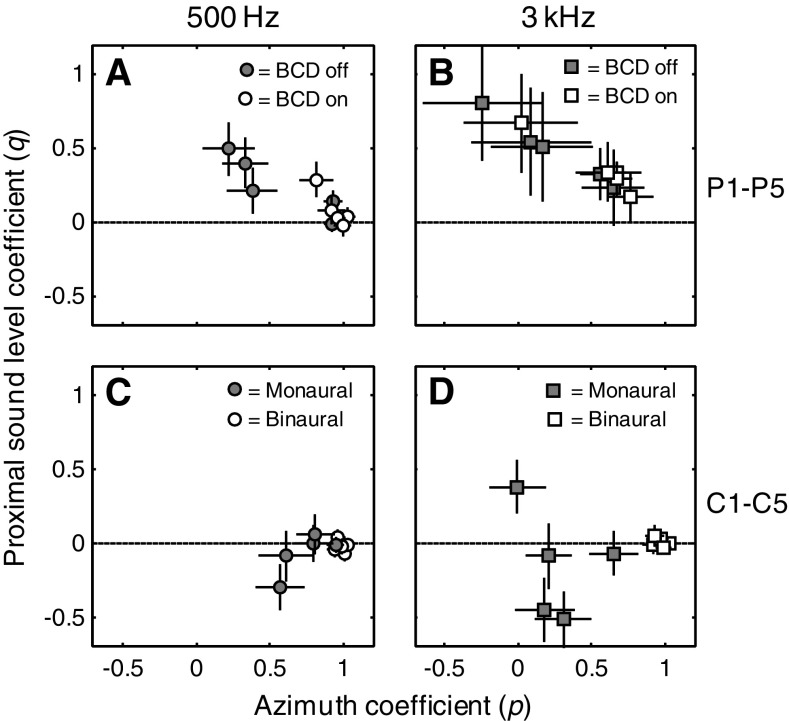
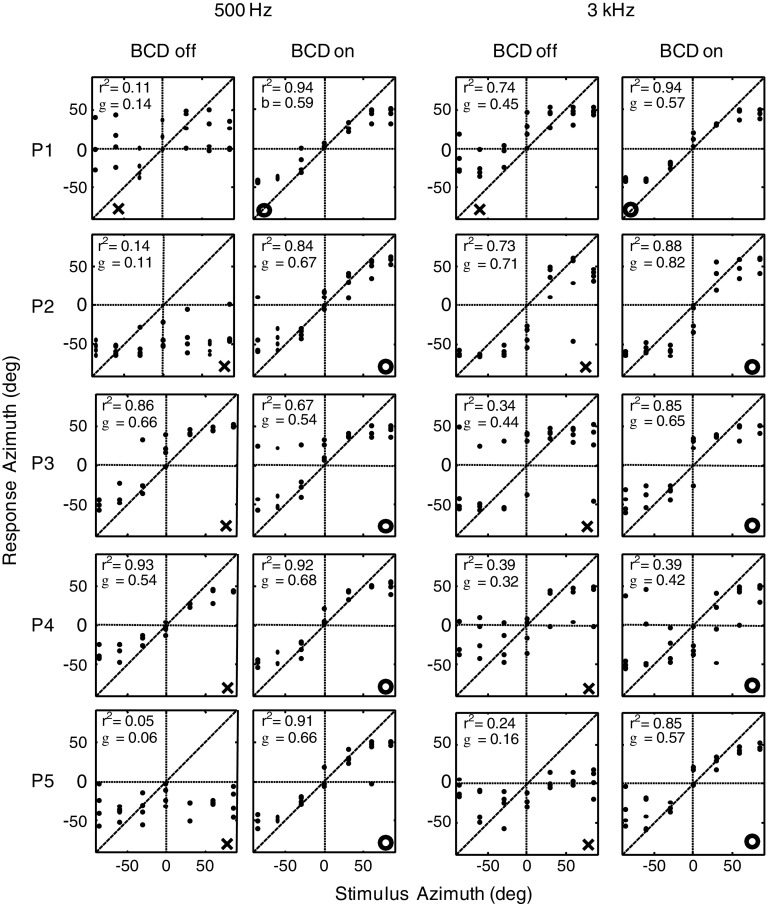
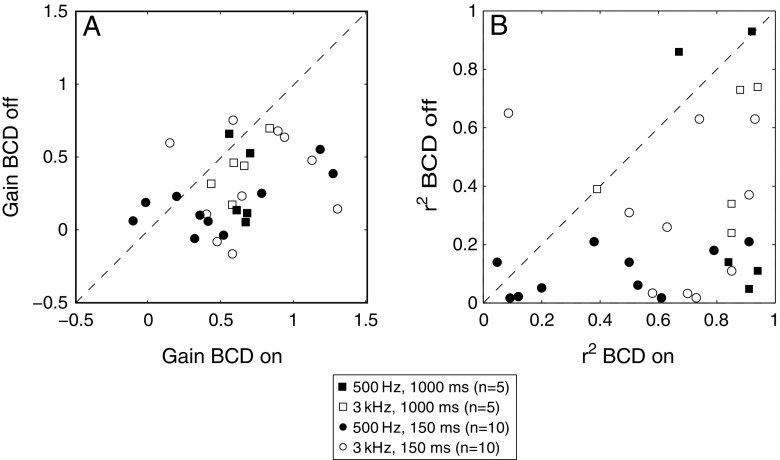
We examined horizontal directional hearing in patients with acquired severe unilateral conductive hearing loss (UCHL). All patients (n = 12) had been fitted with a bone conduction device (BCD) to restore bilateral hearing. The patients were tested in the unaided (monaural) and aided (binaural) hearing condition. Five listeners without hearing loss were tested as a control group while listening with a monaural plug and earmuff, or with both ears (binaural). We randomly varied stimulus presentation levels to assess whether listeners relied on the acoustic head-shadow effect (HSE) for horizontal (azimuth) localization. Moreover, to prevent sound localization on the basis of monaural spectral shape cues from head and pinna, subjects were exposed to narrow band (1/3 octave) noises. We demonstrate that the BCD significantly improved sound localization in 8/12 of the UCHL patients. Interestingly, under monaural hearing (BCD off), we observed fairly good unaided azimuth localization performance in 4/12 of the patients. Our multiple regression analysis shows that all patients relied on the ambiguous HSE for localization. In contrast, acutely plugged control listeners did not employ the HSE. Our data confirm and further extend results of recent studies on the use of sound localization cues in chronic and acute monaural listening.
我们研究了后天性单侧严重传导性听力损失(UCHL)患者的水平方向听觉。所有患者(n=12)均已配备骨导设备(BCD)以恢复双耳听力。患者在未助听(单耳)和助听(双耳)条件下接受测试。5 名听力正常的听众作为对照组进行测试,他们使用单耳耳塞和耳罩,或双耳(双耳)进行测试。我们随机改变刺激呈现水平,以评估听力是否依赖于声学头部阴影效应(HSE)进行水平(方位)定位。此外,为了防止基于头部和耳廓的单耳频谱形状线索进行声音定位,受试者接触了窄带(1/3 倍频程)噪声。我们证明 BCD 显著改善了 12 名 UCHL 患者中的 8 名的声音定位。有趣的是,在单耳听力(BCD 关闭)下,我们观察到 4/12 的患者的未助听方位定位性能相当好。我们的多元回归分析表明,所有患者均依赖于不明确的 HSE 进行定位。相比之下,急性耳塞对照者并未使用 HSE。我们的数据证实并进一步扩展了最近关于慢性和急性单耳听力中声音定位线索使用的研究结果。