Lilly USA, LLC, Indianapolis, IN, USA.
BMC Psychiatry. 2010 Sep 14;10:72. doi: 10.1186/1471-244X-10-72.
Clinically significant weight gain has been reported during treatment with atypical antipsychotics. It has been suggested that weight changes in patients treated with olanzapine may be associated with increased appetite.
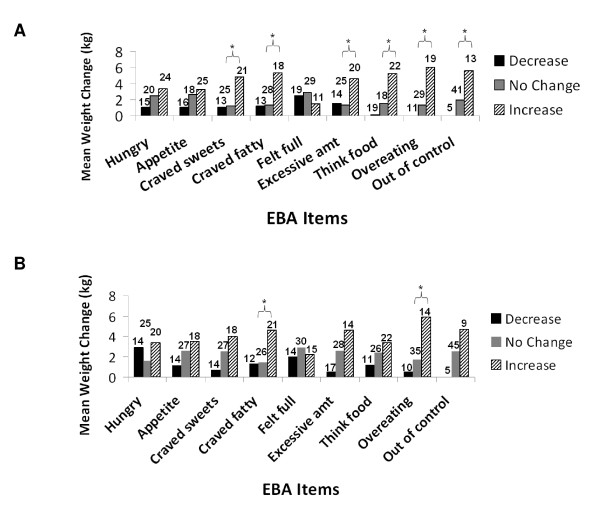
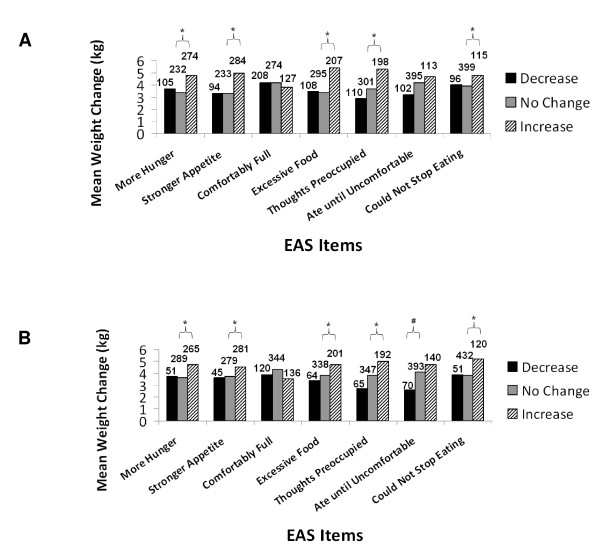
Data were used from adult patients for whom both appetite and weight data were available from 4 prospective, 12- to 24-week clinical trials. Patients' appetites were assessed with Eating Behavior Assessment (EBA, Study 1), Platypus Appetite Rating Scale (PARS, Study 2), Eating Inventory (EI, Study 3), Food Craving Inventory (FCI, Study 3), and Eating Attitude Scale (EAS, Study 4).
In Studies 1 (EBA) and 4 (EAS), patients who reported overall score increases on appetite scales, indicating an increase in appetite, experienced the greatest overall weight gains. However, in Studies 2 (PARS) and 3 (EI, FCI), patients who reported overall score increases on appetite scales did not experience greater weight changes than patients not reporting score increases. Early weight changes (2-4 weeks) were more positively correlated with overall weight changes than early or overall score changes on any utilized appetite assessment scale. No additional information was gained by adding early appetite change to early weight change in correlation to overall weight change.
Early weight changes may be a more useful predictor for long-term weight changes than early score changes on appetite assessment scales.
This report represents secondary analyses of 4 clinical studies. Studies 1, 2, and 3 were registered at http://clinicaltrials.gov/ct2/home, under NCT00190749, NCT00303602, and NCT00401973, respectively. Study 4 predates the registration requirements for observational studies that are not classified as category 1 observational studies.
使用非典型抗精神病药物治疗时会出现临床意义上的体重增加。有研究提示,奥氮平治疗患者的体重变化可能与食欲增加有关。
我们利用了来自 4 项前瞻性、12-24 周临床试验的成年患者的数据,这些患者均有食欲和体重数据。患者的食欲通过进食行为评估量表(EBA,研究 1)、鸭式食欲评分量表(PARS,研究 2)、进食问卷(EI,研究 3)、食物渴求量表(FCI,研究 3)和饮食态度量表(EAS,研究 4)进行评估。
在研究 1(EBA)和 4(EAS)中,报告食欲量表总分增加(表明食欲增加)的患者体重增加最多。然而,在研究 2(PARS)和 3(EI、FCI)中,报告食欲量表总分增加的患者体重变化并不大于报告总分未增加的患者。早期体重变化(2-4 周)与总体体重变化的相关性强于任何使用的食欲评估量表的早期或总体评分变化。在与总体体重变化的相关性中,将早期食欲变化添加到早期体重变化中并不能获得更多信息。
与食欲评估量表的早期评分变化相比,早期体重变化可能是预测长期体重变化的更有用指标。
本报告是 4 项临床研究的二次分析。研究 1、2 和 3 在 http://clinicaltrials.gov/ct2/home 上注册,注册号分别为 NCT00190749、NCT00303602 和 NCT00401973。研究 4 早于不分类为 1 类观察性研究的观察性研究的注册要求。