Department of Biology, University of York, Heslington, York, YO10 5DD, United Kingdom.
J Biol Chem. 2010 Nov 19;285(47):36977-83. doi: 10.1074/jbc.M110.156935. Epub 2010 Sep 15.
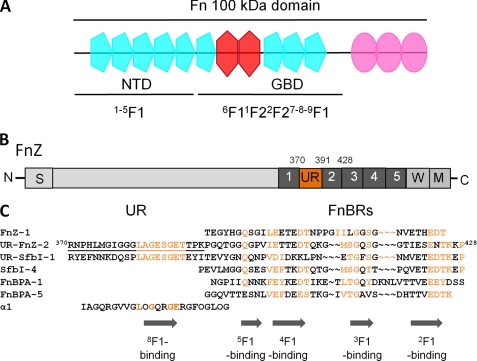
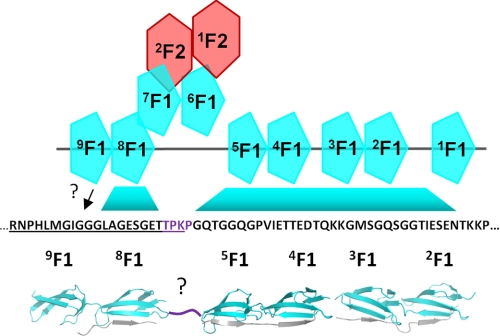
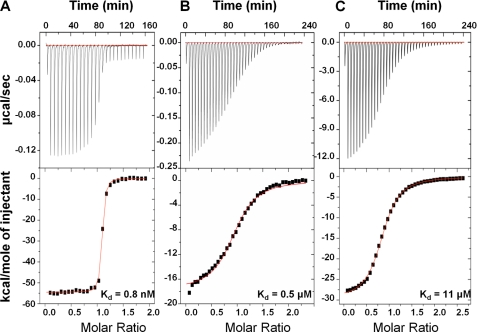
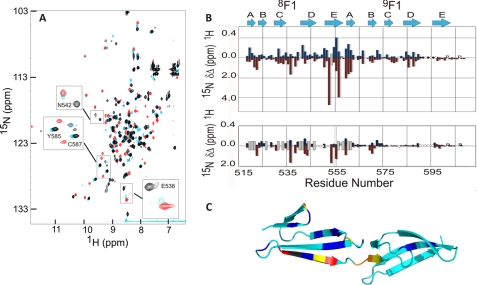
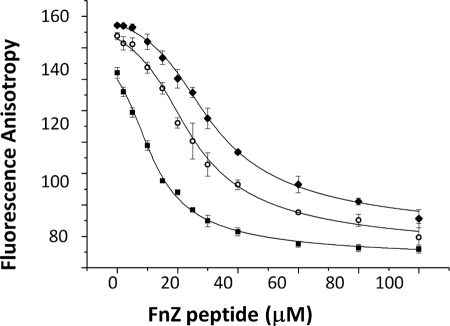
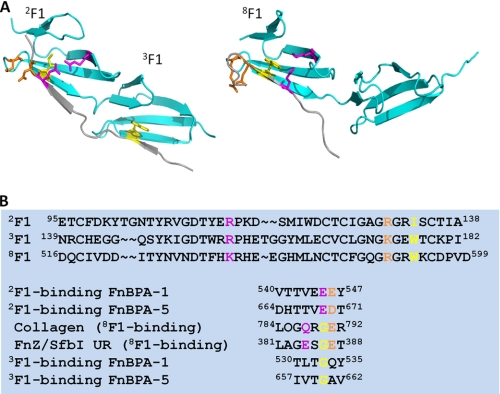
Fibronectin-binding proteins (FnBPs) of Staphylococcus aureus and Streptococcus pyogenes mediate invasion of human endothelial and epithelial cells in a process likely to aid the persistence and/or dissemination of infection. In addition to binding sites for the N-terminal domain (NTD) of fibronectin (Fn), a number of streptococcal FnBPs also contain an upstream region (UR) that is closely associated with an NTD-binding region; UR binds to the adjacent gelatin-binding domain (GBD) of Fn. Previously, UR was shown to be required for efficient streptococcal invasion of epithelial cells. Here we show, using a Streptococcus zooepidemicus FnBP, that the UR-binding site in GBD resides largely in the (8)F1(9)F1 module pair. We also show that UR inhibits binding of a peptide from the α1 chain of type I collagen to (8)F1(9)F1 and that UR binding to (8)F1 is likely to occur through anti-parallel β-zipper formation. Thus, we propose that streptococcal proteins that contain adjacent NTD- and GBD-binding sites form a highly unusual extended tandem β-zipper that spans the two domains and mediates high affinity binding to Fn through a large intermolecular interface. The proximity of the UR- and NTD-binding sequences in streptococcal FnBPs is consistent with a non-linear arrangement of modules in the tertiary structure of the GBD of Fn.
金黄色葡萄球菌和化脓性链球菌的纤连蛋白结合蛋白(FnBPs)介导了人类内皮细胞和上皮细胞的入侵,这一过程可能有助于感染的持续存在和/或传播。除了纤连蛋白(Fn)N 端结构域(NTD)的结合位点外,许多链球菌 FnBPs 还包含一个与 NTD 结合区密切相关的上游区(UR);UR 与 Fn 的相邻明胶结合结构域(GBD)结合。先前已经表明,UR 对于链球菌有效入侵上皮细胞是必需的。在这里,我们使用兽疫链球菌 FnBP 表明,GBD 中的 UR 结合位点主要位于(8)F1(9)F1 模块对中。我们还表明,UR 抑制来自 I 型胶原 α1 链的肽与(8)F1(9)F1 的结合,并且 UR 与(8)F1 的结合可能通过反平行β-拉链形成发生。因此,我们提出含有相邻的 NTD 和 GBD 结合位点的链球菌蛋白形成一个非常不寻常的扩展串联β-拉链,跨越两个结构域,并通过大的分子间界面介导对 Fn 的高亲和力结合。UR 和 NTD 结合序列在链球菌 FnBPs 中的接近性与 Fn 的 GBD 中模块的三级结构的非线性排列一致。