Center for Sleep and Respiratory Neurobiology, University of Pennsylvania School of Medicine, 3624 Market Street, Philadelphia, PA 19104, USA.
Curr Opin Pulm Med. 2010 Nov;16(6):574-82. doi: 10.1097/MCP.0b013e32833f0d55.
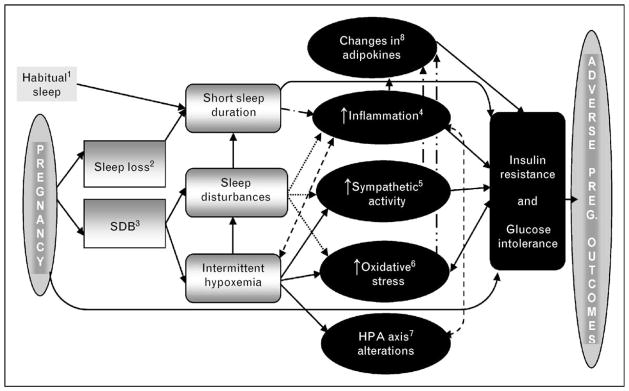
This article reviews current data on pathophysiologic mechanisms by which sleep-disordered breathing during pregnancy may cause harm, and explores biological pathways for associated adverse maternal and fetal outcomes, especially pregnancy-induced hypertension and gestational diabetes.
Accumulating data indicate that snoring and sleep apnea during pregnancy are likely to increase the risk for gestational hypertension and preeclampsia. Several new studies have observed that sleep-disordered breathing and short sleep duration also increase the risk of gestational diabetes, similar to observations in the general population. There are varying levels of emerging evidence for potential mechanisms, including oxidative stress, increased sympathetic activity and inflammation, adipokine levels and insulin resistance, linking sleep-disordered breathing events during pregnancy to adverse outcomes.
Sleep-disordered breathing and adverse maternal-fetal outcomes such as preeclampsia and gestational diabetes share a number of mechanistic pathways, and growing data in pregnant women indicate that snoring and sleep apnea increase the risk of these and other complications for both the mother and the fetus. Nevertheless, direct evidence of the pathophysiologic mechanisms by which sleep-disordered breathing during pregnancy exerts negative effects remains sparse.
本文综述了孕期睡眠呼吸障碍导致不良母婴结局的病理生理机制,探讨了与不良母婴结局相关的生物学途径,特别是妊娠高血压和妊娠糖尿病。
越来越多的数据表明,孕期打鼾和睡眠呼吸暂停可能会增加妊娠高血压和先兆子痫的风险。几项新的研究观察到,睡眠呼吸障碍和睡眠时间短也会增加妊娠糖尿病的风险,这与普通人群的观察结果相似。目前有不同程度的证据表明,包括氧化应激、交感神经活动和炎症增加、脂肪因子水平和胰岛素抵抗等潜在机制,将孕期睡眠呼吸障碍与不良结局联系起来。
睡眠呼吸障碍和不良的母婴结局,如先兆子痫和妊娠糖尿病,有一些共同的发病机制,越来越多的孕妇数据表明,打鼾和睡眠呼吸暂停会增加母亲和胎儿患这些和其他并发症的风险。然而,孕期睡眠呼吸障碍对母婴产生负面影响的病理生理机制的直接证据仍然很少。