Section of Epidemiology and Biostatistics, Leeds Institute of Molecular Medicine, St James's University Hospital, Beckett Street, Leeds LS97TF, UK.
Br J Cancer. 2010 Oct 12;103(8):1229-36. doi: 10.1038/sj.bjc.6605849. Epub 2010 Sep 21.
To optimise predictive models for sentinal node biopsy (SNB) positivity, relapse and survival, using clinico-pathological characteristics and osteopontin gene expression in primary melanomas.
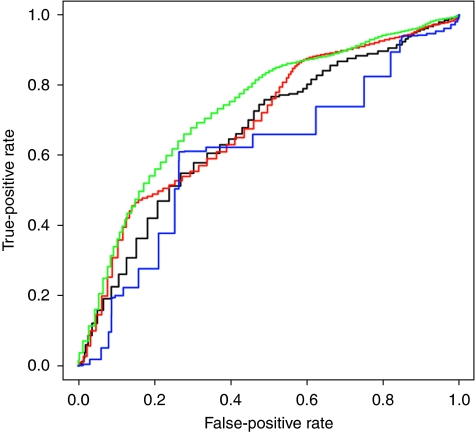
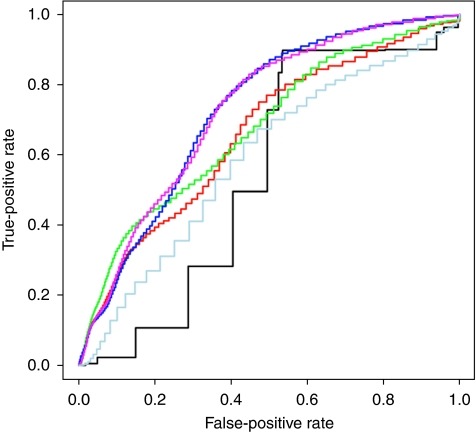
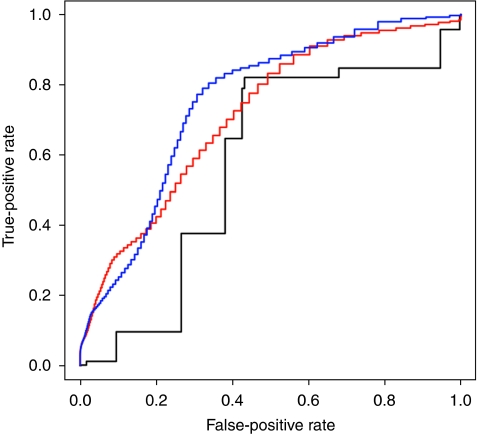
A comparison of the clinico-pathological characteristics of SNB positive and negative cases was carried out in 561 melanoma patients. In 199 patients, gene expression in formalin-fixed primary tumours was studied using Illumina's DASL assay. A cross validation approach was used to test prognostic predictive models and receiver operating characteristic curves were produced.
Independent predictors of SNB positivity were Breslow thickness, mitotic count and tumour site. Osteopontin expression best predicted SNB positivity (P=2.4 × 10⁻⁷), remaining significant in multivariable analysis. Osteopontin expression, combined with thickness, mitotic count and site, gave the best area under the curve (AUC) to predict SNB positivity (72.6%). Independent predictors of relapse-free survival were SNB status, thickness, site, ulceration and vessel invasion, whereas only SNB status and thickness predicted overall survival. Using clinico-pathological features (thickness, mitotic count, ulceration, vessel invasion, site, age and sex) gave a better AUC to predict relapse (71.0%) and survival (70.0%) than SNB status alone (57.0, 55.0%). In patients with gene expression data, the SNB status combined with the clinico-pathological features produced the best prediction of relapse (72.7%) and survival (69.0%), which was not increased further with osteopontin expression (72.7, 68.0%).
Use of these models should be tested in other data sets in order to improve predictive and prognostic data for patients.
为了优化前哨淋巴结活检(SNB)阳性、复发和生存的预测模型,我们使用临床病理特征和原发性黑色素瘤中的骨桥蛋白基因表达。
对 561 例黑色素瘤患者的 SNB 阳性和阴性病例进行了临床病理特征比较。在 199 例患者中,使用 Illumina 的 DASL 检测法研究了福尔马林固定的原发性肿瘤中的基因表达。采用交叉验证方法检验预后预测模型,并生成接收者操作特征曲线。
SNB 阳性的独立预测因子是 Breslow 厚度、有丝分裂计数和肿瘤部位。骨桥蛋白表达最佳预测 SNB 阳性(P=2.4×10⁻⁷),在多变量分析中仍然具有显著性。骨桥蛋白表达与厚度、有丝分裂计数和部位相结合,对预测 SNB 阳性的曲线下面积(AUC)最佳(72.6%)。无复发生存的独立预测因子是 SNB 状态、厚度、部位、溃疡和血管浸润,而只有 SNB 状态和厚度预测总生存。使用临床病理特征(厚度、有丝分裂计数、溃疡、血管浸润、部位、年龄和性别)预测复发(71.0%)和生存(70.0%)的 AUC 优于 SNB 状态(57.0%,55.0%)。在有基因表达数据的患者中,SNB 状态与临床病理特征相结合,对复发(72.7%)和生存(69.0%)的预测最佳,与骨桥蛋白表达(72.7%,68.0%)结合后并未进一步提高。
为了提高患者的预测和预后数据,应在其他数据集上测试这些模型的使用。