Sensory Ecology Group, Max Planck Institute for Ornithology, Seewiesen, Germany.
PLoS One. 2010 Sep 17;5(9):e12842. doi: 10.1371/journal.pone.0012842.
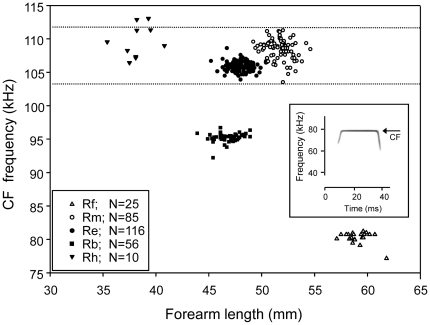
Only recently data on bat echolocation call intensities is starting to accumulate. Yet, intensity is an ecologically crucial parameter, as it determines the extent of the bats' perceptual space and, specifically, prey detection distance. Interspecifically, we thus asked whether sympatric, congeneric bat species differ in call intensities and whether differences play a role for niche differentiation. Specifically, we investigated whether R. mehelyi that calls at a frequency clearly above what is predicted by allometry, compensates for frequency-dependent loss in detection distance by using elevated call intensity. Maximum echolocation call intensities might depend on body size or condition and thus be used as an honest signal of quality for intraspecific communication. We for the first time investigated whether a size-intensity relation is present in echolocating bats.
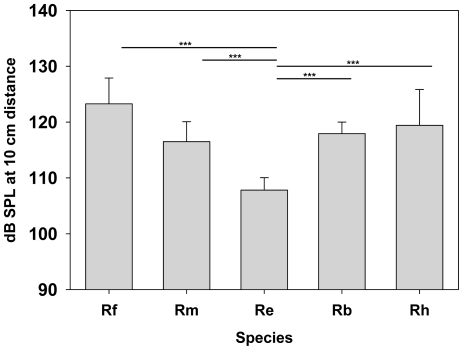
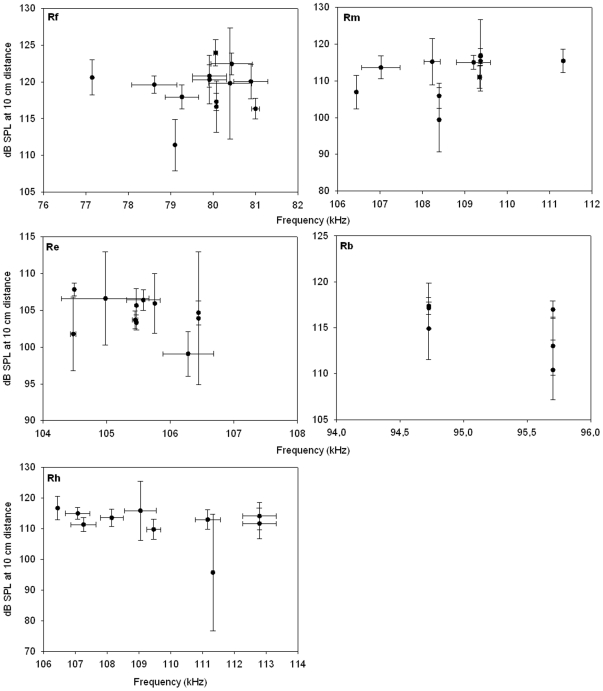
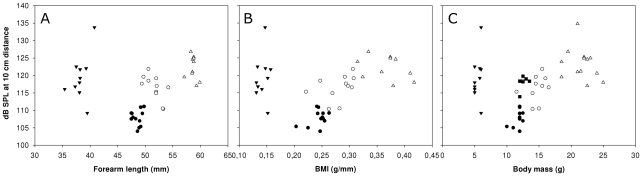
METHODOLOGY/PRINCIPAL FINDINGS: We measured maximum call intensities and frequencies for all five European horseshoe bat species. Maximum intensity differed among species largely due to R. euryale. Furthermore, we found no compensation for frequency-dependent loss in detection distance in R. mehelyi. Intraspecifically, there is a negative correlation between forearm lengths and intensity in R. euryale and a trend for a negative correlation between body condition index and intensity in R. ferrumequinum. In R. hipposideros, females had 8 dB higher intensities than males. There were no correlations with body size or sex differences and intensity for the other species.
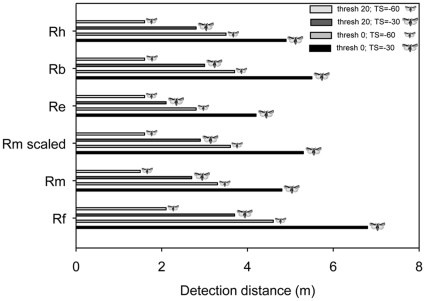
CONCLUSIONS/SIGNIFICANCE: Based on call intensity and frequency measurements, we estimated echolocation ranges for our study community. These suggest that intensity differences result in different prey detection distances and thus likely play some role for resource access. It is interesting and at first glance counter-intuitive that, where a correlation was found, smaller bats called louder than large individuals. Such negative relationship between size or condition and vocal amplitude may indicate an as yet unknown physiological or sexual selection pressure.
蝙蝠回声定位叫声强度的数据最近才开始积累。然而,强度是一个生态关键参数,因为它决定了蝙蝠的感知空间范围,特别是猎物探测距离。因此,我们在种间水平上研究了是否同域的、同属的蝙蝠物种在叫声强度上存在差异,以及这些差异是否在生态位分化中发挥作用。具体来说,我们调查了以明显高于体型预测的频率发出叫声的 R. mehelyi 是否通过提高叫声强度来补偿因频率依赖性而导致的探测距离损失。最大回声定位叫声强度可能取决于体型或身体状况,因此可以作为种内交流中质量的诚实信号。我们首次研究了回声定位蝙蝠中是否存在大小-强度关系。
方法/主要发现:我们测量了所有五种欧洲马蹄蝠物种的最大叫声强度和频率。最大强度在物种间差异很大,主要是由于 R. euryale。此外,我们发现 R. mehelyi 没有因频率依赖性的探测距离损失而进行补偿。在种内水平上,R. euryale 的前臂长度与强度呈负相关,而 R. ferrumequinum 的身体状况指数与强度呈负相关趋势。在 R. hipposideros 中,雌性的强度比雄性高 8 分贝。其他物种的强度与体型或性别差异均无相关性。
结论/意义:根据叫声强度和频率的测量,我们估计了我们研究社区的回声定位范围。这些结果表明,强度差异导致不同的猎物探测距离,因此可能在资源获取方面发挥了一定作用。有趣的是,乍一看违反直觉的是,在存在相关性的地方,体型较小的蝙蝠叫声比体型较大的个体更大。体型或身体状况与发声幅度之间的这种负相关关系可能表明存在未知的生理或性选择压力。