Division of Cardiothoracic Surgery, Medical University of South Carolina, Charleston, South Carolina, USA.
J Surg Res. 2012 Jan;172(1):59-67. doi: 10.1016/j.jss.2010.06.015. Epub 2010 Jul 2.
Left ventricular (LV) remodeling following myocardial infarction (MI) is associated with increased levels of specific matrix metalloproteinases (MMPs) and relative reduction of endogenous tissue inhibitors of the MMPs (TIMPs). However, transcriptional mechanisms for the disparate post-MI MMP/TIMP expression remain unknown. Using murine constructs designed to report gene promoter activation, this study tested the hypothesis that distinctly different temporal profiles of MMP-2, MMP-9, and TIMP-1 transcription occurs post-MI.
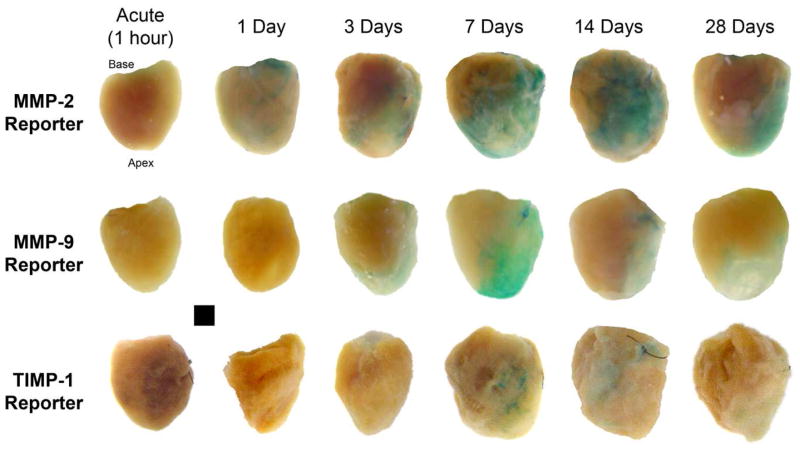
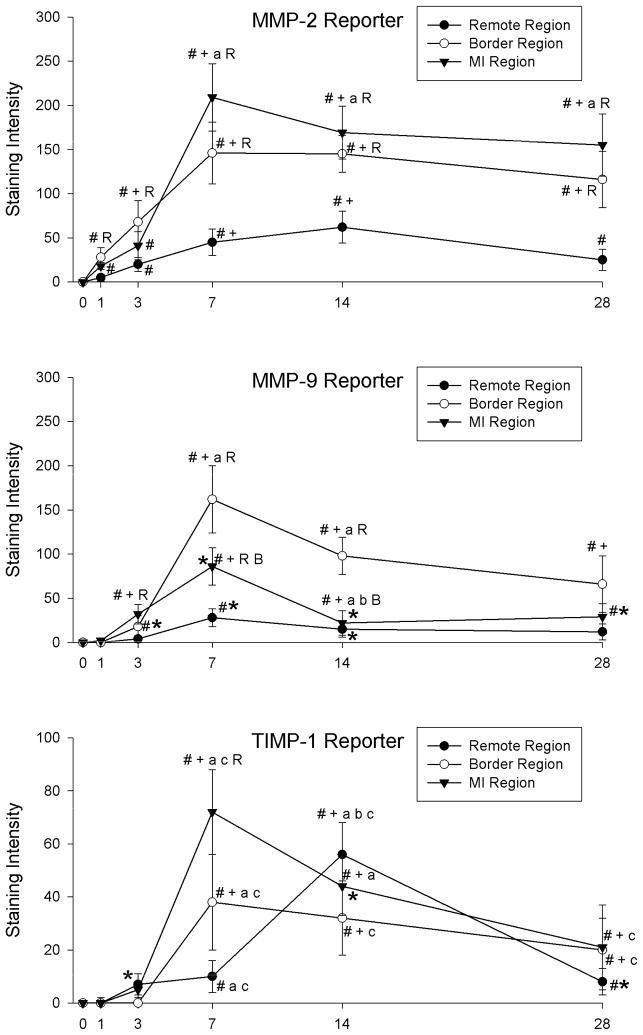
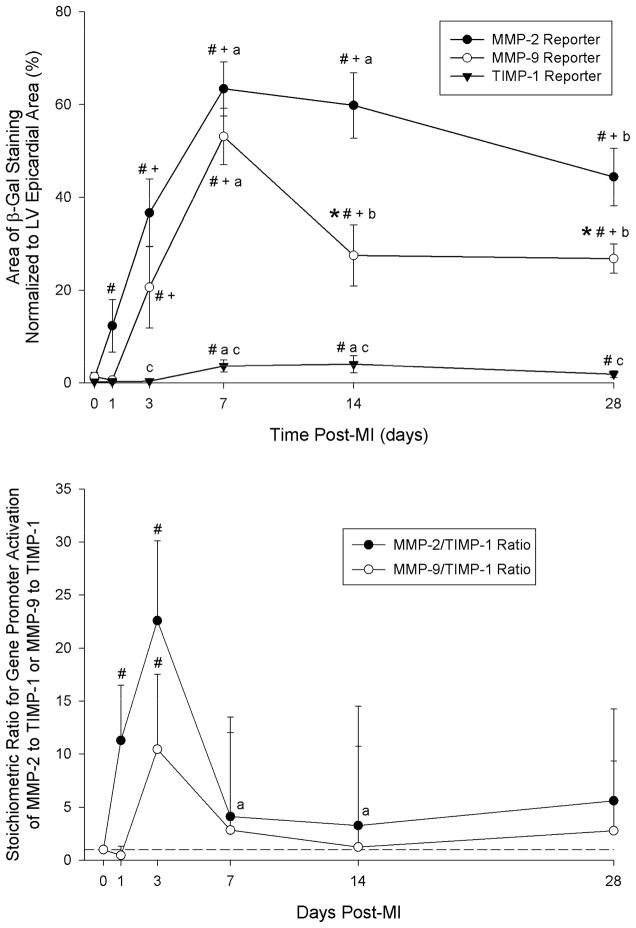
METHODS/RESULTS: Transcriptional activity (β-galactosidase (β-gal) reporter constructs) of MMP-2 (n = 49), MMP-9 (n = 62), or TIMP-1 (n = 40) was assayed at 1 h (acute), and 1-28 d after MI (coronary ligation) in transgenic reporter mice. At 7 d post-MI, the area of promoter activation normalized to LV area was increased from acute values for MMP-2 (63.4 ± 5.8 versus 1.1% ± 1.0%, P < 0.05) and MMP-9 (53.1 ± 6.1 versus 1.3% ± 0.9%, P < 0.05). While TIMP-1 promoter activation at 7 d post-MI increased from acute values (3.6 ± 1.3 versus 0.3% ± 0.5%, P < 0.05), this increase was smaller than that for MMP-2 or MMP-9 (both P < 0.05). MMP-2 promoter activation peaked in the MI region at 7 d post-MI and MMP-9 promoter activation was highest in the border region at 7 and 14 d post-MI. TIMP-1 promoter activation peaked within the MI region at 7 d post-MI and within the remote region at 14 d post-MI.
These findings provided direct in vivo evidence that discordant changes in temporal and spatial patterns of MMP/TIMP transcription occurs with MI. Restoration of TIMP-1 promoter activation may represent a molecular therapeutic target to attenuate/prevent adverse post-MI LV remodeling.
心肌梗死后(MI)左心室(LV)重构与特定基质金属蛋白酶(MMPs)水平升高和内源性 MMPs 组织抑制剂(TIMPs)相对减少有关。然而,MI 后 MMP/TIMP 表达的转录机制尚不清楚。本研究使用设计用于报告基因启动子激活的鼠类构建体,检验了 MI 后 MMP-2、MMP-9 和 TIMP-1 转录的不同时间特征的假说。
方法/结果:在 MI 后 1 h(急性期)和 1-28 d(冠状动脉结扎),在转基因报告鼠中检测 MMP-2(n = 49)、MMP-9(n = 62)或 TIMP-1(n = 40)的转录活性(β-半乳糖苷酶(β-gal)报告基因构建体)。在 MI 后 7 d,与急性期相比,MMP-2(63.4 ± 5.8%比 1.1% ± 1.0%,P < 0.05)和 MMP-9(53.1 ± 6.1%比 1.3% ± 0.9%,P < 0.05)的启动子激活面积占 LV 面积的比例增加。尽管 TIMP-1 启动子激活在 MI 后 7 d 时从急性期值增加(3.6 ± 1.3%比 0.3% ± 0.5%,P < 0.05),但与 MMP-2 或 MMP-9 相比,这一增加较小(均 P < 0.05)。MMP-2 启动子激活在 MI 区域在 MI 后 7 d 达到峰值,MMP-9 启动子激活在 MI 后 7 和 14 d 在边界区域达到峰值。TIMP-1 启动子激活在 MI 后 7 d 在 MI 区域达到峰值,在 MI 后 14 d 在远隔区域达到峰值。
这些发现为 MMP/TIMP 转录的时间和空间模式的不一致变化与 MI 有关提供了直接的体内证据。TIMP-1 启动子激活的恢复可能是一种分子治疗靶点,以减轻/预防 MI 后 LV 重构。