Department of Neurology, Erasmus MC University Medical Center Rotterdam, PO Box 2040, 3000 CA, Rotterdam, The Netherlands.
J Neurol. 2011 Feb;258(2):302-7. doi: 10.1007/s00415-010-5756-4. Epub 2010 Sep 30.
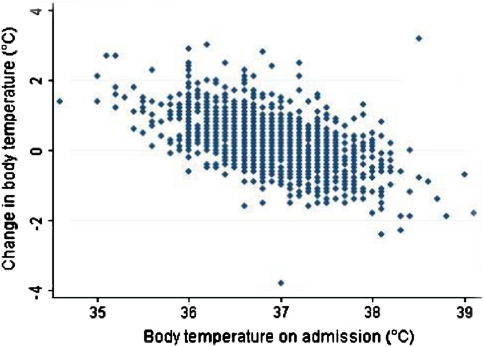
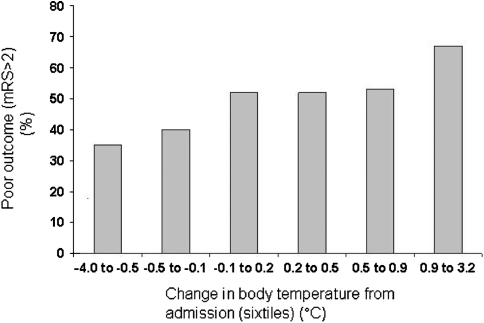
Subfebrile temperature or fever is present in about a third of patients on the first day after stroke onset and is associated with poor outcome. However, the temporal profile of this association is not well established. We aimed to assess the relationship between body temperature on admission as well as the change in body temperature from admission to 24 h thereafter and functional outcome and death. We analyzed data of 1,332 patients admitted within 12 h of stroke onset. The relation between body temperature on admission or the change in body temperature from admission to 24 h thereafter (adjusted for body temperature on admission) on the one hand and unfavorable outcome (death, or a modified Rankin Scale score >2) at 3 months on the other were expressed as odds ratio per 1.0°C increase in body temperature. Adjustments for potential confounders were made with a multiple logistic regression model. No relation was found between admission body temperature and poor outcome (aOR 1.06; 95% CI 0.85-1.32) and death (aOR 1.23; 95% CI 0.95-1.60). In contrast, increased body temperature in the first 24 h after stroke onset was associated with poor outcome (aOR 1.30; 95% CI 1.05-1.63) and death (aOR 1.51; 95% CI 1.15-1.98). An early rise in body temperature rather than high body temperature on admission is a risk factor for unfavorable outcome in patients with acute stroke.
约三分之一的脑卒中患者在发病后第一天出现低热或发热,且与不良预后相关。然而,这种关联的时间模式尚未得到充分证实。我们旨在评估入院时体温以及从入院到 24 小时后体温变化与功能结局和死亡之间的关系。我们分析了 1332 例发病后 12 小时内入院的患者的数据。入院时体温或从入院到 24 小时后体温变化(按入院时体温校正)与 3 个月时不良结局(死亡或改良 Rankin 量表评分>2)之间的关系用每升高 1.0°C 的优势比(OR)表示。采用多因素逻辑回归模型对潜在混杂因素进行了调整。入院时体温与不良结局(aOR 1.06;95%CI 0.85-1.32)和死亡(aOR 1.23;95%CI 0.95-1.60)无关。相反,脑卒中发病后 24 小时内体温升高与不良结局(aOR 1.30;95%CI 1.05-1.63)和死亡(aOR 1.51;95%CI 1.15-1.98)相关。体温的早期升高而不是入院时的高热是急性脑卒中患者不良结局的危险因素。