
孕期长期暴露于高海拔慢性缺氧会导致新生儿在海平面时出现肺动脉高压。
Long-term exposure to high-altitude chronic hypoxia during gestation induces neonatal pulmonary hypertension at sea level.
机构信息
Programa de Fisiopatología, Instituto de Ciencias Biomédicas, Facultad de Medicina, Universidad de Chile. Avda. Salvador 486, Providencia, CP 6640871, Santiago, Chile.
出版信息
Am J Physiol Regul Integr Comp Physiol. 2010 Dec;299(6):R1676-84. doi: 10.1152/ajpregu.00123.2010. Epub 2010 Sep 29.
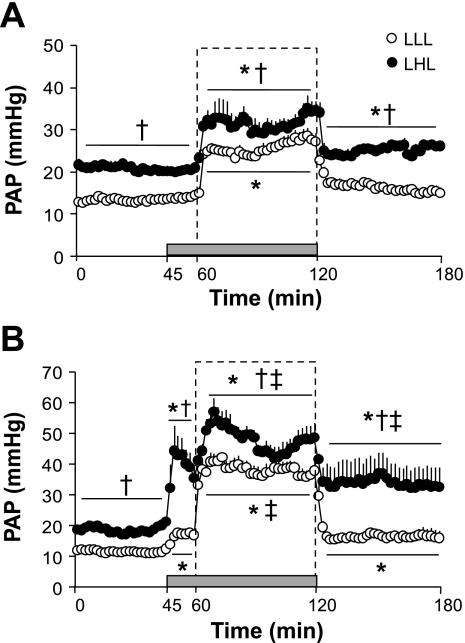
We determined whether postnatal pulmonary hypertension induced by 70% of pregnancy at high altitude (HA) persists once the offspring return to sea level and investigated pulmonary vascular mechanisms operating under these circumstances. Pregnant ewes were divided into two groups: conception, pregnancy, and delivery at low altitude (580 m, LLL) and conception at low altitude, pregnancy at HA (3,600 m) from 30% of gestation until delivery, and return to lowland (LHL). Pulmonary arterial pressure (PAP) was measured in vivo. Vascular reactivity and morphometry were assessed in small pulmonary arteries (SPA). Protein expression of vascular mediators was determined. LHL lambs had higher basal PAP and a greater increment in PAP after N(G)-nitro-L-arginine methyl ester (20.9 ± 1.1 vs. 13.7 ± 0.5 mmHg; 39.9 ± 5.0 vs. 18.3 ± 1.3 mmHg, respectively). SPA from LHL had a greater maximal contraction to K(+) (1.34 ± 0.05 vs. 1.16 ± 0.05 N/m), higher sensitivity to endothelin-1 and nitroprusside, and persistence of dilatation following blockade of soluble guanylate cyclase. The heart ratio of the right ventricle-to-left ventricle plus septum was higher in the LHL relative to LLL. The muscle area of SPA (29.3 ± 2.9 vs. 21.1 ± 1.7%) and the protein expression of endothelial nitric oxide synthase (1.7 ± 0.1 vs. 1.1 ± 0.2), phosphodiesterase (1.4 ± 0.1 vs. 0.7 ± 0.1), and Ca(2+)-activated K(+) channel (0.76 ± 0.16 vs. 0.30 ± 0.01) were greater in LHL compared with LLL lambs. In contrast, LHL had decreased heme oxygenase-1 expression (0.82 ± 0.26 vs. 2.22 ± 0.44) and carbon monoxide production (all P < 0.05). Postnatal pulmonary hypertension induced by 70% of pregnancy at HA promotes cardiopulmonary remodeling that persists at sea level.
我们确定了在高海拔(HA)地区怀孕 70%所导致的产后肺动脉高压在后代返回海平面后是否仍然存在,并研究了在这种情况下起作用的肺血管机制。将怀孕的母羊分为两组:低海拔(580 m,LLL)的受孕、怀孕和分娩,以及从妊娠 30%到分娩的低海拔(HA)受孕、怀孕,然后返回低地(LHL)。在体内测量肺动脉压(PAP)。评估小肺动脉(SPA)的血管反应性和形态计量学。测定血管介质的蛋白表达。LHL 羔羊的基础 PAP 较高,N(G)-硝基-L-精氨酸甲酯(20.9 ± 1.1 对 13.7 ± 0.5 mmHg;39.9 ± 5.0 对 18.3 ± 1.3 mmHg)后 PAP 增加更大。来自 LHL 的 SPA 对 K+的最大收缩幅度更大(1.34 ± 0.05 对 1.16 ± 0.05 N/m),对内皮素-1 和硝普钠的敏感性更高,并且在可溶性鸟苷酸环化酶阻断后仍保持扩张。LHL 相对于 LLL 的右心室-左心室加室间隔的心脏比例更高。SPA 的肌肉面积(29.3 ± 2.9 对 21.1 ± 1.7%)和内皮型一氧化氮合酶(1.7 ± 0.1 对 1.1 ± 0.2)、磷酸二酯酶(1.4 ± 0.1 对 0.7 ± 0.1)和 Ca2+-激活的 K+通道(0.76 ± 0.16 对 0.30 ± 0.01)的蛋白表达在 LHL 中均高于 LLL 羔羊。相比之下,LHL 的血红素加氧酶-1 表达(0.82 ± 0.26 对 2.22 ± 0.44)和一氧化碳生成(均 P < 0.05)减少。在 HA 地区怀孕 70%所导致的产后肺动脉高压会促进心肺重塑,这种重塑在海平面上仍然存在。



 Zotero 插件