Forstbotanik und Baumphysiologie, Büsgen-Institut, Büsgenweg, Göttingen, Germany.
Mycorrhiza. 2011 May;21(4):297-308. doi: 10.1007/s00572-010-0338-y. Epub 2010 Oct 1.
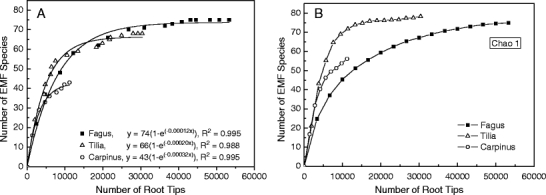
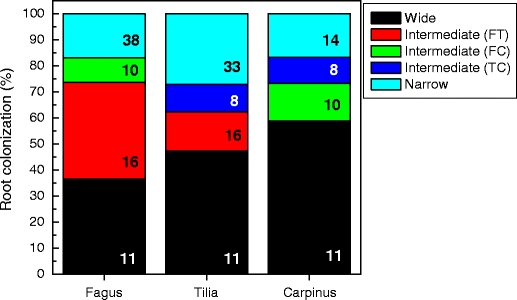
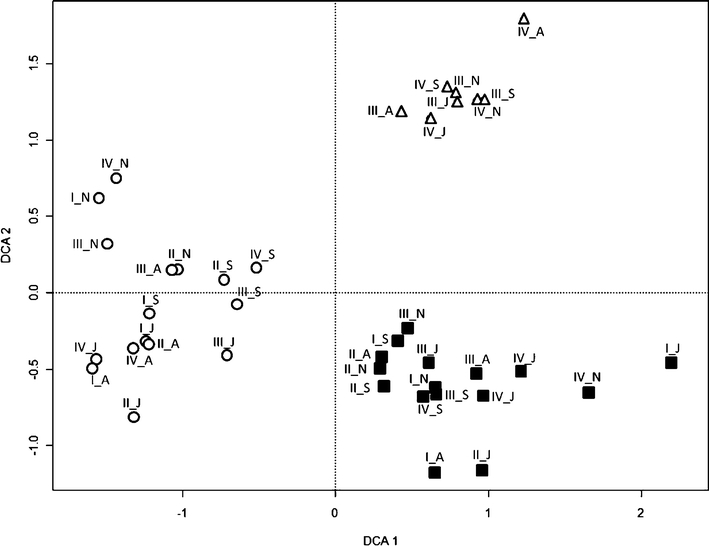
Mycorrhizal species richness and host ranges were investigated in mixed deciduous stands composed of Fagus sylvatica, Tilia spp., Carpinus betulus, Acer spp., and Fraxinus excelsior. Acer and Fraxinus were colonized by arbuscular mycorrhizas and contributed 5% to total stand mycorrhizal fungal species richness. Tilia hosted similar and Carpinus half the number of ectomycorrhizal (EM) fungal taxa compared with Fagus (75 putative taxa). The relative abundance of the host tree the EM fungal richness decreased in the order Fagus > Tilia >> Carpinus. After correction for similar sampling intensities, EM fungal species richness of Carpinus was still about 30-40% lower than that of Fagus and Tilia. About 10% of the mycorrhizal species were shared among the EM forming trees; 29% were associated with two host tree species and 61% with only one of the hosts. The latter group consisted mainly of rare EM fungal species colonizing about 20% of the root tips and included known specialists but also putative non-host associations such as conifer or shrub mycorrhizas. Our data indicate that EM fungal species richness was associated with tree identity and suggest that Fagus secures EM fungal diversity in an ecosystem since it shared more common EM fungi with Tilia and Carpinus than the latter two among each other.
研究了由欧洲山毛榉、椴树属、欧洲鹅耳枥、槭属和欧洲白蜡组成的混交落叶林中的菌根物种丰富度和宿主范围。槭属和白蜡属被丛枝菌根真菌(AM)定殖,占总林分 AM 真菌物种丰富度的 5%。与山毛榉(75 种可能的分类群)相比,椴树属宿主的外生菌根(EM)真菌类群相似,欧洲鹅耳枥属宿主的 EM 真菌类群则为其一半(50 种)。宿主树种的相对丰度决定了 EM 真菌的丰富度,其顺序为山毛榉属>椴树属>欧洲鹅耳枥属。在修正了相似的采样强度后,欧洲鹅耳枥属的 EM 真菌丰富度仍比山毛榉属和椴树属低约 30-40%。大约 10%的菌根物种存在于 EM 形成的树木之间;29%与两种宿主树种有关,61%仅与一种宿主有关。后一组主要由约 20%的根尖定殖的稀有 EM 真菌物种组成,包括已知的专性真菌,还有可能与针叶树或灌木菌根的非宿主关系。我们的数据表明,EM 真菌物种丰富度与树种有关,并表明山毛榉属在生态系统中确保了 EM 真菌的多样性,因为它与椴树属和欧洲鹅耳枥属共享更多的常见 EM 真菌,而这两个树种之间的 EM 真菌共享较少。