Biomedical Center, School of Electronics Engineering, Beijing University of Posts and Telecommunications, Beijing, 100876, China.
Lab of Computational Linguistics, School of Humanities and Social Sciences, Tsinghua Univ., Beijing, 100084, China.
J Inflamm (Lond). 2010 Sep 30;7:50. doi: 10.1186/1476-9255-7-50.
TNFRSF11B computational development network construction and analysis of frontal cortex of HIV encephalitis (HIVE) is very useful to identify novel markers and potential targets for prognosis and therapy.
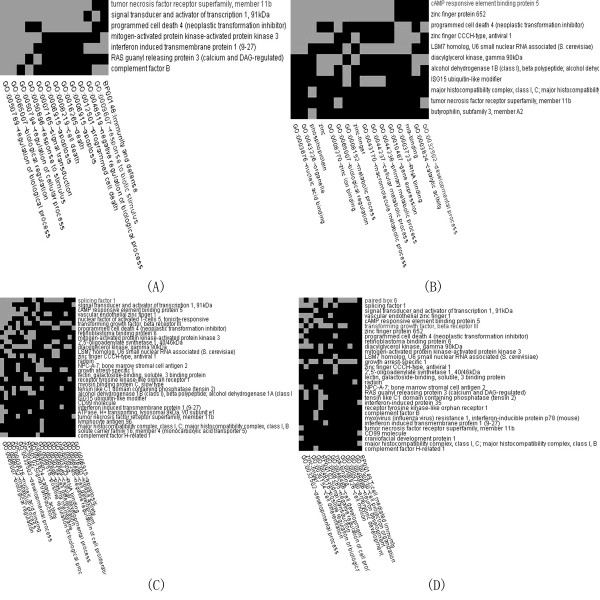
By integration of gene regulatory network infer (GRNInfer) and the database for annotation, visualization and integrated discovery (DAVID) we identified and constructed significant molecule TNFRSF11B development network from 12 frontal cortex of HIVE-control patients and 16 HIVE in the same GEO Dataset GDS1726.
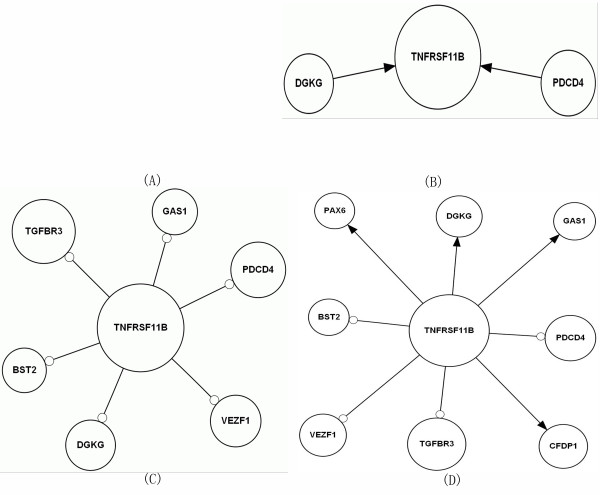
Our result verified TNFRSF11B developmental process only in the downstream of frontal cortex of HIVE-control patients (BST2, DGKG, GAS1, PDCD4, TGFBR3, VEZF1 inhibition), whereas in the upstream of frontal cortex of HIVE (DGKG, PDCD4 activation) and downstream (CFDP1, DGKG, GAS1, PAX6 activation; BST2, PDCD4, TGFBR3, VEZF1 inhibition). Importantly, we datamined that TNFRSF11B development cluster of HIVE is involved in T-cell mediated immunity, cell projection organization and cell motion (only in HIVE terms) without apoptosis, plasma membrane and kinase activity (only in HIVE-control patients terms), the condition is vital to inflammation, brain morphology and cognition impairment of HIVE. Our result demonstrated that common terms in both HIVE-control patients and HIVE include developmental process, signal transduction, negative regulation of cell proliferation, RNA-binding, zinc-finger, cell development, positive regulation of biological process and cell differentiation.
We deduced the stronger TNFRSF11B development network in HIVE consistent with our number computation. It would be necessary of the stronger TNFRSF11B development function to inflammation, brain morphology and cognition of HIVE.
TNFRSF11B 计算发育网络构建和分析人类免疫缺陷病毒脑炎(HIVE)的额皮质非常有助于鉴定新的标志物和潜在的预后和治疗靶点。
通过基因调控网络推断(GRNInfer)和数据库注释、可视化和综合发现(DAVID)的整合,我们从 12 名 HIVE-对照患者和相同 GEO 数据集 GDS1726 中的 16 名 HIVE 的前额皮质中鉴定并构建了显著的 TNFRSF11B 发育网络。
我们的结果仅在 HIVE-对照患者前额皮质的下游验证了 TNFRSF11B 的发育过程(BST2、DGKG、GAS1、PDCD4、TGFBR3、VEZF1 抑制),而在 HIVE 的上游(DGKG、PDCD4 激活)和下游(CFDP1、DGKG、GAS1、PAX6 激活;BST2、PDCD4、TGFBR3、VEZF1 抑制)。重要的是,我们挖掘出 TNFRSF11B 发育簇 HIVE 涉及 T 细胞介导的免疫、细胞投射组织和细胞运动(仅在 HIVE 术语中),而没有细胞凋亡、质膜和激酶活性(仅在 HIVE-对照患者术语中),这对于 HIVE 的炎症、脑形态和认知损伤至关重要。我们的结果表明,HIVE-对照患者和 HIVE 中的共同术语包括发育过程、信号转导、细胞增殖的负调节、RNA 结合、锌指、细胞发育、生物过程的正调节和细胞分化。
我们推断出 HIVE 中更强的 TNFRSF11B 发育网络与我们的计算一致。更强的 TNFRSF11B 发育功能对于 HIVE 的炎症、脑形态和认知是必要的。