HIV/AIDS Group, Centre for Immunology and Infectious Disease, Blizard Institute of Cell and Molecular Science, Barts and the London School of Medicine and Dentistry, 4 Newark Street, Whitechapel, London E1 2AT, UK.
Retrovirology. 2010 Oct 7;7:81. doi: 10.1186/1742-4690-7-81.
'Intrinsic' resistance to retroviral infection was first recognised with the Friend virus susceptibility gene (Fv1), which determines susceptibility to murine leukaemia virus (MLV) infection in different murine species. Similarly, the tripartite motif (TRIM) family of proteins determine lentiviral restriction in a primate host-species specific manner. For example rhesus TRIM5α (rhTRIM5α) can potently restrict HIV-1 infection while human TRIM5α (huTRIM5α) only has a mild effect on SIVmac and HIV-1 infectivity (Lv1). Human TRIM5α is able to restrict MLV-N virus replication, but is ineffective against MLV-B or MLV-NB virus infection. Lv2 restriction of some HIV-2 viruses is seen in human cells. Like Lv1, Lv2 is a post-entry restriction factor, whose viral determinants have been mapped to the viral capsid (CA). Unlike Lv1, however, Lv2 is determined by envelope (Env) in addition to CA. Here we present evidence of a novel Env determined post entry restriction to infection in human cells of pseudotyped MLV-B and MLV-NB cores.
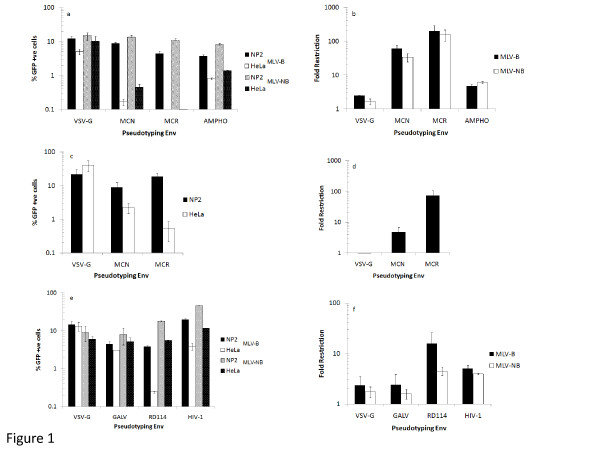
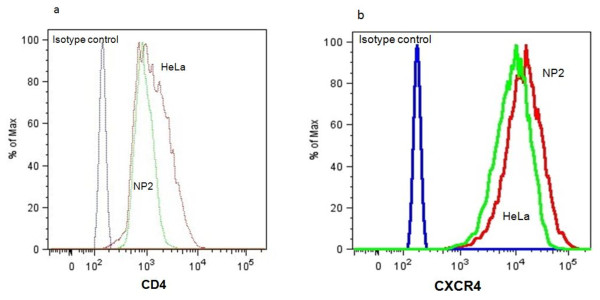
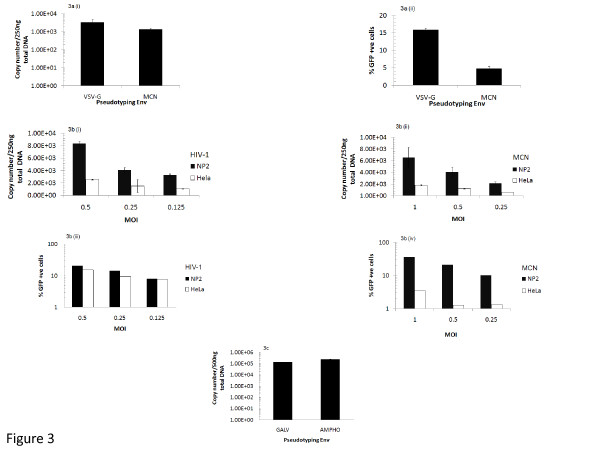
We generated retroviral vectors pseudotyped with various gamma and lentiviral Envs on MLV-B and -NB CAs containing a green fluorescent protein (GFP) reporter. Flow cytometry was used to determine transduction efficiencies in NP2/CD4/CXCR4 (glioma cell line stably transduced with the HIV receptors) and HeLa/CD4 cell lines. The HeLa/CD4 cell line restricted both MLV CAs in an Env dependent manner, compared to NP2/CD4/CXCR4 cells. Quantitative polymerase chain reaction (QT-PCR) analysis of reverse transcription (RT) transcripts demonstrates that this restriction occurs at a post entry and RT level. siRNA knockdown of huTRIM5α ruled out a direct role for this cellular component in mediating this restriction. We describe a previously unobserved Env determined restriction of MLV-B and MLV-NB CAs in HeLa/CD4 cells when pseudotyped with HIV-2 and RD114 Envs, but not gibbon ape leukaemia virus (GALV), HIV-1 or Amphotrophic (Ampho) Envs.
Our data further demonstrate the variability of Env and CA mediated susceptibility to post entry host cell restriction. We discuss the relevance of these findings in light of the growing evidence supporting the complexities involved in innate host immunity to retroviral infection.
“内在”抵抗逆转录病毒感染最初是在 Friend 病毒易感性基因(Fv1)中发现的,该基因决定了不同鼠种对鼠白血病病毒(MLV)感染的易感性。同样,三部分基序(TRIM)蛋白家族以灵长类宿主物种特异性的方式决定慢病毒的限制。例如,恒河猴 TRIM5α(rhTRIM5α)可以强烈限制 HIV-1 感染,而人 TRIM5α(huTRIM5α)对 SIVmac 和 HIV-1 感染性只有轻微影响(Lv1)。人 TRIM5α能够限制 MLV-N 病毒的复制,但对 MLV-B 或 MLV-NB 病毒感染无效。Lv2 限制了一些 HIV-2 病毒在人类细胞中的感染。像 Lv1 一样,Lv2 是一种进入后限制因子,其病毒决定因素已被映射到病毒衣壳(CA)。然而,与 Lv1 不同的是,Lv2 除了 CA 之外还由包膜(Env)决定。在这里,我们提供了证据表明,在人类细胞中,假型 MLV-B 和 MLV-NB 核心存在一种新型的 Env 决定的进入后感染限制。
我们在 MLV-B 和 -NB CA 上生成了各种γ和慢病毒 Env 假型的逆转录病毒载体,该 CA 包含一个绿色荧光蛋白(GFP)报告基因。通过流式细胞术测定 NP2/CD4/CXCR4(稳定转染 HIV 受体的神经胶质瘤细胞系)和 HeLa/CD4 细胞系中的转导效率。HeLa/CD4 细胞系以 Env 依赖的方式限制了两种 MLV CA,而 NP2/CD4/CXCR4 细胞则没有。逆转录(RT)转录的定量聚合酶链反应(QT-PCR)分析表明,这种限制发生在进入后和 RT 水平。huTRIM5α 的 siRNA 敲低排除了该细胞成分在介导这种限制中的直接作用。我们描述了一种以前未观察到的 Env 决定的 MLV-B 和 MLV-NB CA 限制,当用 HIV-2 和 RD114 Env 假型化时,在 HeLa/CD4 细胞中观察到,但用 gibbon ape leukemia virus(GALV)、HIV-1 或 Ampho Env 则没有。
我们的数据进一步证明了 Env 和 CA 介导的对进入后宿主细胞限制的易感性的可变性。我们讨论了这些发现的相关性,因为越来越多的证据支持涉及逆转录病毒感染的先天宿主免疫的复杂性。