Department of Medical Microbiology & Immunology, Creighton University Medical School, Omaha, NE, USA.
Oncogene. 2011 Feb 17;30(7):770-80. doi: 10.1038/onc.2010.458. Epub 2010 Oct 11.
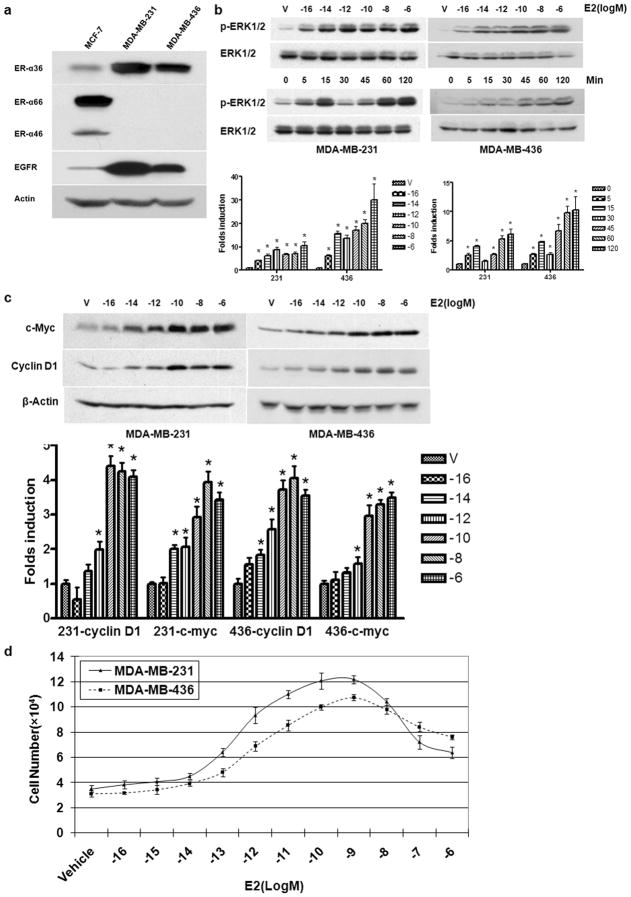
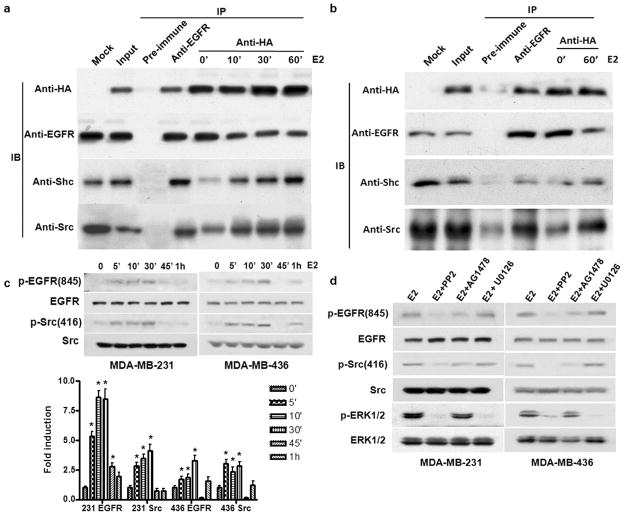
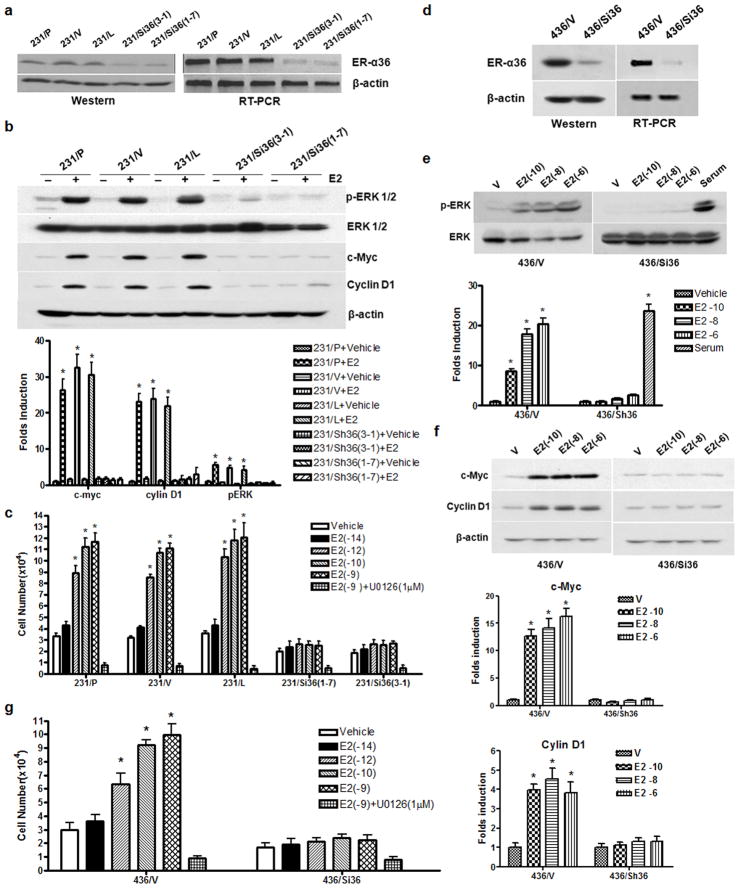
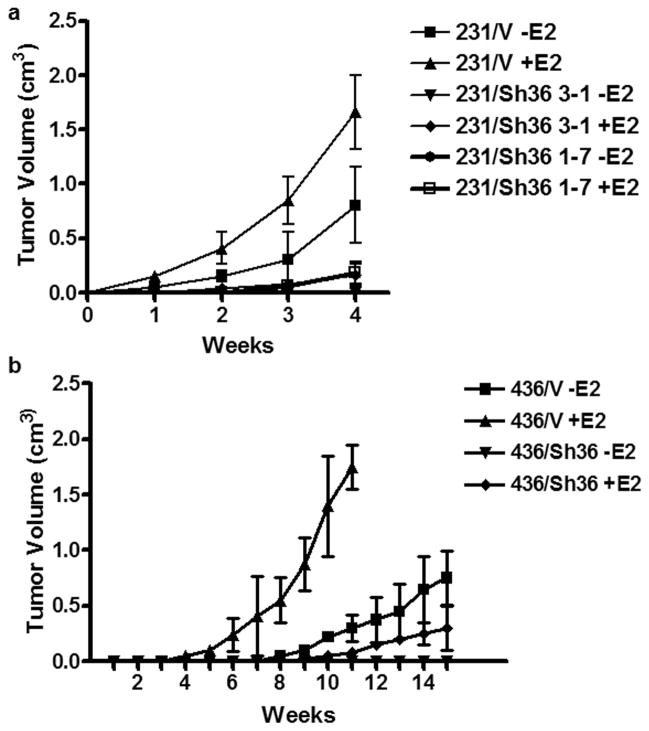
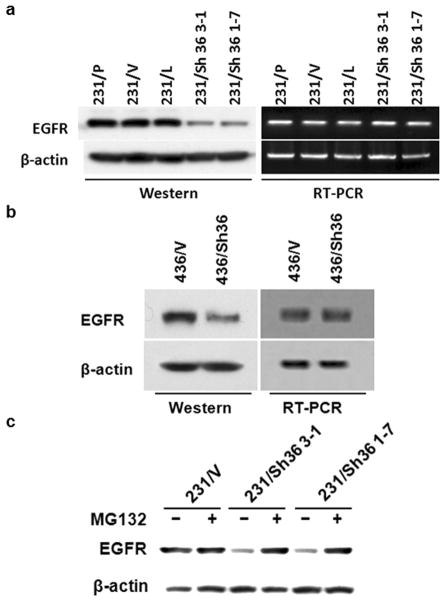
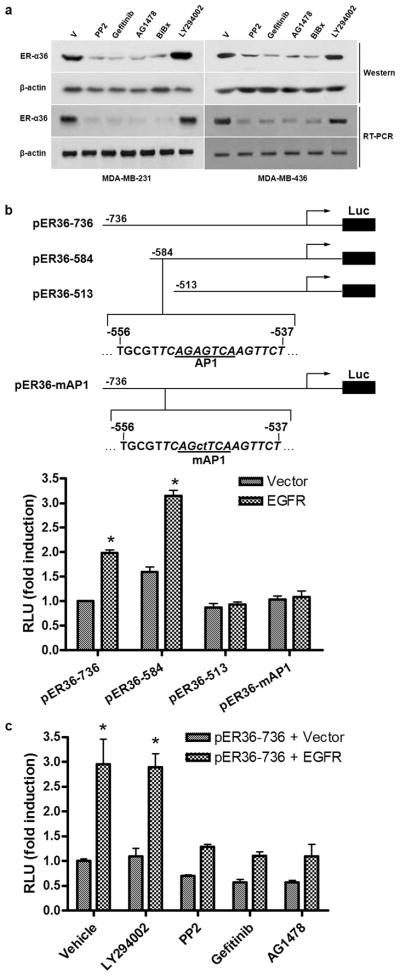
It is prevailingly thought that estrogen signaling is not involved in development of estrogen receptor (ER)-negative breast cancer. However, there is evidence indicating that ovariectomy prevents the development of both ER-positive and -negative breast cancer, suggesting that estrogen signaling is involved in the development of ER-negative breast cancer. Previously, our laboratory cloned a variant of ER-α, ER-α36, and found that ER-α36 mediated nongenomic estrogen signaling and is highly expressed in ER-negative breast cancer cells. In this study, we found that ER-α36 was highly expressed in 10/12 cases of triple-negative breast cancer. We investigated the role of mitogenic estrogen signaling mediated by ER-α36 in malignant growth of triple-negative breast cancer MDA-MB-231 and MDA-MB-436 cells that express high levels of ER-α36 and found that these cells strongly responded to mitogenic estrogen signaling both in vitro and in vivo. Knockdown of ER-α36 expression in these cells using the small hairpin RNA method diminished their responsiveness to estrogen. ER-α36 physically interacted with the EGFR/Src/Shc complex and mediated estrogen-induced phosphorylation of epidermal growth factor receptor (EGFR) and Src. EGFR signaling activated ER-α36 transcription through an AP1 site in the ER-α36 promoter, and ER-α36 expression was able to stabilize EGFR protein. Our results, thus demonstrated that ER-α36 mediates nongenomic estrogen signaling through the EGFR/Src/ERK signaling pathway in ER-negative breast cancer cells and suggested that a subset of ER-negative breast tumors that expresses ER-α36, retains responsiveness to mitogenic estrogen signaling.
普遍认为,雌激素信号不参与雌激素受体(ER)阴性乳腺癌的发生。然而,有证据表明,卵巢切除术可预防 ER 阳性和 ER 阴性乳腺癌的发生,这表明雌激素信号参与 ER 阴性乳腺癌的发生。以前,我们实验室克隆了 ER-α的一种变体 ER-α36,并发现 ER-α36 介导非基因组雌激素信号,并且在 ER 阴性乳腺癌细胞中高度表达。在这项研究中,我们发现 ER-α36 在 12 例三阴性乳腺癌中的 10 例中高度表达。我们研究了由 ER-α36 介导的促有丝分裂雌激素信号在表达高水平 ER-α36 的三阴性乳腺癌 MDA-MB-231 和 MDA-MB-436 细胞中的恶性生长中的作用,发现这些细胞对体外和体内的促有丝分裂雌激素信号强烈反应。使用短发夹 RNA 方法敲低这些细胞中的 ER-α36 表达,减弱了它们对雌激素的反应性。ER-α36 与 EGFR/Src/Shc 复合物相互作用,并介导雌激素诱导的表皮生长因子受体(EGFR)和 Src 的磷酸化。EGFR 信号通过 ER-α36 启动子中的 AP1 位点激活 ER-α36 转录,并且 ER-α36 表达能够稳定 EGFR 蛋白。我们的结果表明,ER-α36 通过 EGFR/Src/ERK 信号通路在 ER 阴性乳腺癌细胞中介导非基因组雌激素信号,并表明表达 ER-α36 的 ER 阴性乳腺癌肿瘤亚群保留对促有丝分裂雌激素信号的反应性。