National Center for Biotechnology Information, NLM, National Institutes of Health, Bethesda, MD 20894, USA.
Archaea. 2010 Sep 26;2010:710303. doi: 10.1155/2010/710303.
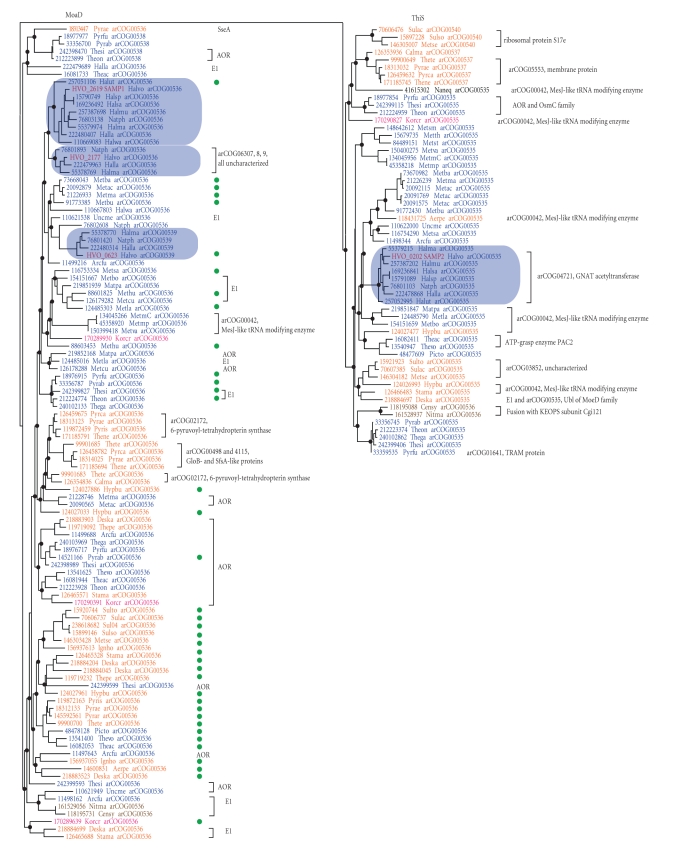
The recent discovery of protein modification by SAMPs, ubiquitin-like (Ubl) proteins from the archaeon Haloferax volcanii, prompted a comprehensive comparative-genomic analysis of archaeal Ubl protein genes and the genes for enzymes thought to be functionally associated with Ubl proteins. This analysis showed that most archaea encode members of two major groups of Ubl proteins with the β-grasp fold, the ThiS and MoaD families, and indicated that the ThiS family genes are rarely linked to genes for thiamine or Mo/W cofactor metabolism enzymes but instead are most often associated with genes for enzymes of tRNA modification. Therefore it is hypothesized that the ancestral function of the archaeal Ubl proteins is sulfur insertion into modified nucleotides in tRNAs, an activity analogous to that of the URM1 protein in eukaryotes. Together with additional, previously described genomic associations, these findings indicate that systems for protein quality control operating at different levels, including tRNA modification that controls translation fidelity, protein ubiquitination that regulates protein degradation, and, possibly, mRNA degradation by the exosome, are functionally and evolutionarily linked.
最近发现了 SAMPs 对蛋白质的修饰作用,即来自古菌 Haloferax volcanii 的泛素样(Ubl)蛋白,这促使人们对古菌 Ubl 蛋白基因和被认为与 Ubl 蛋白在功能上相关的酶的基因进行了全面的比较基因组分析。该分析表明,大多数古菌编码具有β-抓握折叠结构的 Ubl 蛋白的两个主要家族的成员,ThiS 和 MoaD 家族,并表明 ThiS 家族基因很少与硫胺素或 Mo/W 辅因子代谢酶的基因相关联,而是与 tRNA 修饰酶的基因最常相关联。因此,人们假设古菌 Ubl 蛋白的原始功能是将硫插入到 tRNA 中的修饰核苷酸中,这一活性类似于真核生物中 URM1 蛋白的活性。这些发现与其他之前描述的基因组关联一起表明,在不同层面上运作的蛋白质质量控制系统,包括控制翻译保真度的 tRNA 修饰、调节蛋白质降解的蛋白质泛素化,以及可能通过 exosome 进行的 mRNA 降解,在功能和进化上是相互关联的。