Faculty of Health and Medical Sciences, University of Surrey, Guildford, Surrey GU2 7XH, United Kingdom.
J Biol Chem. 2010 Dec 17;285(51):40104-13. doi: 10.1074/jbc.M110.184606. Epub 2010 Oct 12.
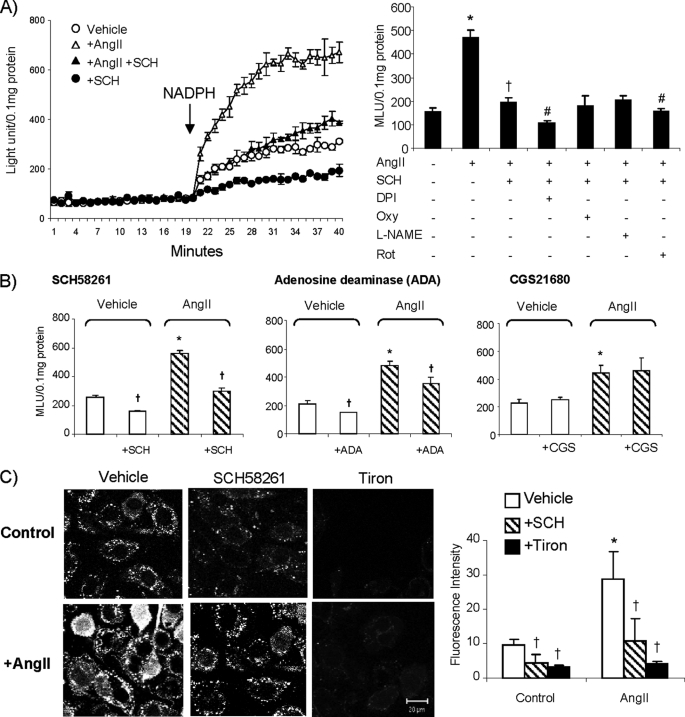
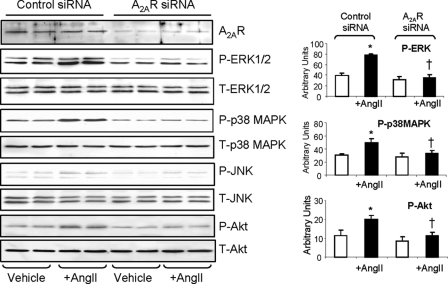
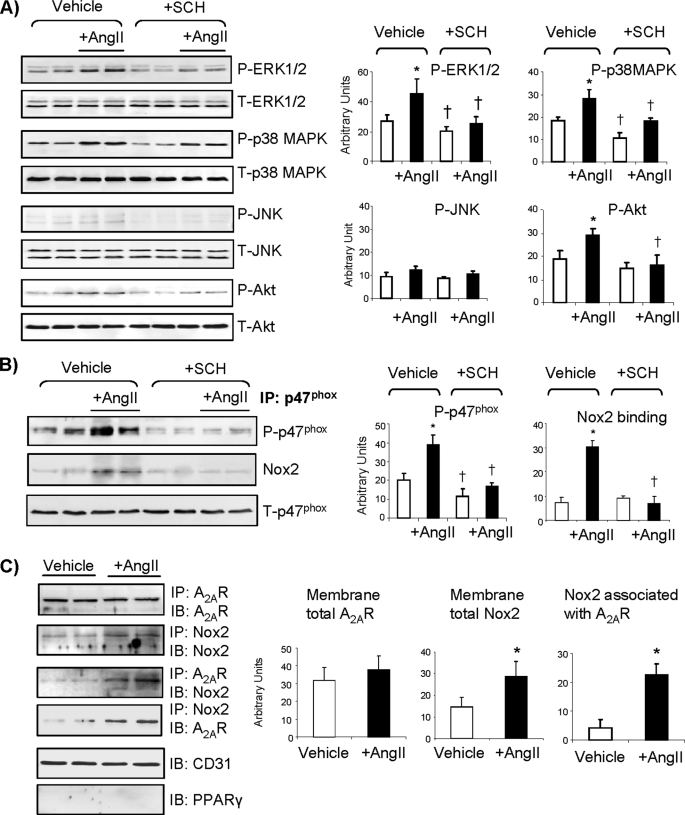
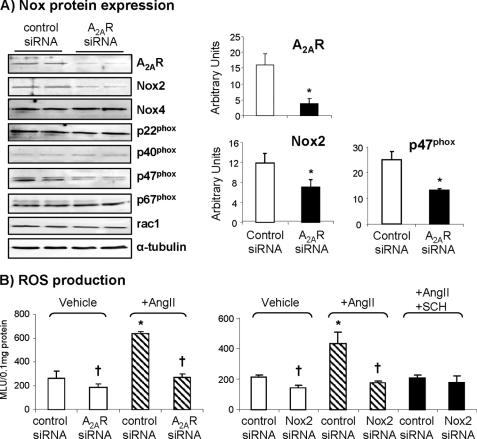
Endothelial cells (ECs) express a Nox2 enzyme, which, by generating reactive oxygen species (ROS), contributes to EC redox signaling and angiotensin II (AngII)-induced endothelial dysfunction. ECs also express abundantly an adenosine A(2A) receptor (A(2A)R), but its role in EC ROS production remains unknown. In this study, we investigated the role of A(2A)R in the regulation of Nox2 activity and signaling in ECs with or without acute AngII stimulation. In cultured ECs (SVEC4-10), AngII (100 nm, 30 min) significantly increased Nox2 membrane translocation and association with A(2A)R. These were accompanied by p47(phox), ERK1/2, p38 MAPK, and Akt phosphorylation and an increased ROS production (169 ± 0.04%). These AngII effects were inhibited back to the control levels by a specific A(2A)R antagonist (SCH58261), or adenosine deaminase, or by knockdown of A(2A)R or Nox2 using specific siRNAs. Knockdown of A(2A)R, as determined by Western blotting, decreased Nox2 and p47(phox) expression. In wild-type mouse aorta, SCH58261 significantly reduced acute AngII-induced ROS production and preserved endothelium-dependent vessel relaxation to acetylcholine. These results were further confirmed by using aortas from A(2A)R knock-out mice. In conclusion, A(2A)R is involved in the regulation of EC ROS production by Nox2. Inhibition or blockade of A(2A)R protects ECs from acute AngII-induced oxidative stress, MAPK activation, and endothelium dysfunction.
内皮细胞 (ECs) 表达 Nox2 酶,该酶通过产生活性氧物种 (ROS),有助于 EC 氧化还原信号转导和血管紧张素 II (AngII) 诱导的内皮功能障碍。ECs 还大量表达腺苷 A(2A) 受体 (A(2A)R),但其在 EC ROS 产生中的作用尚不清楚。在这项研究中,我们研究了 A(2A)R 在急性 AngII 刺激前后调节 ECs 中 Nox2 活性和信号转导的作用。在培养的 ECs (SVEC4-10) 中,AngII (100nm,30min) 显著增加了 Nox2 的膜易位和与 A(2A)R 的结合。这些伴随着 p47(phox)、ERK1/2、p38 MAPK 和 Akt 磷酸化以及 ROS 产生的增加 (169 ± 0.04%)。这些 AngII 作用被特异性 A(2A)R 拮抗剂 (SCH58261)、腺苷脱氨酶或使用特异性 siRNA 敲低 A(2A)R 或 Nox2 抑制回至对照水平。Western blot 测定的 A(2A)R 敲低降低了 Nox2 和 p47(phox) 的表达。在野生型小鼠主动脉中,SCH58261 显著降低了急性 AngII 诱导的 ROS 产生,并保持了乙酰胆碱诱导的血管舒张依赖于内皮。这些结果进一步通过使用 A(2A)R 敲除小鼠的主动脉得到证实。总之,A(2A)R 参与调节 EC 通过 Nox2 产生的 ROS。抑制或阻断 A(2A)R 可防止 EC 受到急性 AngII 诱导的氧化应激、MAPK 激活和内皮功能障碍的影响。