Department of Radiology, Aichi Medical University, Aichi, Japan.
Drugs R D. 2010;10(3):133-45. doi: 10.2165/11539140-000000000-00000.
Safety is a primary concern with contrast agents used for MRI. If precautions could be taken before the repeated administration of gadolinium-based contrast media, then the awareness and management of adverse reactions would be more efficient.
To assess the safety and efficacy of gadoterate meglumine (Gd-DOTA) [Magnescope® in Japan, Dotarem® in other countries], a gadolinium-based contrast agent, in patients undergoing imaging of the brain/spinal cord and/or trunk/limbs, and to identify factors associated with the onset of adverse reactions.
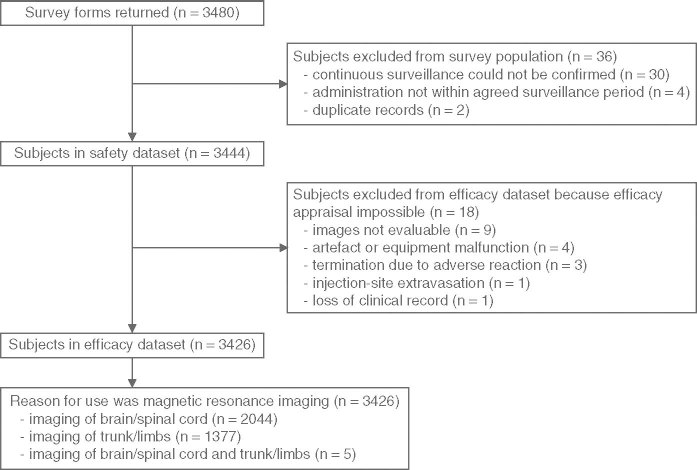
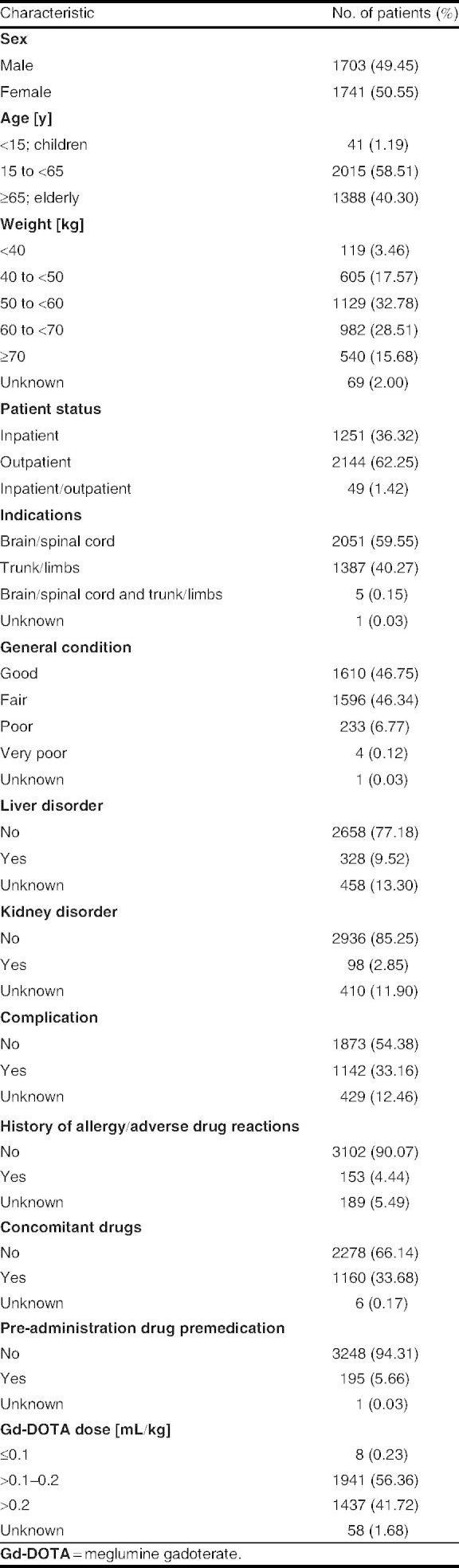
The study ran for 4 years and included 3444 cases. The study was conducted before it became known that gadolinium-based contrast agents could trigger the development of nephrogenic systemic fibrosis. Patients for whom the contrast agent was indicated and who underwent imaging of the brain/spinal cord and/or trunk/limbs by MRI were enrolled. There were 1300 inpatients who were followed up during hospitalization (for several days), and 2144 outpatients who were followed up for at least 2 hours on-site. After Gd-DOTA administration, 13 patient baseline characteristics were used to explore factors that might predict a greater likelihood of acute non-renal adverse reactions. The physician's appraisal of the efficacy of Gd-DOTA was also assessed.
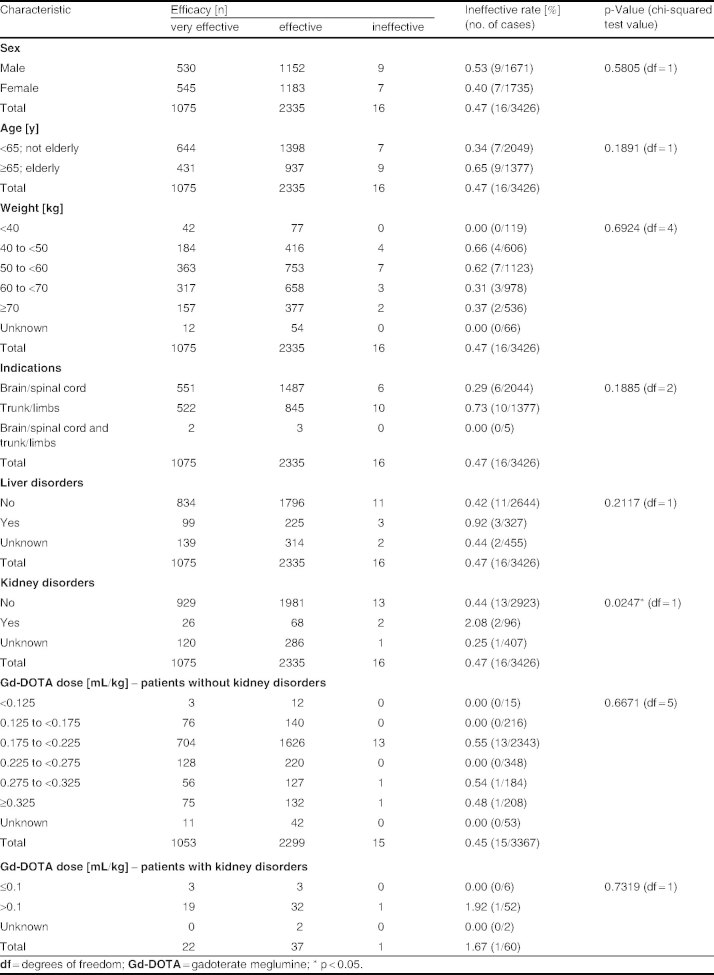
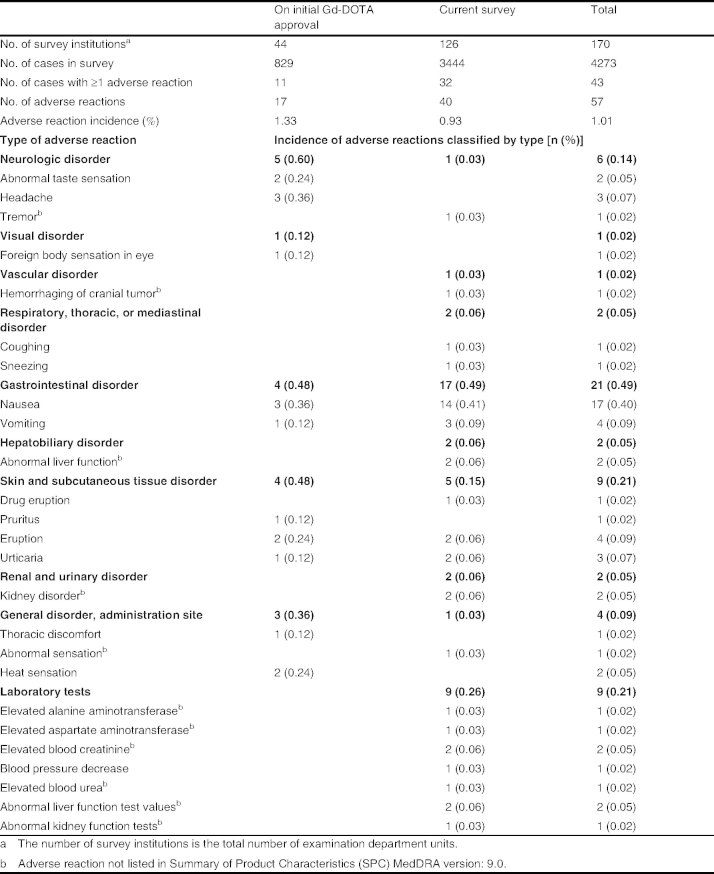
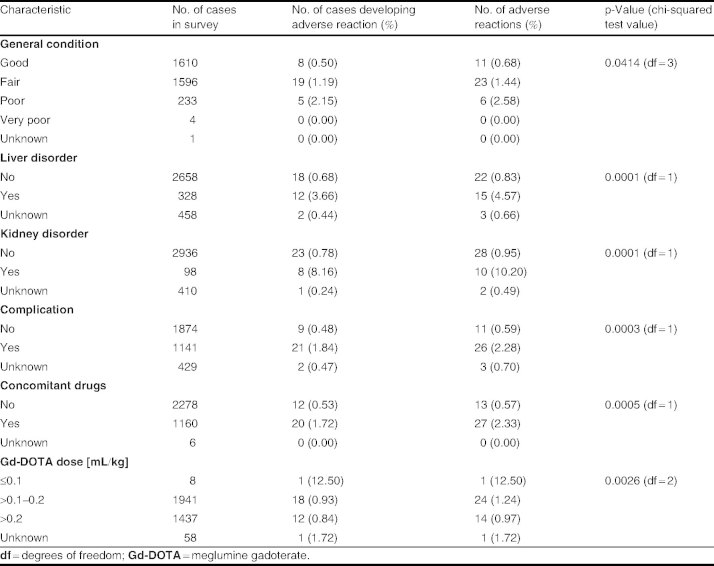
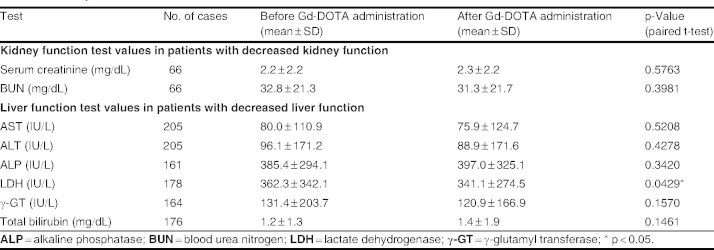
A total of 40 adverse reactions were recorded in 32 patients, giving an overall incidence of adverse reactions of 0.93%. Gastrointestinal disorders were the most commonly reported adverse reactions (0.49%). Most adverse reactions reported were of mild intensity and no serious adverse reactions were reported. This study found that statistically significant risk factors for adverse reactions were general patient condition, liver disorder, kidney disorder, health complications, concomitant treatments, and Gd-DOTA dose (although the incidence of adverse reactions was not dose dependent). In the majority of cases (99.53%), the efficacy of Gd-DOTA was rated as 'effective' or 'very effective'; only the presence of kidney disorder was associated with a significantly greater likelihood of Gd-DOTA inefficacy.
Overall, this post-marketing surveillance study did not reveal any untoward or unexpected findings concerning the safety or efficacy of Gd-DOTA. The low incidence of adverse reactions (<1%) and the absence of serious adverse reactions reported during the survey period showed that Gd-DOTA was very well tolerated. The use of Gd-DOTA as an MRI-enhancing contrast medium in the clinical practice setting appears to be safe and effective.
磁共振成像(MRI)中使用的造影剂的安全性是首要关注的问题。如果能在重复使用钆基造影剂之前采取预防措施,那么对不良反应的认识和管理将更加有效。
评估钆喷替酸葡甲胺(Gd-DOTA)[在日本称为 Magnescope®,在其他国家称为 Dotarem®]作为一种钆基造影剂在进行脑/脊髓和/或躯干/四肢成像的患者中的安全性和疗效,并确定与不良反应发生相关的因素。
该研究持续了 4 年,共纳入了 3444 例患者。该研究是在已知钆基造影剂可能引发肾源性系统纤维化之前进行的。入组患者为符合造影剂适应证且行脑/脊髓和/或躯干/四肢 MRI 成像的患者。其中 1300 例为住院患者(住院期间随访数天),2144 例为门诊患者(至少现场随访 2 小时)。在给予 Gd-DOTA 后,根据 13 项患者基线特征,探讨可能预测急性非肾不良反应发生可能性更大的因素。还评估了医师对 Gd-DOTA 疗效的评价。
在 32 例患者中记录到 40 例不良反应,总不良反应发生率为 0.93%。胃肠道疾病是最常见的不良反应(0.49%)。大多数报告的不良反应为轻度,未报告严重不良反应。本研究发现,不良反应的统计学显著危险因素是一般患者状况、肝疾病、肾疾病、健康并发症、伴随治疗和 Gd-DOTA 剂量(尽管不良反应发生率与剂量无关)。在大多数情况下(99.53%),Gd-DOTA 的疗效被评为“有效”或“非常有效”;只有肾疾病的存在与 Gd-DOTA 无效的可能性显著增加相关。
总体而言,这项上市后监测研究未发现 Gd-DOTA 的安全性或疗效有任何不良或意外发现。不良反应发生率低(<1%),且在研究期间未报告严重不良反应,表明 Gd-DOTA 具有很好的耐受性。在临床实践环境中,将 Gd-DOTA 用作 MRI 增强造影剂似乎是安全有效的。